
It’s not often that we say a law review article is a “must-read.” But this one definitely is, especially for all you regulatory takings mavens: David L. Callies, Through a Glass Clearly: Predicting the Future in Land Use Takings Law, 54 Washburn L. Rev. 43 (2014). A pdf of the article is posted here
New Cert Petition: Property Owner Should Not Be Limited To “Whispering” Anti-Eminent Domain Message

As we hoped it might, the Norfolk, Virginia property owner — represented by the Institute for Justice — who was on the losing side of the Fourth Circuit’s 2-1 recent opinion in Central Radio Co. Inc. v. City of Norfolk, 776 F.3d 229 (4th Cir. Jan. 13, 2015) has filed a cert petition.
Recent California Court Of Appeal Regulatory Takings Opinion Should Be Published
Here’s the letter request which we sent today to the California Court of Appeal, Second Division, asking the court to publish its recent opinion in Brost v. City of Santa Barbara, No. B246153 (Mar. 25, 2015). In our post about the case, we wrote “we hope there’s a motion to publish and that the court
HAWSCT Provides Guidance: How To Submit Attorneys’ Fees Applications That Get Approved
How Are They (I Mean *We*) Going To Pay For Honolulu’s Rail?
The short answer: taxes.
[Update #1: a report from last night’s community meeting, “Railing Against Honolulu’s $6 Billion Rail Project” (“Honolulu Mayor Kirk Caldwell and his top transit official took their licks from a decidedly anti-rail crowd during a boisterous town hall meeting at Washington Middle School on Wednesday.”
Update #2: “
Pacific Business News Details The Rail’s Impact On Honolulu Property
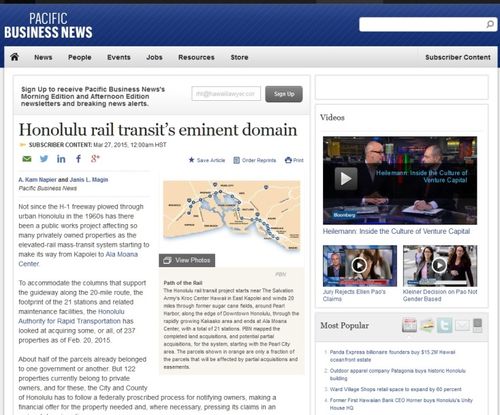
The cover story in Pacific Business News‘ recent edition, “Honolulu rail transit’s eminent domain” is worth reading. Most importantly, the PBN staff created maps which show how much property is targeted for acquisition, and where it is located, precisely. Yes, the full story is behind a partial paywall, but as we said
Amici Brief: Property Owners Have Right Of Direct Access To Highways That Can’t Be Regulated Away
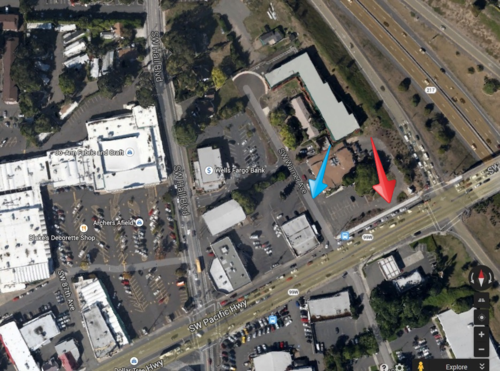
Here’s the amici brief on behalf of Central Oregon Builders Association, Oregonians in Action, and Owners’ Counsel of America in a case being considered by the Oregon Supreme Court, State of Oregon v. Alderwoods (Oregon), Inc., No. S062766.
In an eminent domain action to improve Highway 99W in Tigard, Oregon, the DOT condemned Alderwoods’
NJ Retreats From Curtailed “Blight” Takings Standard
In Gallenthin [Realty Development, Inc. v. Borough of Paulsboro, 191 N.J. 344 (2007)] requires, namely a degree of ‘deterioration or stagnation that negatively affects surrounding areas’ by promoting conditions that can develop into blight.
nn Download A19136264MainStreetvHackensack, No.
62-64 Main Street, LLC v. Mayor and City of Hackensack, No. 072699 (N.J.
State Appeals NC “Map Act” Takings Case
In Kirby v North Carolina Dep’t of Transportation, No. COA14-184 (Feb. 17, 2015), the North Carolina held that state’s “Map Act,” which gives the DOT the ability to designate property for future highway use and prevent its development in the meantime, was a taking. There was great shouting and gnashing of teeth that making
Cal App (Unpub): Temporary Prohibition On Rebuilding In A Landslide Zone Is A Taking
Brost v. City of Santa Barbara, No. B246153 (Mar. 25, 2015) is an unpublished opinion, but (1) we hope the property owners ask the court to publish it, and (2) even if it remains unpublished, it is worth reading, because the court correctly applies both Williamson County‘s futility exception, and the “background principles”