
We would not have guessed back in March when we posted the “first” coronavirus shut down takings complaint that we’d still be at it at the end of 2020, but here we are.

The latest is this complaint filed last week in the U.S. District Court for the District of Oregon against Oregon’s governor (in
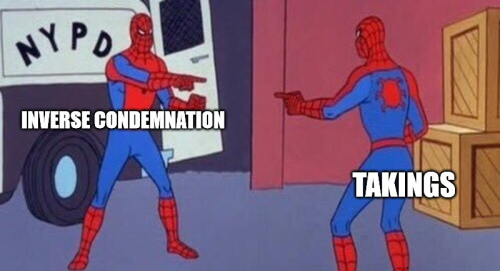

Inverse vs takings

In case you weren’t already aware, Georgia law apparently distinguishes between “inverse condemnation” claims and “takings” claims.

That was not the dispositive point the Georgia Court of Appeals made in its recent opinion in HBC2018, LLC v. Paulding County School District, No. A20A1993 (Dec. 21, 2020), but we thought we’d highlight here, just because:

In New Hampshire v. Beattie, No. 2019-0460 (Nov. 19, 2020), the New Hampshire Supreme Court was presented with two alternatives about how to review a property owner’s objection to the state commission’s approval of the quick-take of land for a state highway. The owner “challenged the necessity and net-public benefit of the taking,” slip

The Town of Fort Myers Beach, Florida, barred the sale of alcohol on beaches in 1995. Turns out that a beachfront business was already (legally) selling alcohol on its property at the time of the ban. And we know what that usually means: a grandfathered nonconforming use.

Today’s case from the Florida District Court

As we noted in this post (“CA4 (Over Dissent): No Taking When Maryland Outlawed ‘Rapid Fire Trigger Activators’“), it was likely that a cert petition would follow after the U.S. Court of Appeals for the Fourth Circuit held (over a strong dissent) that it was not a taking when Maryland outlawed previously lawful

A short one from the Florida District Court of Appeal (Second District) on exactions.

More precisely, what is an “exaction.”

In Murphy Auto Group, Inc. v. Fla. Dep’t of Transportation, No. 2d19-1236 (Nov. 20, 2020), the court held that the requirements of Nollan/Dolan (nexus and rough proportionality) apply when the DOT demanded

A short one from the Virginia Supreme Court. In Palmyra Associates, LLC v. Comm’r of Highways, No. 191680 (Dec. 17, 2020), the court upheld the exclusion of evidence about a property’s “before” condition in a partial take case, concluding that the proffered evidence of the property’s development potential was too speculative. Or, more accurately