
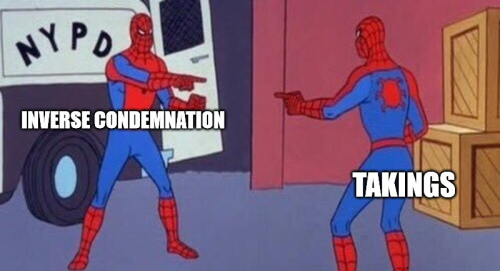
In case you weren’t already aware, Georgia law apparently distinguishes between “inverse condemnation” claims and “takings” claims.
That was not the dispositive point the Georgia Court of Appeals made in its recent opinion in HBC2018, LLC v. Paulding County School District, No. A20A1993 (Dec. 21, 2020), but we thought we’d highlight here, just because:
As a threshold matter, we note that the Bank appears to conflate an inverse condemnation claim with a takings claim. See City of Tybee Island, Ga. v. Live Oak Group, 324 Ga. App. 476, 479 (751 SE2d 123) (2013) (concluding that appellants had failed to raise an inverse condemnation claim and declining to address whether a constitutional taking claim had been raised). An inverse condemnation claim ordinarily involves affirmative government action that causes a nuisance or a trespass, which diminishes the value of private property. See Id. (no inverse condemnation claim where there was no affirmative act by the City). Here, there is no suggestion that the District caused a nuisance or trespass; it thus appears the complaint, in substance, alleges an unconstitutional taking claim, and we construe it as such. See Forest City Gun Club v. Chatham County, 280 Ga. App. 219, 220 (633 SE2d 623) (2006) (courts construe pleadings according to their substance and function rather than by nomenclature).
Slip op. at 5.
We haven’t really thought about this, and in our view, “inverse condemnation” is the procedural device by which you raise a “takings” claim. But we’re not licensed in Georgia, so we’re not going to complain too much about how Georgia law describes the situation.
Onwards.

We found that to be the most interesting part of the opinion, because the merits was a bit predictable. A bank which loaned money to a high school athletic booster club (note: not “athletic supporters”) to build a new field house sued the local school district for inverse condemnation (taking) after the district refused to continue to bail out the booster club when it fell behind on its loan obligations to the bank. The local school district contributed some funds to the construction efforts, with the balance paid by private funding. “According to the Bank, the School’s continued use of the property without payment of the debt constitutes an unconstitutional taking.” Slip op. at 4.
The court of appeals assumed the bank possessed a property interest in being repaid by the booster club, but noted that “the Bank has pointed to no evidence establishing that the School’s use of the field house has frustrated the Bank’s right to seek repayment of the debt [from the booster club.]” Slip op. at 6. While that right seems fairly worthless (the bank had “secured a default judgment” against the booster club), the court concluded that the school district was under no obligation to repay the bank, even if it had contributed some funds to the construction earlier. “It is of no
consequence that the Bank expected the School to repay the loan; a takings claim
requires that the Bank have a legitimate claim of entitlement to repayment.” Id.
What about a physical takings claim? After all, the school district was using the field house, no? No deal either. The bank didn’t have a property interest in the building either. It might have had such an interest if it possessed, for example, a mechanic’s lien as a consequence of providing labor or materials for the construction. But it had not done so.
Finally, the court rejected the bank’s “no good deed goes unpunished” argument that asserted the school district was liable on the loan because it earlier had contributed some money for repayment. “The fact that the School made gratuitous payments did not create a legal obligation on the part of the School.” Slip op. at 8-9.
No property interest, no inverse condemnation…err “taking.”
HBC2018, LLC v. Paulding County School District, No. A20A1993 (Ga. App. Dec. 21, 2020)