Regulatory takings

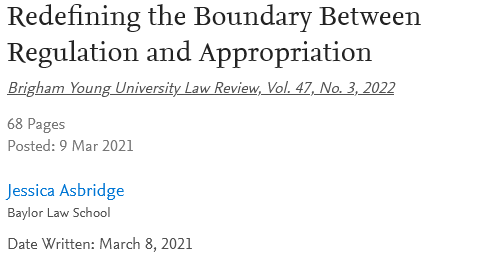
Screenshot_2021-03-10 Redefining the Boundary Between Regulation and Appropriation by Jessica Asbridge SSRN

Next up on our reading list: “Redefining the Boundary Between Regulation and Appropriation” (forthcoming, BYU L Rev), by Baylor Lawprof Jessica Asbridge. Available on SSRN here.

This one is especially relevant in light of the upcoming arguments in Cedar Point, which will consider many of the issues Prof. Asbridge writes about. 

Here’s the Abstract:

The U.S. Supreme Court currently claims to distinguish between appropriations and regulations when interpreting the Fifth Amendment’s Takings Clause. While appropriations always require just compensation to survive constitutional scrutiny, whether a regulation infringing upon property rights requires compensation is determined on an ad hoc basis, guided by concerns of fairness and justness. In Loretto v. Teleprompter Manhattan CATV Corporation, the Court attempted to define the boundary between regulations and appropriations, holding that an appropriation occurs when a government action results in a permanent, physical invasion of an owner’s real property. What constitutes a permanent, physical invasion, however, is entirely unclear due to the Court’s inconsistent decisions applying Loretto. The circumstances under which the physical takings doctrine applies has confounded the lower courts, rendering the heightened constitutional protection for appropriative actions largely illusory.

Takings Clause scholars almost uniformly call for the elimination of the Court’s physical takings doctrine. Most, if not all, critics of Loretto argue that any distinction between appropriations and regulations should be eliminated, such that all government actions short of formal acts of eminent domain should be evaluated on a case-by-case basis, with compensation only justified where the public interest is minimal or the economic hardship on the owner is great. This approach, however, would only further weaken the protection provided by the Takings Clause.

The physical takings doctrine is unsound, but, contrary to the dominant view in the scholarship, the Court’s distinction between regulations and appropriations is not. The Court has long recognized that appropriations require compensation without regard to the public interest at play or fairness and justness concerns, as shown by nineteenth and early twentieth century cases overlooked or ignored by contemporary Takings Clause scholars. Rather than define appropriations as permanent, physical invasions, however, these cases demonstrate that an appropriation occurs when government seeks to transfer the right to use private property to a third party or the government itself whereas a regulation involves the government controlling or restricting an owner’s use of property. Redefining the boundary consistent with this historical understanding would bring much needed doctrinal clarity to takings jurisprudence and further important normative considerations. Requiring compensation for all properly defined appropriative acts furthers multiple values including autonomy and political freedom and accounts for the interests of owners and non-owners alike.

Check it out. Especially before the upcoming oral arguments in Cedar Point.
Continue Reading New Takings Lawrev Article: Jessica Asbridge, “Redefining the Boundary Between Regulation and Appropriation”

It’s Monday, so we’re just going to ease into the week by (inter alia) reading a couple of law review articles:

  • Federal Courts and Takings Litigation, by Prof. Ann Woolhandler & Prof. Julia D. Mahoney: “While Knick clearly expands the lower federal court role in takings claims, many questions remain, for it

How about buying what you thought was a retirement home, only to be told that if you want the local government’s ok change the form of ownership of the property you’ve got to offer any tenant a lifetime lease? Here’s the cert petition, filed today in a case we’ve been following for a while,

6a00d83451707369e20240a51cc266200b-800wi

We were hoping for better news in a case we’ve been following in its various forms for what seems like forever. But today, the U.S. Supreme Court in this order declined to issue a writ of certiorari to review the Ninth Circuit’s decision in Bridge Aina Lea, LLC v. Hawaii Land Use Comm’n, No.

We all know that Knick v. Township of Scott, 139 S. Ct. 2162 (2019) only knocked out the “state action” prong of the two-part Williamson County takings ripeness requirement. You may not need to pursue and lose compensation via state procedures to ripen a takings claims, but still active is the “final decision” requirement

The situation in Hamen v. Hamlin County, No. 28671 (Feb. 10, 2021), a recent opinion by the South Dakota Supreme Court seems pretty bad, but a road we’ve gone down before. Believing that a suspect was inside, the local SWAT team (along with the county Special Response Team — drone and two armored vehicles

Regulatory takings challenges are no doubt tough. Especially Penn Central regulatory takings challenges. Facial Penn Central regulatory takings claims, moreso.

The U.S. Court of Appeals’ opinion in Clayland Farm Ents, LLC v. Talbot County, No. 19-2102 (Feb. 9, 2021) – the latest in this case we’ve been following – proves the point. The court

UrbanLawyer.v.50.1 articles

The latest issue of The Urban Lawyer, the scholarly law journal of the ABA’s Section of State and Local Government Law (our Section) has been published. Takings mavens are going to like this one:

Back to blogging…

Here’s the latest cert petition on an issue we’ve been following for a while (see here, here, here and here, for example). Is invalidation of an already-issued patent via inter partes review a taking?

In this case, the Federal Circuit held no taking, consistent with its earlier opinion