Regulatory takings

A fitting way to bid adieu to 2021: Ruble v. Tate-Nadeau, No. 4-20-0641 (Dec. 28, 2021), in which the Illinois Appellate Court held that the governor’s tavern and dine-in restaurant Covid-19 shut-down orders were not takings of personal property under section 7(4) of the Illinois Emergency Management Act.

This was not a claim

IMG_20191108_121950_1

We like oysters. When we think “oysters,” that means going to a restaurant or oyster bar, sitting down, and ordering up a dozen or more. Easy stuff.

But the real work of oyster farming is “arduous, backbreaking work requiring a special dedication.” Avenal v. State, 886 So. 2d 1085, 1110 (La. 2004). It “takes

Here’s a must-read from the Texas Court of Appeals (Second District).

In City of Grapevine v. Muns, No. 02-19-00257 (Dec. 23, 2021), 

Before 2018, the city’s 1982 zoning ordinance authorized “single-family detached dwellings” and didn’t say anything about short-term renting (short-term being defined as less than 30 days). The ordinance didn’t expressly authorize it

Screenshot 2021-12-12 at 09-10-29 Event Registration

This Wednesday, December 15, 2021, at 1pm ET (10am PT) our PLF colleague Chris Kieser will be presenting an American Bar Association webinar, produced by the Real Property, Probate, and Trust Section, “Cedar Point Nursery v. Hassid: Supreme Court Weighs in on Definition of ‘Private Property’ and Implications for the Future.”

Register here

PASH symposium

Back in February, we were honored to be part of the University of Hawaii Law Review’s symposium “25 Years of PASH,” a retrospective of one of the Hawaii Supreme Court’s most famous (or infamous) decisions, Pub. Access Shoreline Haw. v. Haw. Cnty. Plan. Comm’n, 79 Haw. 425, 903 P.2d 1246 (1993), cert. denied

Check it out: the “Digging a Hole” Podcast includes in one of its recent episodes a discussion of SCOTUS’s latest takings case, Cedar Point Nursery v. Hassid.

Our final guest for Season 3 is Nikolas Bowie, assistant professor of law at Harvard Law School and board member of the ACLU of Massachusetts, Lawyers for

Screenshot 2021-11-17 at 13-11-12 The Realities of Takings Litigation

Another law review article worth reading. This one from lawprof Dave Owen, is about “The Realities of Takings Litigation” (forthcoming BYU Law Review). That title certainly got our attention – any time a law journal article is about ‘reality’ and takings, and includes empirical research, we’re going to read it.

Here’s the

Screenshot 2021-11-15 at 11-33-55 Takings Localism

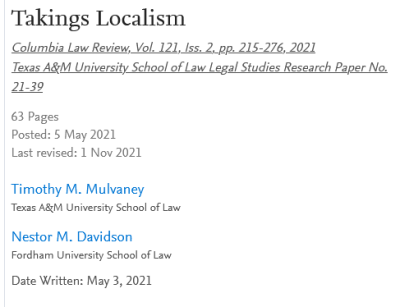
Be sure to check out the latest article from takings scholars and Nestor Davidson and Tim Mulvaney, “Takings Localism,” 121 Colum. L. Rev. 215 (2021) (pdf here).

Here’s the abstract:

Conflicts over “sanctuary” cities, minimum wage laws, and gender-neutral bathrooms have brought the problematic landscape of contemporary state preemption of local governance to national attention. This Article contends that more covert, although equally robust, state interference can be found in property, with significant consequences for our understanding of takings law.

Takings jurisprudence looks to the states to mediate most tensions between individual property rights and community needs, as the takings federalism literature recognizes. Takings challenges, however, often involve local governments. If the doctrine privileges the democratic process to resolve most takings claims, then, that critical process is a largely local one.

Despite the centrality of local democracy to takings, state legislatures have restricted local authority on property issues in a range of ways. States have expanded compensatory liability for owners facing local regulations, imposed procedural constraints on local authority, and limited the exercise of foundational local powers. Seen in its entirety, this state intervention—like contemporary “new preemption”—is acontextual and unduly rigid, cutting at the heart of the devolutionary principles underlying takings jurisprudence.

This unbalanced state role requires a recalibration of decisionmaking power between state and local government to foster intersystemic dialogue and reflection. States certainly play a crucial role in defining and protecting property interests, but they must justify choices to constrain local discretion when state and local values conflict. The extant state statutory regime dispenses with this justificatory task via a formalistic disregard for the contextualization that legitimates vertical allocations of authority. A corrective to decades of imbalance in state ordering of local authority would thus properly recognize “takings localism.”

Free up local governments, or tie their hands…which is better? After reading this, you decide.
Continue Reading New Article: “Takings Localism” (Tim Mulvaney & Nestor Davidson)