Property rights

The Murray N. Rothbard Memorial Lecture, presented by Dr. Wanjiru Njoya. As noted on the Mises Institute’s website:

Recorded at the 2023 Austrian Economics Research Conference hosted at the Mises Institute in Auburn, Alabama, March 16–18.

The Austrian Economics Research Conference is the international, interdisciplinary meeting of the Austrian School, bringing together leading scholars

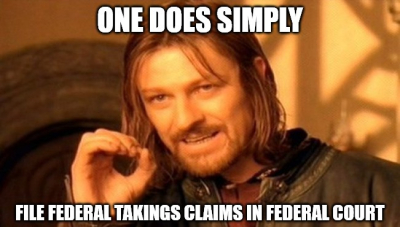
One_does

Check out the U.S. Court of Appeals for the Eighth Circuit’s opinion in Pharmaceutical Research and Manufacturers of America v. Williams, No. 21-1731 (Apr. 3, 2023), where the court reinstated a complaint dismissed by the district court for lack of standing.

The Eighth Circuit held that even though the “usual” remedy for a regulatory

This just in: the U.S. District Court for the Southern District of New York has issued this Opinion & Order in the case which challenges New York City’s rendering “guaranty clauses” in commercial leases unenforceable due to the declared Co-19 emergency.

This is a case we’ve been following. Earlier, the Second Circuit vacated the district

Untitled Extract Pages

We all know by now that the Supreme Court recently has been on a tear about federal statutes of limitations, and is policing up a lot of earlier too-casual language in some of its opinions about whether this SOL or that SOL is “jurisdictional.” In a series of opinions over the last few years, the Court has almost universally confirmed that it used the term rather loosely, and that upon further review, many statutes of limitations are not “jurisdictional” but are “claims processing rules.”

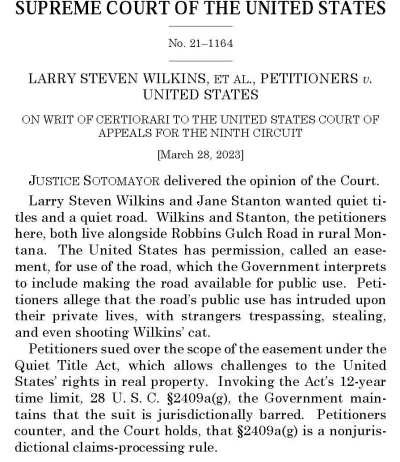
The Court’s 6-3 opinion in Wilkins v. United States, No. 21-1164 (Mar. 28, 2023) is another in a line of decisions so holding. Wilkins involves the Federal Quiet Title Act’s 12-year SOL (see this preview of the issues by our friend and colleague Stephen Davis). The bottom line is that Wilkins concluded the QTA’s SOL is a claims processing rule because Congress did not “clearly state” that the SOL is jurisdictional.

We’ll leave it to you to read the six-Justice majority opinion authored by Justice Sotomayor, and the three-Justice dissent authored by Justice Thomas, because this case is one where our law firm represents a party, the prevailing petitioners. Our colleague Jeffrey McCoy argued the case a couple of months ago (nice job, Jeff!).

Unfortunately, a lot of the reporting on the decision treat it as a wonky, technical issue (which, admittedly, it is), but in so doing regrettably overlook the importance of the case. For the reasons why we think it is very important, read this. And for some of the reporting that gets why the case is important (and which note the somewhat unexpected line up of Justices) see:

The bottom line is that the property owners will get their day in court, and not get tossed out for an arcane, overly-technical reason. And that sounds like a very good thing.

Wilkins v. United States, No. 21-1164 (U.S. Mar, 28, 2023)

Continue Reading “Larry Steven Wilkins and Jane Stanton wanted quiet titles and a quiet road.” 6-3 SCOTUS Says Federal Quiet Title Act Statute Of Limitations Is Not Jurisdictional

Check this out, a recently-filed cert petition in a case we’ve been following, filed by our friends and colleagues at the Institute for Justice. This one involves an issue we’ve been on top of also, most recently in these two cases (see here and here).

That is, what does the Supreme Court’s description

If a zoning statute or ordinance sets out the uses permitted in a zone, and the uses not permitted in the zone, and a property owner wants to make a use not permitted in the zone, all she needs to do is apply for a variance, or a Conditional Use Permit, or a nonconforming use