Penn Central

In this post — the fifth and penultimate post in a series of deeper dives that we’re posting about June’s U.S. Supreme Court opinion in Cedar Point Nursery v. Hassid, No. 20-107 (June 23, 2021) — we’ll be trying to take some educated guesses about what the decision means for the future.

Here are

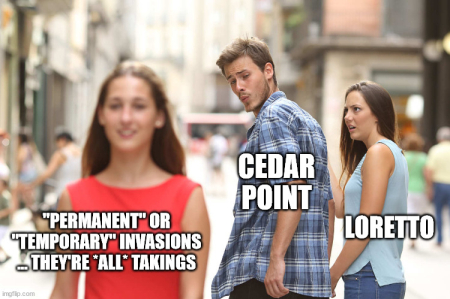
Permanentortemporary

In this post — the fourth in a series of deeper dives that we’re posting about June’s U.S. Supreme Court opinion in Cedar Point Nursery v. Hassid, No. 20-107 (June 23, 2021) — we’ll be discussing the two separate opinions, Justice Kavanaugh’s concurrence, and the Justice Breyer-authored dissent.

Here are all of the posts

In this post — the third in a series of deeper dives that we’ll be posting about last week’s U.S. Supreme Court opinion in Cedar Point Nursery v. Hassid, No. 20-107 (June 23, 2021) — we’ll be discussing whether the “right to exclude” is absolute, what exceptions the Court laid out, and how it

Keep out

In this post — the second in a series of deeper dives that we’re posting about last week’s U.S. Supreme Court opinion in Cedar Point Nursery v. Hassid, No. 20-107 (June 23, 2021) — we’ll be covering more on the “right to exclude,” how the Court treated our old frenemy Pruneyard, and how

More good takings news, hot off the press.

Before Cedar Point came down last week, we were all set to let you know about the Eleventh Circuit’s opinion in South Grande View Dev. Co., Inc. v City of Alabaster, No. 18-14044 (June 21, 2021), in which the court affirmed a jury verdict that

Screenshot 2021-06-23 at 14-25-38 Takings and Eminent Domain After Cedar Point What Practitioners Need to Know

The ink’s not quite yet dry on the U.S. Supreme Court’s landmark decision in Cedar Point Nursery v. Hassid, No. 20-107 (June 23, 2021), but we’re already ready to roll with a program about what this decision means for you and your clients, and for takings law.

Find out from the experts in a

In this post — the first in a series of deeper dives that we’ll be posting about over the next few days about yesterday’s U.S. Supreme Court opinion in Cedar Point Nursery v. Hassid, No. 20-107 (June 23, 2021) — we’ll be covering the background of the case, and the heart of the majority

Keep out

We haven’t had time to read it in detail yet, but here’s the slip opinion in a case we have been following for a long time, Cedar Point Nursery v. Hassid, No. 20-107 (June 23, 2021).

Writing for a six-Justice majority (no one went wobbly!), Chief Justice Roberts concluded that California’s labor regulations, which

PXL_20210402_173956850
The New Mexico Supreme Court

In what amounts to an advisory opinion, in State of New Mexico v. Wilson, No. S-1-SC-3850 (June 7, 2021), the New Mexico Supreme Court (courthouse pictured above) concluded that the State’s public health orders that impose “restrictions on business operations regarding occupancy limits and closures cannot support a claim

Title page

Wondering about so-called “covid takings” such as business lockdowns, seizures, commandeerings, eviction moratoria, and whether these might be takings?

If so, check out our latest article, Evaluating Emergency Takings: Flattening the Economic Curve, just published in the latest issue of the William and Mary Bill of Rights Journal.

Here’s the Intro to the article:

Desperate times may breed desperate measures, but when do desperate measures undertaken as a response to an emergency trigger the Fifth Amendment’s requirement that the government provide just compensation when it takes private property for public use? The answer to that question has commonly been posed as a choice between the “police power”—a sovereign government’s power to regulate property’s use in order to further the public health, safety, and welfare —and the eminent domain power, the authority to seize private property for public use with the corresponding requirement to pay compensation. But that should not be the question. After all, emergencies do not increase government power, nor do they necessarily alter constitutional rights, and an invocation of police power by itself does not solve the compensation question, but is merely the predicate issue: all government actions must be for the public health, safety, or welfare, in the same way that an exercise of eminent domain power must be for a public use.

This Article provides a roadmap for analyzing these questions, hoping that it will result in a more consistent approach for resolving claims for compensation that arise out of claims of emergencies. This Article analyzes the potential takings claims stemming from emergency measures, mostly under current takings doctrine. Which types of claims are likely to succeed or fail? In “normal” times, it is very difficult to win a regulatory takings claim for compensation. In the midst of emergencies—real or perceived—the courts are even more reluctant to provide a remedy, even when they should, and emergencies are a good time to make bad law, especially in takings law. Can a better case be made analytically for compensation?

Part I summarizes the economic “flattening the curve” principle that motivates takings claims for compensation. Part II sets out the prevailing three-factor Penn Central standard for how courts evaluate claims that a health, safety, or welfare measure “goes too far” and requires compensation as a taking, examining the character of the government action, the impact of the action on the owner, and the extent of the owner’s property rights. Deep criticism of the Penn Central standard is beyond the scope of this Article, and here, I accept it as the default takings test. But I argue that the government’s motivation and reason for its actions—generally reviewed under the “rational basis” standard—should not be a major question in takings claims. Rather, as this Article argues in Part III, the government’s emergency justifications should be considered as part of a necessity defense, not subject to the low bar of rational basis, but a more fact and evidence driven standard of “actual necessity.” Part IV attempts to apply these standards and examines the various ways that emergency actions can take property for public use: commandeerings, occupations of property, and restrictions on use. I do not conclude that the approach will result in more (or less) successful claims for compensation, merely a more straightforward method of evaluating emergency takings claims than the current disjointed analytical methods.

In sum, this article argues there is no blanket immunity from the requirement to provide just compensation when property is taken simply because the government claims to be acting in response to an emergency, even though its actions and reasons may satisfy the rational basis test. Instead, claims that the taking is not compensable because of the exigency of an emergency should only win the day if the government successfully shows that the measure was actually needed to avoid imminent danger posed by the property owner’s use and that the restriction on use was narrowly tailored to further that end.

One final word: the editors at the Bill of Rights Journal have been fantastic to work with to get this piece publication ready. Offering helpful comments, gently suggesting that certain parts are not working (but never insisting, and giving the author a lot of discretion), and getting the citations squared away: I could not have asked for more helpful editing. Congratulations on the publication of your latest issue. 

Thomas, Evaluating Emergency Takings: Flattening the Economic Curve, 29 Wm. & Mary Bill of Rights J. 1145 (2021)

Continue Reading New Law Review Article (Ours) – “Evaluating Emergency Takings: Flattening the Economic Curve,” 29 Wm. & Mary Bill of Rights J. 1145 (2021)