Just Compensation | Appraisal

nailhouseThis photo of a “nail house” in Wenling, People’s Republic of China is making the rounds on the internet. The reports (see also here for higher res photos) say that the homeowners refused to take the offers to sell, so the developer built the road around their house. “They are called “nail houses” because the

Here are my remarks from last week’s Brigham-Kanner Property Rights Conference at the William & Mary Law School in Williamsburg, Virginia. Our panel spoke on “Property Rights in Times of Economic Crisis,” and included lawprofs James W. Ely (Vanderbilt), William Fischel, (Dartmouth), and Eric Kades (William & Mary). See the complete faculty list and agenda

Ever since the U.S. Supreme Court’s infamous decision in Kelo v. City of New London, 545 U.S. 469 (2005), the focus of eminent domain scholarship and the public have been on the public use side of the condemnation equation.

However interesting those issues are (and they truly are), practitioners of eminent domain law understand

The Oyez Project has posted the recording in Arkansas Game & Fish Comm’n v. United States, No. 11-597 (cert. granted Apr. 2, 2012), the takings case argued earlier this week in the U.S. Supreme Court.

Check it out here. We posted our summary of the petitioner’s arguments here, and will be posting

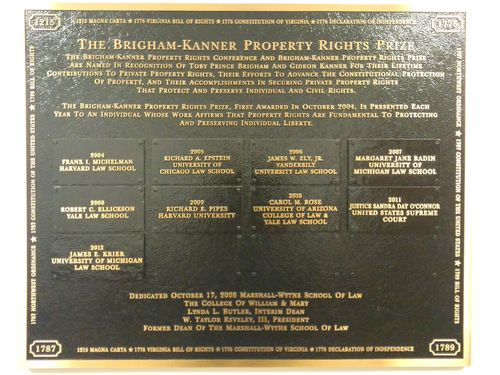
There’s still time to join us later this week at William & Mary Law School in Williamsburg, Virginia for the 2012 Brigham-Kanner Property Rights Conference, and the award of the B-K Prize to University of Michigan lawprof James Krier for his lifetime contributions to property law scholarship.

The Conference includes a day-long series of

Here’s the transcript of Wednesday’s argument in Arkansas Game & Fish Comm’n v. United States, No. 11-597 (cert. granted Apr. 2, 2012).

BLUF (Bottom Line Up Front): we’re predicting the property owner win with a minimum six-Justice majority (perhaps more), with a narrowly drawn opinion vacating the Federal Circuit’s conclusion that temporary

In the op-ed piece “Eminently reasonable,” Brooklyn lawprof David Reiss writes that “using the power of eminent domain to restructure underwater mortgages is constitutional, beneficial and administratively feasible.”

Local governments across the country are considering an innovative use of eminent domain. They propose to condemn underwater mortgages (those that exceed the fair-market value

August 31, 2012 was a big day in the Texas Supreme Court for takings and condemnation lawyers. The court issued three major opinions in our favorite area of law. The first involves a question of public use, the second inverse condemnation, and the third valuation. Trifecta.

Instead of putting our gloss on the opinions, we’ll