
The first sign that the opinion wasn’t going the way of the Golden State Water Company — a private utility that provides water to the City of Ojai, California — was right there in the first paragraphs, which contain the one-two punch of labeling the company both a monopolist, and one that price gouges about
Virginia Papers On The Ramsey Case: VDOT “Bullying” And “Sandbagging” Revealed
Here’s a couple of editorials about the Ramsey case, recently decided by the Virginia Supreme Court. [Disclosure: we filed an amicus brief in support of the Ramseys in that case.]
- In “Sandbagging, exposed,” the Richmond Times-Dispatch editorial board writes: “Around the country, states that want to take people’s land will sometimes pull
Virginia: Jury Gets To Hear About Appraisal Bait-And-Switch
The Virginia Supreme Court today came back with an opinion in Ramsey v. Commissioner of Highways, No, 140929 (Apr. 16, 2015), a eminent domain case in which we filed an amicus brief in support of the property owner.
Under Virginia’s condemnation procedures, as a prerequisite to a court exercising jurisdiction over an eminent domain
Property Owners’ Brief In NC “Map Act” Takings Case: Depressing Acquisition Price Precondemnation Is An Exercise Of The Eminent Domain Power
Here’s the property owners’ brief in opposition to the DOT’s request for the North Carolina Supreme Court to review the court of appeals’ opinion in Kirby v. N.C. Dep’t of Transportation, No. OA14-184 (Feb. 17, 2015).
The court concluded that the Map Act — which gives the DOT the ability to designate hundreds of
New Book Forthcoming: “The Grasping Hand: Kelo v. City of New London & The Limits Of Eminent Domain” by Ilya Somin
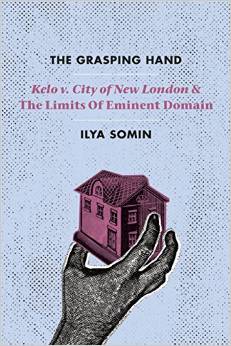
To put on your to-buy, to-read list: lawprof Ilya Somin‘s forthcoming book about the Kelo case and the aftermath, available on June 5, 2015. (We’re in the process of organizing some book talk events with Prof Somin in the fall, and if you have suggestions for venues or want to host one, let us
Iowa: “Liberty Requires Accountability” – Delegation Of Eminent Domain Power Strictly Construed, And Commission With Private Members Could Not Take Property
Here’s one that just rolled in, from the Iowa Supreme Court. In Clarke County Reservoir Comm’n v. Edwin D. & Deloris A. Robins Revocable Trust, No. 14-0774 (Apr. 10, 2015), the court held that the Commission did not have the power of eminent domain because several of its members were private actors. The court
New Jersey: When Designating Blight, Baby Can Be Tossed Without First Showing The Bathwater’s Dirty
A few years ago, in Gallenthin Realty Development, Inc. v Borough of Paulsboro, 191 N.J. 344 (2007), the New Jersey Supreme Court held that in order to target property for redevelopment as “blighted,” the government must show that it is in such condition that it “negatively affects surrounding areas” by promoting conditions that can develop
New Law Review Article Worth Reading: “Through a Glass Clearly: Predicting the Future in Land Use Takings Law”
It’s not often that we say a law review article is a “must-read.” But this one definitely is, especially for all you regulatory takings mavens: David L. Callies, Through a Glass Clearly: Predicting the Future in Land Use Takings Law, 54 Washburn L. Rev. 43 (2014). A pdf of the article is posted here
New Cert Petition: Property Owner Should Not Be Limited To “Whispering” Anti-Eminent Domain Message

As we hoped it might, the Norfolk, Virginia property owner — represented by the Institute for Justice — who was on the losing side of the Fourth Circuit’s 2-1 recent opinion in Central Radio Co. Inc. v. City of Norfolk, 776 F.3d 229 (4th Cir. Jan. 13, 2015) has filed a cert petition.
How Are They (I Mean *We*) Going To Pay For Honolulu’s Rail?
The short answer: taxes.
[Update #1: a report from last night’s community meeting, “Railing Against Honolulu’s $6 Billion Rail Project” (“Honolulu Mayor Kirk Caldwell and his top transit official took their licks from a decidedly anti-rail crowd during a boisterous town hall meeting at Washington Middle School on Wednesday.”
Update #2: “