

Photo of Robert H. Thomas

Robert H. Thomas

IMG_20180322_100645

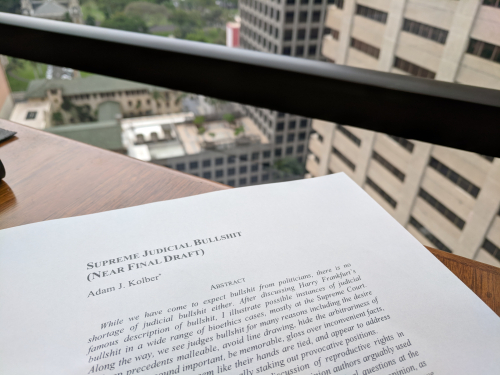
Here’s some of the things we’re reading or reviewing today, focused on the legal scholars and takings (with the last one being of general interest):

  • Michael Pollack, Taking Data, 86 U. Chi. L. Rev. ___ (2018) (“This Article proposes a new approach to regulating government investigations of data that has been shared with ISPs
After the Supreme Court’s decision in Lingle v. Chevron U.S.A., Inc., 544 U.S. 528 (2005), whether a government action “substantially advances a legitimate state interest” — for a long time assumed to be a takings question under Agins — found a new home in the the Due Process Clause.  

Here’s the recently-filed cert petition

You might not think that the conclusion which the U.S. Court of Appeals for the Tenth Circuit reached in M.A.K. Investment Group, LLC v. City of Glendale, No. 16-1492 (May 14, 2018) would be all that controversial: when private property is declared by a municipality to be “blighted” and subject to redevelopment (and eminent

The Virginia Supreme Court once famously noted that some things were so obvious, you didn’t need to cite any authority for the proposition. See Goldstein v. Old Dominion Peanut Corp., 177 Va. 716, 722, 15 S.E.2d 103, 105 (Va. 1941) (“We have so often said this that no citation for its verity is needed,”

If you understand this post’s headline, congratulations: you are the nerdiest of law nerds, checking no less than two boxes in the obscure law category, takings and patent law.

But if you have been paying attention here, you know that recently, the Supreme Court, in Oil States Energy Services, LLC v. Greene’s Energy Group

Yesterday, the U.S. Court of Appeals heard arguments about the Mountain Valley Pipeline (which will run from northern West Virginia to southern Virginia), a situation receiving a lot of attention, and which has generated a number of lawsuits (go here for a list of the cases and a summary).

The question in Berkley

DSCF3357

Two cases which we’ve been following are up for consideration on the Supreme Court’s conference schedule today. Indeed, by the time we post this, the conference will likely be over, although we won’t know the results until next week. Check these out, and hold your breath:

A water district, with regulatory approvals and permits from the California Department of Health Services, added chemicals — “secondary disinfectants” — to the tap water system to make the water safe to drink. The water complied with all federal and California drinking standards. 

Sounds good. No one wants undrinkable drinking water. Problem was these additives caused