April 2024

If there’s a money quote in yesterday’s opinion by the Supreme Court of Nevada which “wholly affirm[ed] a trial court judgment awarding $48 million in just compensation for Las Vegas’s regulatory taking in City of Las Vegas v. 180 Land Co., LLC, No. 24-13605 (Apr. 18, 2024), it might just be this sentence:

Although

PXL_20231101_125417762.PORTRAIT (Small)
Guess where we stopped for coffee this morning?
(A reminder: this case has nothing to do
with the convenience store.)

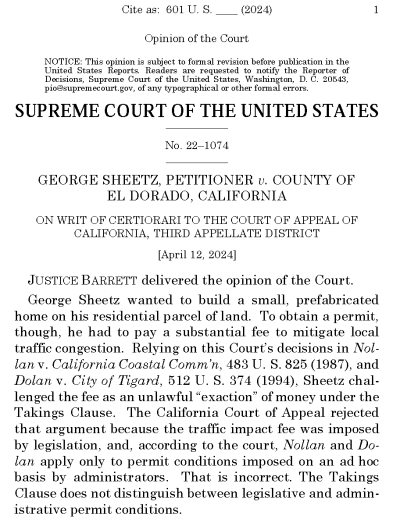
Note: this is the first of two posts on the recent Supreme Court opinions in Sheetz v. County of El Dorado, the case in which the unanimous Court held that exactions imposed by

Here’s what folks are saying about yesterday’s unanimous U.S. Supreme Court decision in Sheetz v. County of El Dorado, where the Court held that impact fees and exactions imposed by legislative action are not categorically immune from the close nexus and rough proportionality requirements already applicable to ad hoc/administratively-imposed exactions under Nollan, Dolan, and

Sheetz

This just in: the U.S. Supreme Court has issued a unanimous opinion in Sheetz v. County of El Dorado, a case we’ve been following (not only because it is one of ours).

The Court, as predicted, held that an exaction (in this case a traffic impact fee) isn’t immune from the Nollan/Dolan nexus

This one takes a bit of sifting through, but if you do so, you will eventually savor the arguments. Try and follow this thread.

In 2014, pistachio growers with what seemed to be established rights to pump groundwater for irrigation of their trees and who never had to pay fees or were subject to other

Screenshot 2024-04-09 at 12-04-36 https __pd.pacificlegal.org (Small)

Have thoughts about where regulatory takings are (or should be) headed? Here’s your chance to get in on the conversation, and to shape the future of the law.

Our outfit, the Pacific Legal Foundation, in cooperation with the Antonin Scalia Law School’s Journal of Law, Economics, and Policy, are calling for papers on “Imagining

A quick one from the Arizona Supreme Court that isn’t so much a true takings case, but more like “takings adjacent.” In our view, it well illustrates the way that takings arguments can shape how statutes are interpreted, even if there isn’t a taking.

The case — Cao v. PFP Dorsey Investments, LLC, No.