
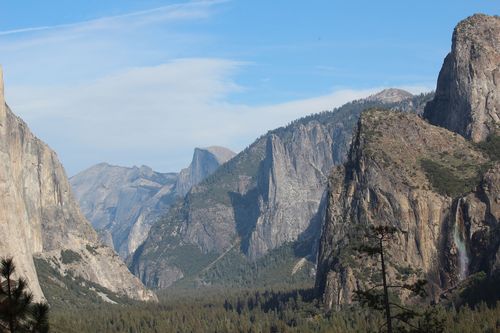
“Yosemite,” according to California Place Names, Erwin Gudde’s seminal work on the origins of (surprise) California place names, means “they are killers.” It was “[e]vidently a name given to the Indians of the valley by those outside it.”
I raise this historical tidbit because I must admit to feeling a little like “those outside it” when I was invited to speak about regulatory takings at the California State Bar’s Environmental Law Conference at Yosemite. I figured as a conference devoted to environmental law, it was a going to be a decidedly skeptical audience, given my advocacy for property owners and property rights. I accepted the invitation nonetheless, heartened that this conference wasn’t going to be an echo chamber and that they were at least open to hearing competing ideas.
It turns out that my prediction about “they are killers” was not accurate — the audience, while not exactly sympathetic to my viewpoints, was was certainly open and friendly and welcoming while I spoke about “Regulatory Takings: Looking Back and Looking Forward” with U.C. Berkeley law professor Joseph Sax and Deputy California Attorney General Daniel L. Siegel. We focused on seminal regulatory takings cases from the recent past, and each made predictions of what might be next. “The panelists, who have been involved in several of the most significant takings cases since even before the founding of the annual Yosemite Environmental Law Conference twenty years ago, will highlight key decisions, offer their views on the evolution of takings law, and discuss cutting-edge issues raised by more recent court decisions.”
Sidebar: if you were not able to attend, the audio recording is now available for purchase for a very modest price ($34 gets you the two CD set and the written materials, and includes the 1.5 hours of MCLE credit) from Versa Tape. Go here to order (if that link does not work, go here and enter “11ELC-15AB” in the search box). I’ve posted some short sound bytes of each presentation to give you a flavor of the session.
To start us off, Clem Shute provided us with a quick history of regulatory takings law over the last 40-plus years since Penn Central. He also moderated the panel discussion. Listen to his introduction here:
I was up next. I focused on five takings issues that I predict will be important to watch: (1) the definition of “property” (including the judicial takings question); (2) how courts define “regulatory taking,” and whether those cases holding that a government action is not a taking simply because the government is not purporting to exercise its eminent domain power will survive close scrutiny; (3) the growing body of state court decisions on takings under state constitutions; (4) what to do with the Penn Central three-part standard now that the Court has reaffirmed is as the default test; and (5) will the Court abandon or modify the Williamson County ripeness test, as four Justices suggested in the San Remo Hotel case?
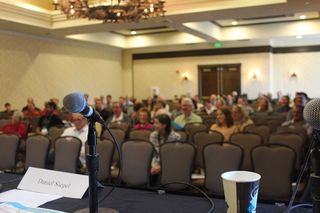
What it looked like from where I sat.
I also mentioned one “non takings” issue that is worth watching: whether substantive due process will become more important now that the Supreme Court has removed the “substantially advance” test from takings analysis, and moved it over to due process (more detail on this issue here). In this area, Justice Kennedy is the one to watch, as his concurring opinions in Kelo and Lingle both telegraph his notion that on questions of the legitimacy of government actions that impact property, the due process clause is more critical than the takings clause. Links to all of the cases I discussed and that are referenced in my written materials are posted here.
Next, Dan Siegel noted the sharp decline in the number of regulatory takings/inverse condemnation cases heard by the Supreme Court since the mid-1980’s.
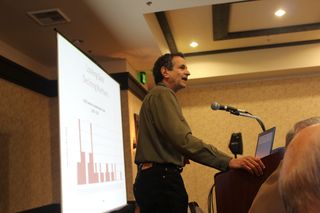
Dan Siegel (Deputy California Attorney General)
Dan also noted areas he believes are still unresolved: (1) whether the nexus and rough proportionality standards of Nollan and Dolan are limited to exactions of real property, an issue the subject of a pending cert petititonCasitas decision from the Federal Circuit for an example of a court treating it as a physical take); (3) Williamson County‘s future; (4) is there such a thing as a “judicial taking;” and (5) the parcel-as-a-whole question. On whether these issues are open, I agree wholeheartedly with Dan; our differences are on how the Court should resolve them.
Professor Sax ended the session by providing his scholarly view. He rightly suggested that the law of regulatory takings has largely escaped clear doctrinal development. Thus, it appears that decisions in which the Court has found a taking are driven more by the apparent unfairness of the situation than by the application of clear or consistent rules. See, e.g., the government’s repeated rejections of development proposals while informing the property owner that it might approve its application if only it returned with a more modest proposal in the Del Monte Dunes case.
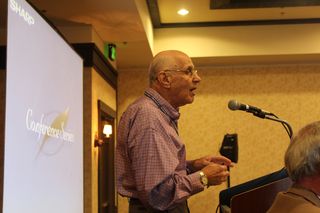
Professor Joseph Sax sums it all up.
Professor Sax concluded that the Court will be reluctant in the next few years to take up cases in order to articulate “large general principles or major doctrinal theories of property,” but that if a situation appears to involve “serious over-reaching by regulators (especially land use regulators),” the Court will step in. He also agreed with Dan and I that the judicial takings issue is an open question, as are issues involving the boundary between public and private property at the shoreline. Of course, this being Professor Sax, the public trust issue and the question of what are “background principles” of state property law were never far from our minds.
In sum, it was an enjoyable and informative session (as was the remainder of the presentations at the Conference).I appreciate the invitation to speak, as well as the warm welcome I received.
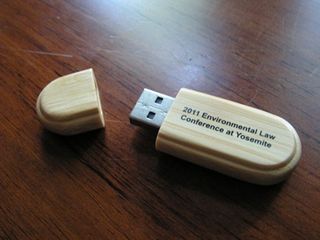
The written materials were not distributed on paper, but
on a USB drive. With a faux wood casing, no less. Very green.
There was a lot of quality swag at the conference: backpacks,
water bottles, flashlights, and more post-its and pens
than you could possibly take.
This photo has nothing to do with the conference, except that we
passed by this sign on the drive out of the mountains via the National
Park. Call it “bad marketing,” since I am not going anywhere near
any body of water labeled “Mosquito Creek.”