Penn Central

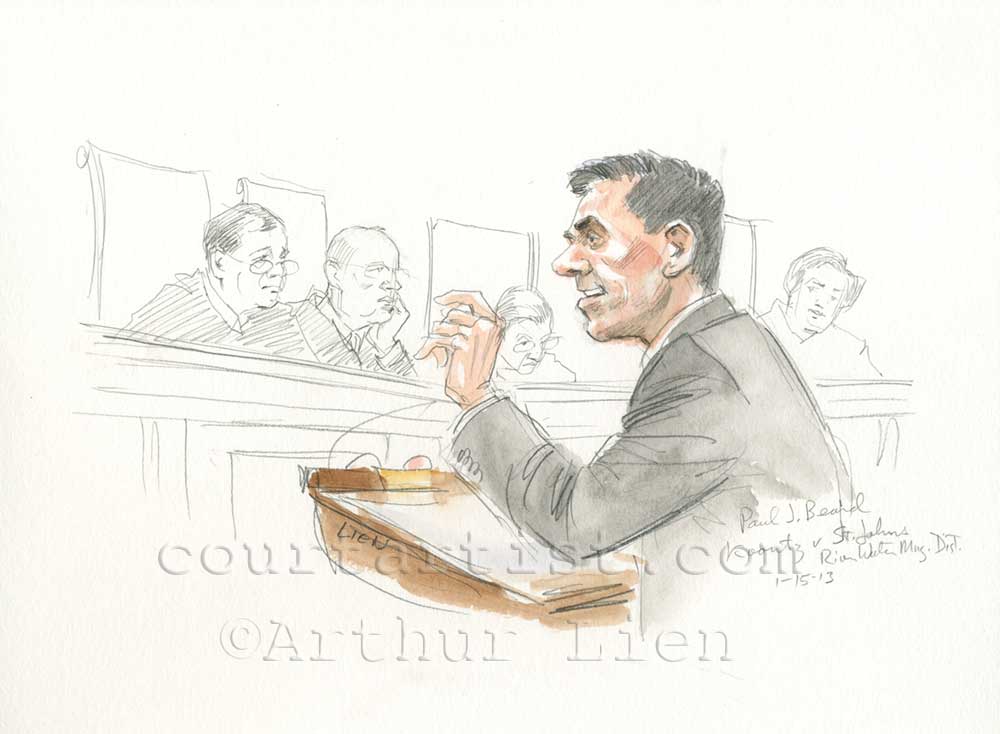
In addition to our summary of and reaction to yesterday’s oral arguments in Koontz v. St Johns River Water Mgmt Dist., No. 11-1447 (cert. granted Oct. 5, 2012), here is the leading commentary from other sources:

Okay, all you “relevant parcel” mavens, here’s another decision for you (once again involving land in Florida, although, unlike the other case which came out of the Florida court of appeals, this one is out of the U.S. Court of Appeals for the Federal Circuit) .

These decisions provide a measure of sanity to the

pbeard

When you are a property owner making a takings argument and Justice Scalia gives you a hard time at oral argument, you would be safe in thinking that you’ve got an uphill battle.

That was the situation today during the oral argument (transcript here) in Koontz v. St Johns River Water Mgmt Dist.

William W. Wade, Ph.D., a resource economist with the firm Energy and Water Economics (Columbia, Tennessee) is a frequent author and speaker on the topic of regulatory takings and is familiar to readers of this blog. (His next gig is a talk on Penn Central and inverse condemnation at the 12th Annual Texas Eminent Domain

There have been five amicus briefs filed supporting the Water Management District’s arguments in Koontz v. St Johns River Water Mgmt Dist., No. 11-1447 (cert. granted Oct. 5, 2012). That’s the case in which the Supreme Court is considering whether the “essential nexus” and “rough proportionality” standards of Nollan and Dolan are applicable only

LgoIt’s time for the annual ALI-CLE (fka ALI-ABA) eminent domain conferences, to be held January 24-26, 2013 in Miami Beach, Florida.

In the “advanced” course, Eminent Domain and Land Valuation Litigation, we’ll be covering topics such as “Condemning Underwater Mortgages,” “An Engineer’s Role in Damage,” “How To Develop and Implement a Business Plan for

Here’s the respondent’s brief in Koontz v. St Johns River Water Mgmt Dist., No. 11-1447 (cert. granted Oct. 5, 2012). That’s the case in which the Supreme Court is considering whether the “essential nexus” and “rough proportionality” standards of Nollan and Dolan are applicable only to exactions for land, or whether they are generally-applicable

An opinion worth reading. In Galleon Bay Corp. v. Bd. of County Commissioners, No. 3D11-1296 (Dec. 5, 2012), the Florida District Court of Appeal (Third District), held that the trial court improperly applied the “investment-backed expectations” prong of the Penn Central factors, by not treating the parcels at issue separately from the plaintiff’s other

Here are some thoughts about yesterday’s opinion in Arkansas Game and Fish Comm’n v. United States, No. 11-597 (Dec. 4, 2012), in which a unanimous Supreme Court held that government-induced flooding could be a taking, even if temporary. 

Bad Puns and a “Flood” of Litigation

First, the temptation in flooding cases is to make

The three-part Penn Central test for an ad hoc regulatory taking tasks courts with evaluation of the economic impact of the regulation on the property’s use, the property owner’s distinct investment-backed expectations, and the character of the government action. Throw all of these “factors” into a pot, stir, and voila, the answer of whether