“You can’t have rights without advocates.”
– Michael Berger
We’re at the William and Mary Law School in Williamsburg, Virginia today for the 11th Brigham-Kanner Property Rights Conference. As we’ve noted earlier, Michael Berger is this

“You can’t have rights without advocates.”
– Michael Berger
We’re at the William and Mary Law School in Williamsburg, Virginia today for the 11th Brigham-Kanner Property Rights Conference. As we’ve noted earlier, Michael Berger is this
We’re tied up today and don’t have time to do any analysis, so we post this without comment: Bowman v. California Coastal Comm’n, No. B243015 (Oct. 23, 2014), wherein the court held:
In Kleiniecke v. Montecito Water District (1983) 147 Cal.App.3d 240, we held it would not be inequitable to apply the doctrine of

If you haven’t already, please mark you calendars: the agendas and faculty lists for the February 5-7, 2015 ALI-CLE eminent domain programs in San Francisco have been finalized. Registration is ongoing, and there’s even a few more days left for the early registration discount. Substantial group discounts are also available.
We’re talking, of course
Ah, Williamson County. We’ve ranted about it before, so we won’t do so here (again). But takings mavens know that a property owner must meet two tests before she can raise a takings claim against a state or local government in federal court: the state or local government must have reached a final
You mght read the headline of this post and naturally say to yourself, “well, that’s obvious.” But to the Eleventh Circuit in Kentner v. City of Sanibel, 750 F.3d 1274 (11th Cir. 2014), it wasn’t.
In that case, the court concluded that riparian rights are not “fundamental rights” protected by the Due Process Clause
We’re tied up in court today, so don’t have time to post up the latest cases which have crossed our desk in the past few days.
We will get to them soon, but in the meantime, check out this story (“The Stubborn ‘Nail Houses’ That Refuse to Get Demolished“) from Gizmodo (a blog about

Remember that case which we posted about earlier, in which the City and County of Honolulu condemned an undeveloped lot in rural Oahu for a fire station, but has been met with staunch resistance by the property owners? Not only did we post on the case, but it made national waves, also.
The City
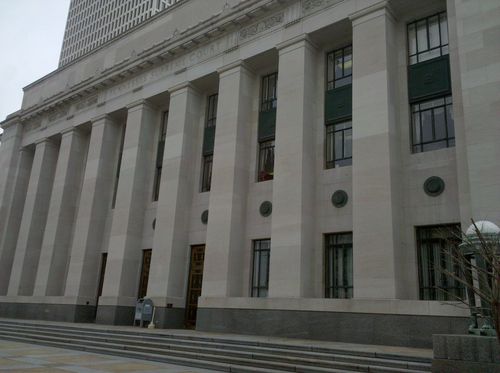
Tennessee Supreme Court, Nashville
In Phillips v. Montgomery County, No. M2012-00737-SC-R11-CV (Aug. 18, 2014), the Tennessee Supreme Court held that a property owner could recover under the state’s inverse condemnation statute, Tenn. Code Ann. § 29-16-123, for a regulatory taking:
We hold that, like the Takings Clause of the United States Constitution, article I
Here’s what we’re reading on this blustery Friday:
A couple of years ago, we posted the complaint (actually, a petition for mandate) alleging a big regulatory takings claim against the County of San Luis Obispo based on the County’s denial of a permit to drill for oil. A very big claim. $6.24 billion big. See “Wow, That’s A Lot of Just Compensation