
Eminent Domain | Condemnation

This one is more for our muni law friends, but today’s post also has two eminent domain angles. 

Anyone who has been to a city council meeting knows at least one fellow like this, considered a pain-in-the-butt by officials. A gadfly, who testifies on seemingly every issue. This is Fane Lozman, eminent domain protester

A quick check of the Supreme Court’s docket in the Knick v. Township of Scott case shows that no less than 18 amici briefs have been filed top side. Not all of them in support of the Petitioner mind you (two, the briefs of the United States and of the American Planning Association, are in

It’s a go for next Monday, June, 11, 2018, and the exclusive Honolulu screening of Little Pink House,” the feature film about the Kelo v. City of New London case.

There are still some seats left, so if you are even thinking of attending, buy your ticket here, right now.

We’ve seen

Here’s the latest in a case we’ve been tracking, the City of Missoula, Montana’s takeover of a privately-owned water system. In 2016, the Montana Supreme Court held that the city could exercise its power of eminent domain to take the property for a “more necessary” public use. The court allowed the city to take the

Recently, Pennsylvania property owners filed two cert petitions (download here and here) asking the U.S. Supreme Court to review this question:

Whether the Hazardous Liquid Pipeline Safety Act (HLPSA)1 preempts the Pennsylvania Public Utility Commission’s (PUC) jurisdiction to issue Certificates of Public Convenience resulting in eminent domain power when the HLPSA states it

You have about a week to reserve your tickets for the exclusive Honolulu screening of Little Pink House,” the feature film about the Kelo v. City of New London case,  scheduled for June 11, 2018:

Two key dates:

  • June 4, 2018: This is the deadline to buy your ticket. The way this works

Jeff Benedict, author of “Little Pink House,” the book about the Kelo v. New London eminent domain debacle (and now a movie) has made a video (at the still-vacant Fort Trumbull site), and written an op-ed, arguing that the land should be conveyed back to its former owners, including Ms. Kelo:

20170918_171304_Richtone(HDR)

Today’s 7-2 U.S. Supreme Court ruling in Upper Skagit Indian Tribe v. Lundgren, No. 17-387 (May 21, 2018), isn’t a takings case, and is more about appellate procedure and framing your issues, but there are several nuggets which takings mavens should note. 

It’s not often that a simple boundary dispute gets to the Supreme Court, and the ultimate question in the case is who owns a one acre parcel in Washington. The Tribe bought a 40 acre parcel, planning to add it to its adjacent reservation. A survey showed that one acre of land on the other side of a barbed wire fence was part of that parcel, even though the Lundgrens thought they owned it.

The Lundgrens brought a quiet title action in Washington state courts. The Tribe responded by asserting its sovereign immunity. “It relied on the many decisions of this Court recognizing the sovereign authority of Native American tribes and their right to ‘the common-law immunity from suit typically enjoyed by sovereign powers.’” Slip op. at 3 (quoting Michigan v. Bay Mills Indian Community, 134 S. Ct. 2024 (2014). The Washington Supreme Court sided with the Lundgrens:

The court reasoned that sovereign immunity does not apply to cases where a judge “exercis[es] in rem jurisdiction” to quiet title in a parcel of land owned by a Tribe, but only to cases where a judge seeks to exercise in personam jurisdiction over the Tribe itself. 187 Wash. 2d 857, 867, 389 P. 3d 569, 573 (2017). In coming to this conclusion, the court relied in part on our decision in Yakima [v. Confederated Tribes and Bands of Yakima Nation, 502 U. S. 251 (1992)]. Like some courts before it, the Washington Supreme Court read Yakima as distinguishing in rem from in personam lawsuits and “establish[ing] the principle that … courts have subject matter jurisdiction over in rem proceedings in certain situations where claims of sovereign immunity are asserted.” 187 Wash. 2d, at 868, 389 P. 3d, at 574.

Slip op. at 3. 

In an opinion by Justice Gorsuch, the U.S. Supreme Court disagreed, concluding that the Yakima case didn’t sweep so broadly, and was merely a case about statutory interpretation, not about the differences, if any between in personam and in rem jurisdiction. Here’s your appellate practice pointer: courts appreciate it when counsel is candid:

Commendably, the Lundgrens acknowledged all this at oral argument. Tr. of Oral Arg. 36. Instead of seeking to defend the Washington Supreme Court’s reliance on Yakima, they now ask us to affirm their judgment on an entirely distinct alternative ground.

Slip op. at 5. Knowing when to hold em and knowing when to fold em is not necessarily something which comes naturally to zealous advocates, so bravo to the Lundgren’s lawyers for good lawyering. 

The Lundgrens’ Plan B was to argue that the Court should reach the same result by applying common law sovereign immunity. Slip op. at 5 (“At common law, they say, sovereigns enjoyed no immunity from actions involving immovable property located in the territory of anothe rsovereign.”). In those cases, the government is acting more like a private landowner, and therefore is subject to suit. 

But rather than decide the case, the seven-Justice majority sent the case back to the Washington courts to develop the arguments (not briefed in the Supreme Court). Justices Thomas and Alito, by contrast, argued the Court should have decided the issue because “the immovable-property exception was extensively briefed and argued, and its application here is straightforward.” Dissent at 2. They would have resolved the question in favor of the Lundgrens and the courts of Washington, concluding “there has been ‘uniform authority in support of the view that there is no immunity from jurisdiction with respect to actions relating to immovable property.’” Dissent at 4. Land is governed by the law of where the land is. 

Here are the two nuggets from the case that might be of interest to takings folk:

  • The distinction between in rem and in personam jurisdiction appears to be losing whatever meaning it may have once had. For example, the feds (and a few states) still adhere to the fiction that an eminent domain action is against the land, and not the owner. And some eminent domain doctrines — such as the “undivided fee rule” — are based on the idea that the government is taking the land, and not the rights of the owner of that land. The in rem vs in personam distinction doesn’t mean much when it comes to jurisdiction (see, for example, Shaffer v. Heitner, 433 U.S. 186, 207 (1977), which held that the same due process standards govern in rem cases, and that in rem jurisdiction is really shorthand for “referring to jurisdiction over the interests of a person in a thing.”). That the Court in Skagit didn’t go down the in rem vs in personam path tells us that this trend continues. 
  • Sovereign immunity is still hanging out there. Check out the Chief Justice’s concurring opinion, joined by Justice Kennedy, in which he laments the position which the ruling puts private litigants like the Lundgrens in, and notes that broad claims of sovereign immunity cannot carry the day. Concurring op. at 1 (“The correct answer cannot be that the tribe always wins no matter what; otherwise a tribe could wield sovereign immunity as a sword and seize property with impunity, even without a colorable claim of right.”). This could be of interest to those (like us), with a continuing interest in the question of whether the federal government is immune from being sued in an Article III court for just compensation. The concurring Justices also pointed out that when a government acts like a private party, it should be treated like a private party.      

A quick and interesting read all around. 

Upper Skagit Indian Tribe v. Lundgren, No. 17-387 (U.S. May 21, 2018) 

Continue Reading The Difference Between “In Rem” And “In Personam” Jurisdiction Becoming Much Less Important

IMG_20180322_100645

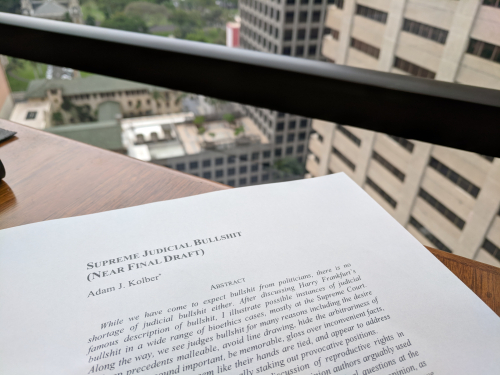
Here’s some of the things we’re reading or reviewing today, focused on the legal scholars and takings (with the last one being of general interest):

  • Michael Pollack, Taking Data, 86 U. Chi. L. Rev. ___ (2018) (“This Article proposes a new approach to regulating government investigations of data that has been shared with ISPs