Eminent Domain | Condemnation

Today, we filed the Reply Brief (also available below) in the case that asks: after Kelo, when is eminent domain pretextual? 

Last month, we filed a cert petition asking the Supreme Court to review the Hawaii Supreme Court’s decision in County of Hawaii v. C&J Coupe Family Ltd. P’ship, 242 P.3d 1136

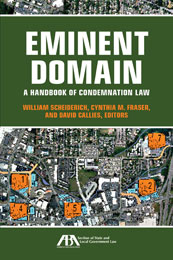
5330215_big The American Bar Association’s Section of State & Local Government Law has just published a new book on eminent domain fundamentals: Eminent Domain – A Handbook of Condemnation Law (available for preorder here).

I was privileged to author two chapters (Prelitigation Process and Flooding & Erosion), and my Damon Key colleagues Mark

Last week the developer and the County of Hawaii filed their joint Brief in Opposition in C & J Coupe Family Limited Partnership v. County of Hawaii, No. 11-75 (cert. petition filed July 14, 2011), responding to the cert petition we filed earlier, that poses this Question Presented:

The Hawaii Supreme Court held that

Yosemite_conference

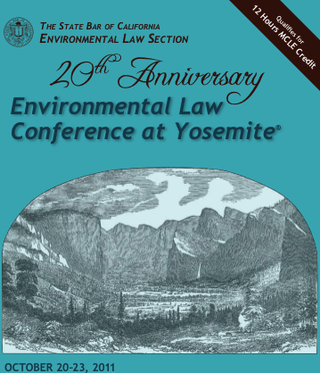
Mark your calendars for October 20 – 23, 2011. That’s when the State Bar of California will present its 20th Anniversary Environmental Law Conference at Yosemite® (yes, it is trademarked), at the Tenaya Lodge in Fish Camp, California.

Along with U.C. Berkeley law professor Joseph Sax and Deputy California Attorney General Daniel L. Siegel

Many of the cases we cover on this blog present unusual fact patterns and cutting-edge legal claims. But they may not present an accurate view of the typical cases that cross the desk of lawyers who have chosen this line of work, as much of the work of eminent domain and property lawyers involves issues

Here’s what we’re reading this fine summer Monday:

Lawyers all know of the canons of statutory construction that usually cause us run for our Latin dictionaries. They provide courts with the means to interpret the words in a statute or apply the code to a particular case, and supposedly are guideposts to guide us through the often-byzantine language of statutes and ordinances. The

Bulldozed_home Note to appellate practitioners: it’s not a good sign when an opinion’s treatment of your arguments starts with the phrase “[t]o the extent we are able to discern the arguments, we address them below.”

As that statement telegraphed, it didn’t go very well for the appellee in Main v. Royall, No. 05-09-1503-CV (July 25

Goodtobeking As Mel Brooks once said, “It’s good to be the King.” That’s especially true in eminent domain law. Even when you’re not the King.

Exhibit A: the plaintiff in this federal condemnation action was a railroad, the Dakota, Minnesota & Eastern Railroad Corporation. It brought suit against 97.943 acres of land, more or