
Eminent Domain | Condemnation

Here’s a short one from the Ohio Supreme Court. In City of Girard v. Youngstown Belt Railway Co., No. 2012 Ohio 5370 (Nov. 21, 2012), the court held:

In this case, we are called upon to determine the extent to which the Interstate Commerce Commission Termination Act (“ICCTA”), 49 U.S.C. 10101 et seq.

nailhouseThis photo of a “nail house” in Wenling, People’s Republic of China is making the rounds on the internet. The reports (see also here for higher res photos) say that the homeowners refused to take the offers to sell, so the developer built the road around their house. “They are called “nail houses” because the

Check out “Property rights take center stage in disputes over wetlands, flooding,” by Greenwire‘s Lawrence Hurley, asking whether the U.S. Supreme Court’s recent “flurry of activity” in property cases augurs a renewed interest in these issues by the Court, or is, as lawprof John Echeverria is quoted as suggesting, “serendipity.”

So far

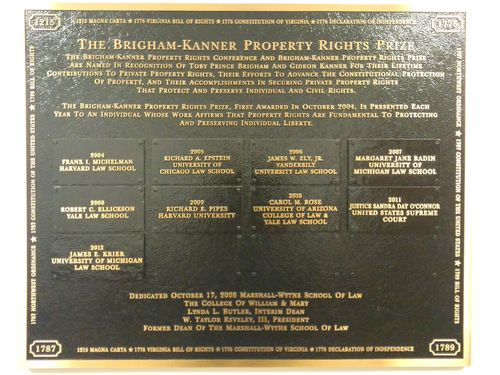
Here are my remarks from last week’s Brigham-Kanner Property Rights Conference at the William & Mary Law School in Williamsburg, Virginia. Our panel spoke on “Property Rights in Times of Economic Crisis,” and included lawprofs James W. Ely (Vanderbilt), William Fischel, (Dartmouth), and Eric Kades (William & Mary). See the complete faculty list and agenda

Ever since the U.S. Supreme Court’s infamous decision in Kelo v. City of New London, 545 U.S. 469 (2005), the focus of eminent domain scholarship and the public have been on the public use side of the condemnation equation.

However interesting those issues are (and they truly are), practitioners of eminent domain law understand

There’s still time to join us later this week at William & Mary Law School in Williamsburg, Virginia for the 2012 Brigham-Kanner Property Rights Conference, and the award of the B-K Prize to University of Michigan lawprof James Krier for his lifetime contributions to property law scholarship.

The Conference includes a day-long series of

The New York Times editorial page has weighed in on Arkansas Game & Fish Comm’n v. United States, No. 11-597 (cert. granted Apr. 2, 2012), the takings case argued earlier this week in the U.S. Supreme Court.

And, no surprise, in When Flooding Is Not a Taking, the great beneficiary of eminent domain