Articles and publications

Misusingheader

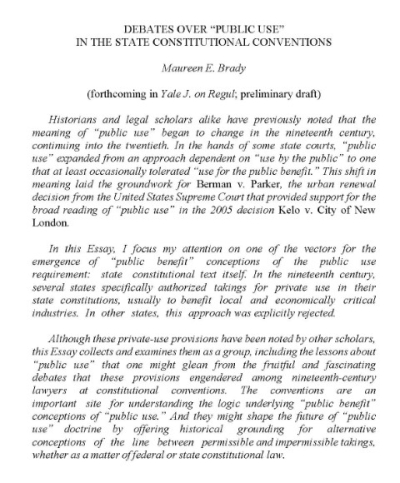
Check out this recently-published student note: Cameron P. Hellerman, Misusing Eminent Domain: Pretextual Takings For A Traditional Public Use, 93 Fordham L. Rev. 2229 (2025).

The article considers the Second Circuit’s decision in Brinkmann v. Town of Southhold, about what we call “spite takings” — those in which the government’s stated public purpose

Daunting

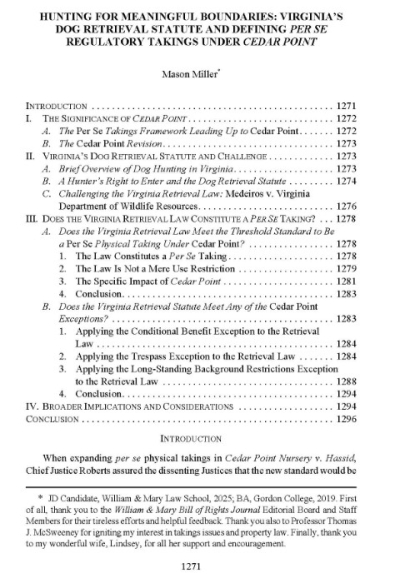
You know the claim: even after the federal courts opened back up to regulatory takings claims, winning a case is still pretty difficult. 

Yes, that may be by design: maybe it’s not supposed to be easy to get in the way of the regulatory state and prevail on a claim that a government action

Mulvaney_front_page.jjpg

Lawprof Timothy Mulvaney has published “Reconceptualizing ‘Background Principles’ in Takings Law,” 109 Minn. L. Rev. 689 (2025). 

If the title alone doesn’t grab your interest, here’s the summary from the article’s introduction:

Both libertarians and progressives rejoiced in the result reached by the Supreme Court in the 2023 matter of Tyler v. Hennepin County. This Article asserts that such unified celebration has overshadowed the extent to which the Supreme Court’s reasoning calls into question even our most foundational assumptions about the meaning of property and the takings protections the Constitution affords to it. Followed to its literal end, Tyler remarkably suggests that owners may well need to ground their expectations in the background principles of property laws endorsed by a majority of states rather than in those underpinning the laws of their own state.

Suspicious that the Court intended such a revolutionary upheaval of the state variations that have characterized our federalist system for more than two centuries, the Article contends that Tyler is better interpreted as an epic failure in judicial transparency: The opinion reflects a sly reticence to acknowledge the reality that resolving competing claims to property demands moral judgment regarding the background principles of property law. In following this deceptive course, Tyler invites a race to legislative homogeneity and erects a dangerous barrier to states’ abilities to innovate in the face of evolving social, economic, and environmental conditions.

Check it out.
Continue Reading New Article: “Reconceptualizing ‘Background Principles’ in Takings Law,” 109 Minn. L. Rev. 689 (2025)

Blevins

Our Pacific Legal Foundation colleague Ethan Blevins has published the lead article in the latest edition of the Wake Forest Journal of Law and Policy, and it is on a subject that makes it a must-read for you takings mavens.

The title says it all: “Penn Central in the States.” How do

Screenshot 2025-01-23 at 15-10-58 Takings and Choice of Law After i Tyler v. Hennepin County _i by Eric R. Claeys SSRN

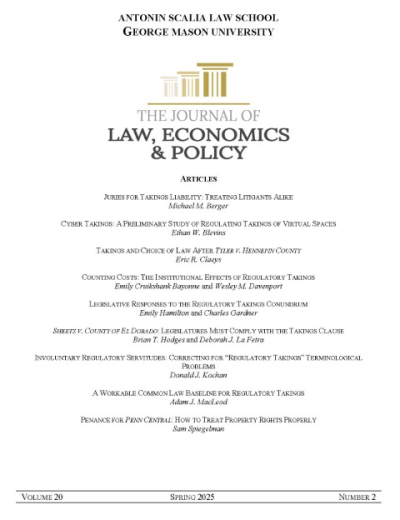
Check out this article, forthcoming in the George Mason Journal of Law, Economics, and Policy from lawprof Eric Claeys, “Takings and Choice of Law After Tyler v. Hennepin County.”

This is one of the pieces coming out of the recent symposium “Imaging the Future of Regulatory Takings” at George Mason Law School.

Here’s the Abstract:

This Essay contributes to a symposium on the future of regulatory takings. It focuses on choice of law in eminent domain disputes. When claimants bring eminent domain claims in federal courts, the courts must determine whether the claimants have constitutional “private property” in the entitlements allegedly taken. Should that determination be made with federal law, with the law of the state allegedly taking property, or law from some other source?

The 2023 Supreme Court decision Tyler v. Hennepin County addressed that issue. Under Tyler, it is a federal question whether an eminent domain claimant has constitutional private property. To answer the question, federal courts usually consult the law of the state where the alleged taking took place. But that presumption applies only if state law seems to secure and not to circumvent the federal right. And if that reservation is not satisfied, federal courts may consult a wider pattern of legal sources—Anglo-American history, the general law of the several United States, federal court precedents, and a broader cross-section of law from the state allegedly taking property. That approach resembles the approach taken generally for federal constitutional rights—especially in Indiana ex rel. Anderson v. Brand (1938)—but varies from the general approach in the sources it makes relevant to settle what counts as private property under the Fifth Amendment. This Essay interprets Tyler, and it offers a normative justification for Tyler’s approach to choice of law in eminent domain. 

Don’t miss this one.Continue Reading New Article (Eric Claeys): “Takings and Choice of Law After Tyler v. Hennepin County”

Here’s what we’re reading this day:

Screenshot 2025-01-12 at 09-35-14 Taking Old Ladies’ Homes A Comparative Exploration of Eminent Domain in

Check this out, a just-published unsigned student piece: Note, “Taking Old Ladies’ Homes: A Comparative Exploration of Eminent Domain in Islamic Law,” 138 Harv. L. Rev. 841 (2025).

Not that we have any background to be able to evaluate the author’s assertions, but at the very least, the piece is very interesting (you

Screenshot 2025-01-04 at 08-42-51 Revisiting Palazzolo The Blurry Lines Between Ripeness and Standing that Enable Windfalls by Timothy Harris SSRN

Check out, the latest from Professor Timothy Harris, “Revisiting Palazzolo: The Blurry Lines Between Ripeness and Standing that Enable Windfalls,” 73 Kan. L. Rev. 289 (2024). He dives into the question of whether an owner who acquires property already subject to regulations that allegedly work a taking may assert a claim, or does

Heads up law students and young lawyers: the American Bar Association’s Section of State & Local Government Law has called for submissions for its annual writing competition.

Topics which the Urban Lawyer publish pieces about include land use, takings, eminent domain, housing, RLUIPA, exactions … and more. 

Here’s the announcement: 

The State and Local Government