Appellate law

20150422_112618
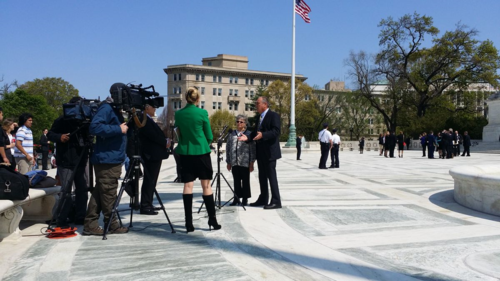
The Hornes outside the Supreme Court

“Separate educational facilities are inherently unequal.”
Chief Justice Earl Warren,
Brown v. Board of Education

“The Fourteenth Amendment does not enact
Mr. Herbert Spencer’s Social Statics.”
Justice Oliver Wendell Holmes,
dissenting in Lochner v. New York

“…prejudice against discrete and insular minorities…”
Justice Harlan Fiske Stone, in footnote 4
This opinion isn’t big news, but come on, it’s about two of our favorite topics (eminent domain and appellate jurisdiction), it’s short, and it’s from the Supreme Court of the Virgin Islands. How often do we get those? Plus, we’re just interested in how courts from fellow island jurisdictions rule.

Bottom line: in a

Even though the defendant in Martinez v. California Dep’t of Transportation, No. G048375 (June 12, 2015, ordered published July 7, 2015) was Caltrans, this was not an eminent domain case, but rather a tort case about whether the agency negligently designed a roadway which caused Mr. Martinez to crash his motorcycle.  

But no

Remember the Roca Solida case? That’s the follow up to the Supreme Court’s recent decision in United States v. Tohono O’odham Nation, 131 S. Ct. 1723 (2011), highlighting the jurisdictional problem in takings cases which that case left open. We labeled it a “jurisdictional ambush” that awaits any property owner who has a takings

2012-02-06_11-19-51_574

Here’s a case in which the court ruled there wasn’t a taking, but it could be argued that the property owners won. How so? Because this case pitted the property rights of railroads against the property rights of the owners over whose land the rail lines run.

The U.S. Court of Appeals asked the Louisiana Supreme

2010-06-08 13.10.15

If there’s one thing that keeps appellate lawyers up at night, it’s jurisdictional questions. Too late and you’re toast: failing to appeal within the short appellate time frames are usually fatal to your case. Although there’s usually no overall harm in an early filing, it can be awkward when you’ve teed up a case only

There’s a category of cases in which it isn’t difficult, with reasonable accuracy, to predict the ultimate outcome without knowing much about the substantive law. The recent ACA and marriage cases, for example. You kind of just know how they’re going to come out. Bush v. Gore, 531 U.S. 98 (2000), was another one of

131996

In this Order, the Supreme Court has granted the cert petition in the case we’ve been following about the anti-eminent domain sign in Norfolk, Virginia. The Court vacated the Fourth Circuit judgment and sent the case back down for consideration in light of the recent ruling in Reed v. Town of Gilbert.

Attend any talk by a judge which includes legal writing tips, and there’s sure to be this one: keep it as short as is necessary to make your points. Justice Kennedy’s remark that “I never read a brief I couldn’t put down in the middle” and Chief Justice Roberts noting “I can’t

One for you muni law types (and for future students of Admin Law to assist them with writing their outlines). In Ruggles v. Yagong, No. SCWC-13-0000117 (June 25, 2015), a divided Hawaii Supreme Court refined the test for determining when a municipal ordinance or charter provision is preempted by state law.

The court clarified