42 U.S.C. § 1983 | Civil Rights

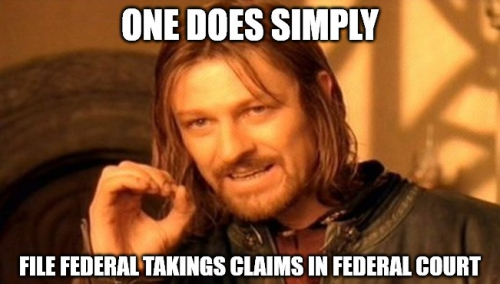
One does knick meme

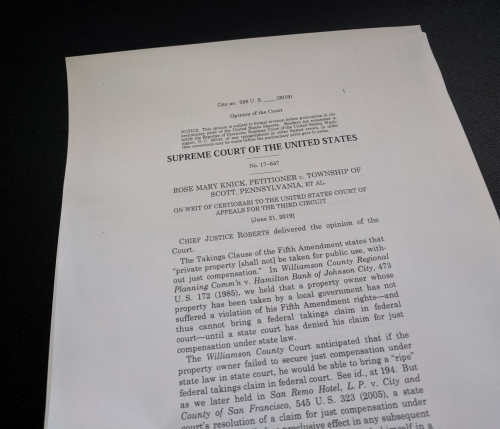
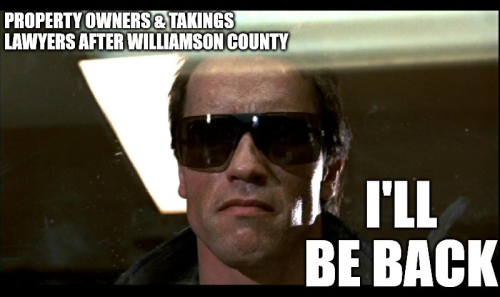
Property lawyers, dust off your Federal Rules of Civil Procedure, and federal judges your long vacay from dealing with regulatory takings and inverse condemnation cases is over, because this just in: by a 5-4 margin (Chief Justice Roberts authored the majority opinion, with Justice Kagan writing the dissent), the U.S. Supreme Court today finally (finally!)

A must-read for takings mavens. Property rights gurus Professor Gideon Kanner and Michael Berger have published a new article, The Nasty, Brutish, and Short Life of Agins v. Tiburon, 50 Urb. Lawyer 1 (2019). It’s the lead article in the latest volume of The Urban Lawyer, the law journal of our Section of

Our friend and colleague Dwight Merriam recently published this piece about the looming Knick v. Township of Scott decision. Yes, ripeness, and how SCOTUS will treat regulatory takings. We posted our own prognostications here (“Shaka, When The Walls Fell: Yes, Knick Will Be About Takings, But It Will Be More About Federalism“).

Awaiting

With the opinion in the Knick v. Township of Scott case to drop as soon as Tuesday (we’re guessing the opinion will be by Chief Justice Roberts, by the way), hold on: we’re about to get super nerdy here. Impossibly nerdy. Yes, we’re revisiting the Star Trek analogies. We’ve been down this road before

The title of this post may have you wondering, especially the part about how a regulation that invites others to physically enter private property, is determined by a court to not be a physical taking. (The court also hints at looking at a physical taking under Penn Central, and not by applying per se

Photoskidrow

As we’ve noted before, the growing homeless and “urban camping” situation seems to be getting worse, and in our perception is reaching the point of being intractable. A trip down the sidewalk of any major city  — if you dare, particularly in the west — will confirm. And there are no easy answers

We’ve been meaning to post the U.S. Court of Appeals for the Eleventh Circuit’s opinion in Hillcrest Property, LLP v. Pasco County, No. 16-14789 (Feb. 13, 2019), mostly because of the provocative way it starts off: 

The question before us is whether a litigant in this Circuit has a substantive-due-process claim under the Due

IMG_20180720_151841

Rather than sum up the issue and the Massachusetts Appeals Court’s** conclusion in Smyth v. Conservation Comm’n of Falmouth, No. 17-P-1189 (Feb. 19, 2019), here’s the first part of the opinion:

GREEN, C.J. A land owner brought this action in the Superior Court, claiming that local land use regulation effected a taking of her