March 2016

Here’s a new cert petition, seeking SCOTUS review of an unpublished opinion from the Eleventh Circuit. That court concluded that Dibbs’ equal protection challenge to the Hillsborough County’s Community Plan failed because he could not identify others who were similarly situated but treated differently.

Dibbs asserted. among other claims, that the County treated

As part of a railroad realignment project, Salt Lake City needed B’s land. But B wouldn’t sell, and since B’s land was already committed to public use as a power substation, the city had doubts whether it could condemn it. So the city and B agreed that B would voluntarily give the city the land

Rhode Island has a provision in its constitution which allows condemning agencies to take more property than they might actually need “for actual construction” when building “public highways, streets, places, [and] parks or parkways.”  See R.I. Const. art. VI, § 19. This provision also requires that in the event the condemnor doesn’t use

20160325_125208

A nondescript corner of what could be just about any urban city street in America. Nothing of overwhelming interest, just the usual commercial buildings, traffic signals, and small businesses. A self-storage facility. Pretty typical in a Commercial district. Here, the “C-4 District.”

Nothing at all, in fact, to indicate that just over a century ago, this was

Mississippi, like many states, by statute allows private parties to condemn a neighbor’s land for use as a private access road, if doing so is “necessary” for a landlocked parcel to gain ingress and egress. This power is subject to limitations: for example, the parcel must be truly landlocked with no other access. Mississippi apparently has

Today’s post is by colleague William Wade, an economist in Nashville, Tennessee, who has thought a lot — and written extensively — about the just compensation and damages available in inverse condemnation and regulatory takings cases.

He provides his thoughts on a recent trial court decision in a closely-watched Texas water case, in which the

20160131_103348

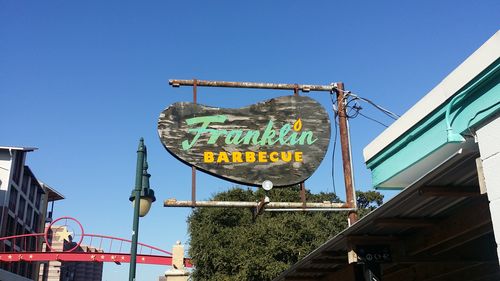
The photo above has pretty much nothing to do with today’s case, except it also involves a Texas barbecue joint. More on the photo after a short review of the Texas Court of Appeals’ decision in Lenox Barbeque and Catering, Inc. v. Metro. Transit Authority of Harris Cnty., No. 14-14-00383-CV (Feb. 23, 2016).

Lenox