
The California Coastal Commission has filed its Brief in Opposition to the cert petition in Charles A. Pratt Const. Co. v. California Coastal Comm’n, No. 08-668 (cert. petition filed Nov. 18, 2008) (SCOTUS docket report here). The California Court of Appeal’s opinion, reported at 76 Cal. Rptr. 2d 466 (Cal. Ct. App. 2008) is
State & Local Government Condemnation Committee Links
Here are links to the cases discussed on the conference call this morning:
- County of Hawaii v. C & J Coupe Family Limited Partnership, No. 28882 (Dec. 24, 2008) – public use, pretext, and damages for failed taking
The majority opinion by Justice Acoba, joined by Justices Nakayama and Duffy is posted here:
We hold that (1) a landowner in a condemnationaction is entitled to damages under HRS § 101-27 where the property atissue is not finally taken in the context of a particular condemnationproceeding, irrespective of whether the government attempts to take theland through subsequent condemnation proceedings; (2) abatement doesnot apply where the relief sought in two concurrent actions is not thesame; and (3) although our courts afford substantial deference to thegovernment’s asserted public purpose for a taking in a condemnationproceeding, where there is evidence that the asserted purpose ispretextual, courts should consider a landowner’s defense of pretext. Therefore, (1) automatic denial of statutory damages under HRS §101-27in Condemnation 1 is vacated and the case remanded for a determinationof damages, (2) the court’s conclusion that Condemnation 2 was notabated by Condemnation 2 is vacated and the case remanded for adetermination of whether the public purpose asserted in Condemnation 2was pretextual.
Slip op. at 5. Here’s the concurring and dissenting opinion by Chief Justice Moon joined by Justice Levinson. The briefs in the case are available here: Opening Brief, Answering Brief of the County of Hawaii, Reply Brief. Disclosure: we represent the property owner.
- The Ninth Circuit’s decision in West Linn Corporate Park, LLC v. City of West Linn, Nos. 05-36061, 05-46062 (9th Cir. July 28, 2008) (regulatory takings case removed to US District Court, Ninth Circuit certified questions to Oregon Supreme Court)
- SCOTUS Williamson County ripeness cert petitions (Braun, Agripost, Pratt)
- Aspen Creek Estates, Ltd. v. Town of Brookhaven (New York Court of Appeals – arguments on municipality’s ability to take property purportedly to preserve farmland)
- Kamaole Pointe – Maui affordable housing exaction
Continue Reading State & Local Government Condemnation Committee Links
A Blustery Day Office Swag Contest
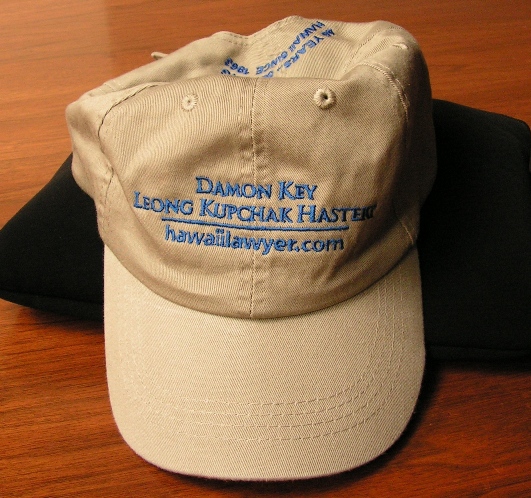 In the winter, everywhere else has “snow days.”
But Hawaii — obviously — has not.
We have “windy days.” Very windy days.
Today is one of those days.
Schools closed. Sporting events canceled. People evacuated. Even the state courts are shuttered.
But we’re here, and through whatever today’s weather may bring, we’re
2008 Land Use In Review: Ripeness Games In Regulatory Takings
In 2008, we continued to castigate the Williamson County ripeness rules, culminating in December when we filed an amicus brief urging the Supreme Court to take a harder look at how the “final determination” aspect of the rule is being applied. The rule has two parts.
First, the state-litigation rule requires a regulatory takings plaintiff
Latest Gambit In SCOTUS Ceded Lands Case
Here’s the latest in the “ceded lands” case, now being briefed in the U.S. Supreme Court.
The Honolulu Advertiser writes that “OHA looks for some backup,” and has drafted a bill, to be considered by the Hawaii Legislature in its upcoming session, that appears to codify the Hawaii Supreme Court decision in Office
Admin Note: hawaiilawyer.com Email Back Online
Thanks to everyonefor your patience while our tech people worked through our email issues. You can resume sending email to us at hawaiilawyer.com.
Owners’ Counsel Of America
 I’m honored to have been designated as the Hawaii member of the Owners’ Counsel of America. OCA is “a voluntary network of experienced eminent domain attorneys from every state of the nation, representing property owners facing condemnation or other infringement on their constitutional rights to own property, and dedicated to advancing the cause of
Upcoming: Hawaii Land Use Law Conference
 It’s not too late to register to attend the Hawaii Land Use Law Conference, taking place January 15 and 16, 2009, in Honolulu.
Items on the agenda include eminent domain, environmental law, transit-oriented development, subdivision requirements, and cultural impact statements. The program co-chairs are Professor David Callies and land use lawyer Ben Kudo.
This
New York Court Of Appeals To Hear Appeal Challenging Reason For Taking
Thanks to Professor Patty Salkin’s Law of the Land blog for letting us know that on January 14, 2009, the New York Court of Appeals (that state’s highest court) will be hearing oral arguments in Aspen Creek Estates, Ltd. v. Town of Brookhaven, a case challenging a municipality’s ability to take property. Professor Salkin
2008 Land Use In Review: The Ninth Circuit Rediscovers Substantive Due Process
In a development that began in November 2007 (2005 actually, if the starting point is seen as the U.S. Supreme Court’s decision in Lingle v. Chevron, U.S.A., Inc., 544 U.S 528 (2005)), the Ninth Circuit finally ditched Armendariz v. Penman,75 F.3d 1311 (9th Cir. 1996) (en banc), and recognized that property owners are