The view from the podium

That’s right. More than 300 of the nation’s best eminent domain lawyers, judges, appraisers, right-of-way agents, scholars, and other industry professionals are in Savannah for the next two and a half days for what is now known as the American Law Institute (“ALI” alone, no longer with the “-CLE” addition) Eminent Domain & Land Valuation Litigation Conference.

We’re now in our 43d edition and have a record attendance as the above photo, taken from the podium as we got underway, shows.

The view from the audience

If you are not here, you really should consider joining us. We’ll announce the location for the 2027 Conference tomorrow (hint: it will be in the west).

We’ll have more as the Conference progresses.

Continue Reading We’re Underway At The 43d American Law Institute Eminent Domain & Land Valuation Conference, Savannah

In an earlier post (“CAFED: Like We Said Before, “Inevitably Recurring” Flooding Is A Taking“), we covered the U.S. Court of Appeals for the Federal Circuit’s recent opinion in Alban v. United States, No. 23-1363 (Dec. 22, 2025), which held that the failure of the Corps of Engineers to properly operate two dams which resulted in upstream flooding when Hurricane Harvey struck was a “permanent” taking.

In this post, we’ll cover the latter part of the opinion, which dealt with the just compensation aspects of the case (each party appealed a portion of the Court of Federal Claims’s damage award).

The first claim was that the CFC’s award of compensation for damage to structures and personal property was not compensable. The Federal Circuit clarified that had the government merely taken a flowage easement, its claim to not be liable for such damage might have had some merit.

Continue Reading CAFED: Where The Government Chooses To Not Condemn But Allows It To Happen, It “Bears The Risk” That The Property Taken Is More Than The Government Wants To Pay For

A reminder: there’s still time to join us for the upcoming American Law Institute-CLE Eminent Domain & Land Valuation Litigation Conference in Savannah.

Now in its 43rd year, this flagship gathering remains the undisputed national hub for practitioners, academics, appraisers, and anyone else who lives and breathes property and eminent domain law. We will be at the JW Marriott Plant Riverside District in Savannah, where historic charm meets Southern hospitality, moss-draped oaks, riverfront vibes. If you can’t make it in person, live webcast option is available.

What makes this conference indispensable? It’s the place to reconnect and talk shop with the sharpest minds in eminent domain and property law. Whether you’re on the owner’s side, or serve as agency-side counsel, or an appraiser, the programming is customizable and multi-track: 30+ programs tackling everything from relocation benefits to regulatory takings, valuation, and courtroom techniques. With 40+ speakers from across the

Continue Reading There’s Still Time To Join Us In Savannah (Jan. 21 – 24, 2026) For ALI-CLE’s 43d Eminent Domain & Land Valuation Litigation Conference

We start off 2026 with some good news: after a short hiatus (explained in the episode), Bobby Debelak’s Eminent Domain Podcast is back with Episode 150: “Year in Review and ALI-CLE Preview.”

And we get to join him!

Here’s how Bobby describes the episode:

Bobby returns to the podcast after a brief hiatus due to the birth of a child. Robert Thomas returns to the show to talk about 2025 in review. The two cover twenty years of Kelo, an update on COVID takings, the year with a new presidential administration and legislative change, and a few key cases around the country. Robert looks ahead to the 2026 [ALI-CLE] conference in Savannah, GA. The cross exam is a musical themed head-to-head from the 80s.

Check it out. We have a bit of fun (esp. the “cross exam” portion).

Listen above, or download it here.

Continue Reading Welcome Back, Bobby: We Return To The Eminent Domain Podcast To Talk The Year That Was, ALI Savannah, And 80’s Music

It is time to bid farewell to the Year 2025, and our mind wanders back over the last 364 days in an attempt to ascribe meaning, a theme — a vibe — to the year that was.

Scientists tell us that this is just another trip around the Sun, but we humans like to assign meaning to a measure of time, so here’s our thoughts on what will stick with us about 2025.

Barista’s note: in the interest of objectivity, we shall exclude our shop’s cases such as this one: “Fla Ct App (en banc) In Takings Case: ”failing to vindicate a right expressly stated in the Constitution is not judicial restraint but judicial abnegation. That we must not do.'”

That said, here we go with what we think were the highlights of 2025 (lowlights are posted here in Part II).

Regulatory Takings Case of the Year:

Continue Reading Adieu To The Highs And Lows Of 2025 (Part I: The Highs)

Here’s the latest in a case we’ve been following. [Disclosure: this is one of ours, so we won’t be commenting much at all.]

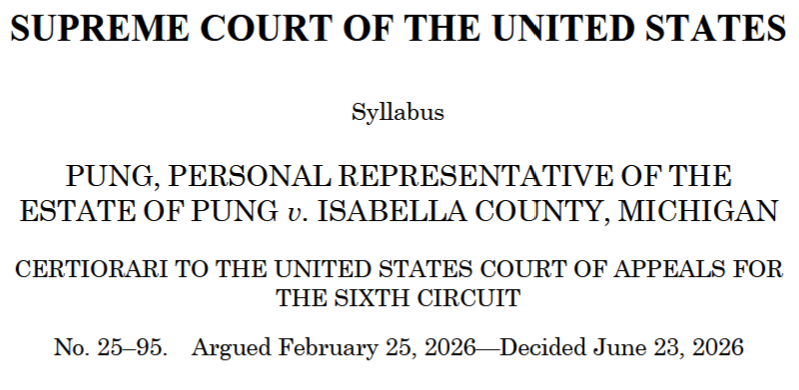
In Pung v. Isabella County, No. 25-95, the U.S. Supreme Court is considering these Questions Presented:

1. Whether taking and selling a home to satisfy a debt to the government, and keeping the surplus value as a windfall, violates the Takings Clause of the Fifth Amendment when the compensation is based on the artificially depressed auction sale price rather than the property’s fair market value?

2. Whether the forfeiture of real property worth far more than needed to satisfy a tax debt but sold for fraction of its real value constitutes an excessive fine under the Eighth Amendment, particularly when the debt was never actually owed?

(Here’s the cert petition.)

Today, the petitioner filed the merits brief, arguing that yes, “[w]hen

Continue Reading SCOTUS Merits Brief (Ours) In Just Comp/Excessive Fines Case

As we wrap up another year, it’s time to look ahead to the one event that always gets our eminent domain blood pumping: the annual ALI-CLE Eminent Domain and Land Valuation Litigation Conference. Details, including faculty list, a complete agenda, and registration information is posted here.

Now in its 43rd year, this flagship gathering remains the undisputed national hub for practitioners, academics, appraisers, and anyone else who lives and breathes property rights law. Mark your calendars for January 22-24, 2026, when we’ll convene at the JW Marriott Plant Riverside District in Savannah, Georgia. Think historic charm meets Southern hospitality, with moss-draped oaks, riverfront vibes, and enough ghost tours to inspire a dozen inverse condemnation hypotheticals. (For those of you who prefer pixels to palm trees, a live webcast option is available.)

What makes this conference indispensable? For starters, it’s the place to reconnect and talk shop with the

Continue Reading Savannah Bound: Don’t Miss The 43rd ALI-CLE Eminent Domain & Land Valuation Litigation Conference (Jan. 22-24, 2026)

In United States v. 191.07 Acres of Land (Martinek) (No. 04-35131, Apr. 4, 2007), the Ninth Circuit addressed two interesting issues in the context of a federal taking of unpatented gold- mining claims in Alaska’s Denali National Park.

The first is a question of appellate procedure: whether a party waives the right to appeal the denial of a demand for a jury trial by not seeking an immediate interlocutory appeal. 

The government instituted eminent domain proceedings against the landowner (which entitles the landowner to request a jury trial on the issue of just compensation), and the landowner filed a claim for inverse condemnation (which does not carry with it the right to jury trial).  The trial court held that the landowner had only a single claim for compensation, and the parties stipulated that the taking occurred on a date earlier than the government’s declaration of taking.  Consequently, the court held

Continue Reading ▪ Ninth Circuit on Jury Trials in Federal Eminent Domain and Inverse Condemnation Valuations

In United States v. 191.07 Acres of Land (Martinek)(No. 04-35131, Apr. 4, 2007), the Ninth Circuit set out a good definition of “inverse condemnation” in the context of when a property owner has a right to a jury trial for federal takings. 

    Where the [condemnor] does not acquire privately owned land statutorily but instead physically enters into possession or institutes regulations that restrict the land’s use, the owner has a right to bring an “inverse condemnation” action to recover the value of the land.  Kirby Forest [Inds., Inc. v. United States, 467 U.S. 1, 4-5 (1984)].  “Such as suit is ‘inverse’ because it is brought by the affected owner, not by the condemnor.  The owner’s right to bring such a suit derives from the self-executing character of the constitutional provision with respect to condemnation.”  Id. at 5 n.6

(slip op. at 3865).  In Martinek

Continue Reading ▪ What is “Inverse Condemnation?”