
You know the drill: DOT takes property and pays compensation for that as part of the project. But the project also resulted in elimination of what was the “shortest indirect access route” to the subject property from the public road, for which the DOT did not pay compensation. Question: is the owner who loses such access entitled to compensation?
In South Dakota v. Gustafson, No. 30723 (Feb. 18, 2026), the South Dakota Supreme Court held no, at least where the owner of the cut-off property does not already possess a special right to access.
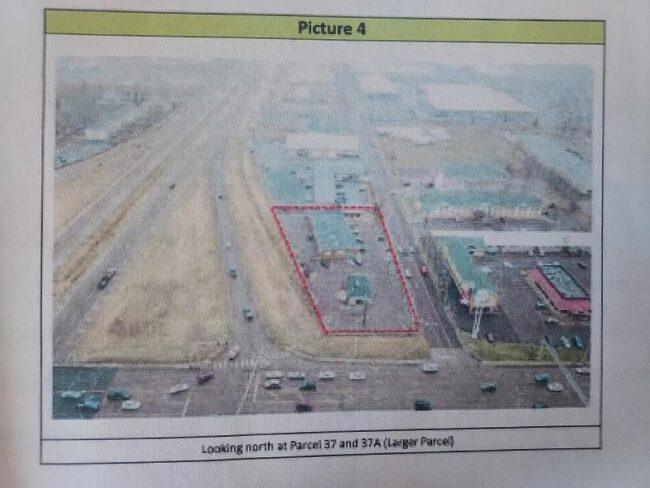
Here’s a photo from the opinion (we like opinions that include photos of the “subject property.”
Back in 1958 this area was rural, and as part of the I-29 project the prior owners of the property entered into an agreement with the State for a partial acquisition. The deed which came out of the agreement seemed to say that the owners had no access as a result of the acquisition. The deed noted “CONTROLLED ACCESS … No Access.”
Flash forward to 1982 when Gustafson purchased the property, and 2020 when the DOT condemned a portion. As noted above, the DOT acknowledged its obligation to pay for the land taken, but denied it was obligated the pay for the loss of access for its closure of the adjacent intersection which by then was a “busy corridor surrounded by many retail businesses and restaurants[.]” Slip op. at 3.
The Gustafson property was not rendered totally without access, but access was severely reduced and became very circuitous rather than direct. The trial court agreed that the owner possessed a “constitutionally protected special right of access” to their property from the intersection and thus its loss was compensable, and granted the owners summary judgment.
But the Supreme Court reversed, holding that the existing access to the Gustafson property isn’t protected by the constitution. Yes, access can be a property right, but “not all restrictions of access to property constitute a taking[.]” Slip op. at 12. The court held that the right of access to the public street is not “special” because way back in 1958, the Gustafson’s predecessors-in-interest “relinquished all of their special access rights … when they sold it to the State.” Slip op. at 13. The “No Access” provision in the deed was fatal to the claim:
The circuit court’s finding that the option agreement contained “no reference to taking control of access to the section line road that eventually became 41st Street” is clearly erroneous because the entire portion of the Eagans’ property that abutted 41st Street became part of the controlled access highway to which they expressly relinquished all rights of access.
Slip op. at 13 (footnote omitted).
The Supreme Court then addressed whether the Gustafsons could succeed to greater access than the predecessor owners did. The court rejected the argument that ion 1968, the State left the intersection open as a special benefit to the parcel as an offset to the special damages which the State would have owed to the owners for severing their parcel by a partial taking. Slip op. at 17. Not so, held the court, the prior owners simply “relinquished all rights to access between the controlled access highway, which included the 41st Street interchange, and their property.” Id.
South Dakota v. Gustafson, No. 30723 (S.D. Feb. 18, 2026)