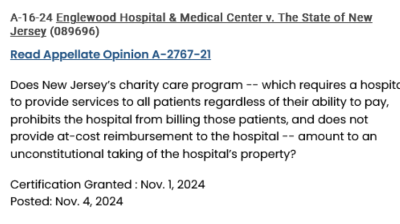
Because the latest takings cert petition is one of ours (our colleagues Dave Breemer and Deb La Fetra are counsel for the petitioner), we won’t be commenting all that much on it.

Except to say that this is the latest in a series of cases where the obligation to provide just compensation for takings butts

We were all set to write up a scintillating and detailed analysis of the New Jersey Appellate Division’s opinion in Englewood Hospital & Med. Center v. New Jersey, No. A-2767-21 (June 27, 2024), when we thought, ah, why not just ask you to read our New Jersey colleague Joe Grather’s scintillating and detailed analysis.

Short story is right there in the title of this post. As Joe puts it:

In short, the hospitals argued that requiring them to provide charity care and Medicaid care at a loss was an unconstitutional taking of private property without just compensation.  The trial court analyzed the claims as an “as-applied” challenge.  Therefore, it dismissed some of the claims because of a failure to exhaust administrative remedies.  The “slightly different reason” was that the Appellate Court found the claims were a facial challenge to the constitutionality of the statute, and therefore it analyzed the takings claims under the familiar rubric of whether there was a “direct government appropriation or physical invasion of private property,” or an “uncompensated regulatory interference with a property owner’s interest in their property.” Slip op. at 14.

No physical taking, no Penn Central taking. We recommend you read his entire post “As We Approach Our Nation’s Birthday, a New Jersey Appellate Court Rejects Hospitals’ Takings Claims.”

Joe ends it this way: “I bet the hospitals are preparing their petition for certification to the New Jersey Supreme Court now.  Happy 4th of July!”

That means to stay tuned for more.

Englewood Hospital & Med. Center v. New Jersey, No. A-2767-21 (N.J. App. Div. June 27, 2024)

Continue Reading New Jersey: Forcing Hospital To Provide Care At A Loss Isn’t A Taking

Alicle

Join us next week with ALI-CLE for “Property Rights and Regulatory Takings at the Supreme Court.” We’ve assembled legal experts including counsel in the Sheetz and DeVillier Supreme Court cases, and a dirt law legal scholar to discuss these important decisions and answer your questions (including “what’s next?”):

The 2023-24 Supreme Court term

IMG_20180719_154523
The famous corner of India and Milk, Boston
(at least for takings nerds)

Today, along with our friend and colleague Hawaii eminent domain lawyer Mark M. Murakami, we filed this Application for a Writ of Certiorari* in a condemnation case that has been pending for more than a decade (including more than five

Worth reading: a student-authored piece in the latest issue of the Harvard Journal of Law & Public Policy, “Original Understanding of ‘Background Principles’ in Cedar Point Nursery v. Hassid.

From the Introduction:

But in Cedar Point, when considering a regulation that authorized union organizers to enter certain businesses, the Court

Check this out, a local government has filed a cert petition seeking reversal of one of those relatively rare circumstances where the property owner won below on a temporary regulatory takings claim for the County’s denial of a development permit.

We won’t go into details on this, but urge you to read the petition, especially

We were all set to write up the Wisconsin Supreme Court’s recent opinion in Sojenhomer LLC v. Village of Egg Harbor, No. 2021AP1589 (June 19, 2024) — after all, we were already following the case — when Lawprof Ilya Somin beat us to the punch: “Wisconsin Supreme Court Rules Sidewalks are not “Pedestrian

2012-02-06_11-19-51_574 (Small)

Here’s the latest in a case (and issue) we’ve been following closely.

In Watson Memorial Spiritual Temple of Christ v. Korban, No. 24-0055 (June 28, 2024), the Louisiana Supreme Court unanimously affirmed the Court of Appeal, concluding the duty to actually pay just compensation for a taking is ministerial. 

That may

The line between negligence torts and inverse condemnation can be a fine one. In Roman Realty, LLC v. City of Morgantown, No. 220587 (June 11, 2024), the West Virginia Supreme Court came down on the tort side.

Now before we go on, a caution: technically speaking the claimant did not assert an inverse condemnation