
Land use law

Thank you to several of our readers for pointing out that SCOTUSblog has determined that Agripost, LLC v. Miami-Dade County, Florida, No. 08-567 (cert. petition filed Oct. 27, 2008) is a “petition to watch” for the Supreme Court’s March 27, 2009 conference.

The petition asks the Court to overrule Williamson County Regional Planning Comm’n v.
Instead of an in-person Spring Meeting this year, the ABA Section of State & Local Government Law will be “meeting” virtually from March 31-April 2, 2009.  As part of the meeting, the Section will be featuring a series of teleconference and live audio webcasts on a variety of subjects including topics near and dear to

Check out the interview with Nalo Farms owner (and Hawaii Farm Bureau Federation president) Dean Okimoto in this month’s Hawaii Business

here text

The state Constitution even, in article XI, section 3, expressly protects farming and ranching by commanding the State to “conserve and protectagricultural lands, promote diversified agriculture, increaseagricultural self-sufficiency and assure

Thank you to Kamuela attorney Margaret Wille for allowing us to post the commentary she published in West Hawaii Today (Mar. 7, 2009), but which is not available on line. Posting on inversecondemnation.com is not an endorsement of the views expressed or the conclusions reached, but we thought it was worthwhile to hear others’ voices on this important subject. Disclosure: we represent the property owners in the eminent domain cases instituted by the County, County of Hawaii v. C&J Coupe Family Ltd. P’ship which she discusses. Our thoughts on the topic are posted here.

Who Pays For Impacts: You Do
by Margaret Wille

Recently there have been several articles in West Hawaii Today about “fair share” versus “impact” fees.  Probably there are many readers who wonder why do these fees matter to me. In other words, does this issue affect the ordinary Big Island taxpayer?  Yes, very much so.  

These fees, regardless of name, are charged to developers to defray a portion of the cost to maintain the current level of service for one or more categories of public facilities impacted by the proposed development.

The first question to ask is whether you believe the developer who reaps the financial benefit of the new development should shoulder a portion of the financial cost to maintain the current level of service for affected public facilities that are off of the developed property, e.g. area roads or police and fire stations. Would you rather all of the resulting costs to maintain the current level of service of these affected public facilities be paid for by us existing taxpayers? By way of example, when Costco went in, who paid the 5.5 million in cost to upgrade the Queen K intersection, just to maintain the current level of service at that intersection (I believe the level of service of that intersection was level D if not worse.) We did, you, me, all of us existing taxpayers and businesses paid for the improvements needed just to continue at that same low level of service (and if bond money was used for a portion of either the County’s or the State’s cost, you could say we saddled our kids with some of this expense).  If the County had passed a development fee ordinance consistent with the State’s 1992 impact fee law, some of the County’s cost of those intersection improvements would instead have been paid by Costco’s owners.  

Continue Reading Impact Fees And “Fair Share” Guest Commentary: “Who Pays For Impacts: You Do”

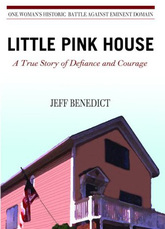
Lph Certain addresses — real and fictitious — are instantly recognizable: 1600 Pennsylvania Avenue NW, Washington, DC and 221B Baker Street, London for example.

8 East Street, New London, Connecticut, however, isn’t an address that most people recognize. 

is the former address of the “little pink house” which is the subject of Jeff Benedict’s Little

Some interesting items have crossed my desk on Friday and Saturday:

  • From the Grand Theft: Property blog, Jim Mattson posts his thoughts about Monks v. City of Rancho Palos Verdes, 67 Cal. App. 4th 263 (Cal. Ct. App. 2008), the case in which a California Court of Appeals held that a municipality’s development moratorium

At first, it was a bit odd to see Washington, D.C. attorney Kannon Shanmugam, counsel for the Office of Hawaiian Affairs in the “ceded lands” case immediately concede in oral argument that the U.S. Supreme Court should rule against OHA — and hold the Apology Resolution was simply a symbolic statement of regret —

5430464_big A recent book of interest to condemnation lawyers, Current Condemnation Law: Takings, Compensation & Benefits (2d ed.).

The book is co-edited by my Owner’s Counsel of America colleague Alan T. Ackerman. (He also has a blog about eminent domain issues.)

From the blurb:

Condemnation of property is an especially topical subject after the U.S.