Articles and publications

20141104_135324

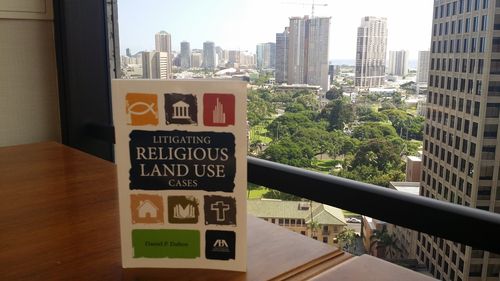
A big thank you to our friend and colleague from Detroit, Dan Dalton, who sent us a recently-published book which he authored, “Litigating Religious Land Use Cases.” 

This book discusses how to litigate such a religious land use case on behalf of a religious entity pursuant to the Religious Land Use and

Here’s our latest article, from the upcoming edition of The Practical Real Estate Lawyer, via ALI-CLE.

Despite its grand title, “A Full and Perfect Equivalent for Just Compensation: The Historical Context and Practice,” its just a short piece that asks whether just compensation is the next big thing, identifies three issues in

9780199322541_450After a couple of days detouring to election law, today we’re back to our usual programming.

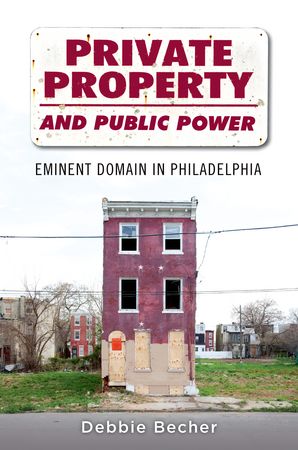
We caught wind of an upcoming book (September 2014), “Private Property and Public Power: Eminent Domain in Philadelphia,” by Barnard College Professor Deborah Becher. “Her book—the first comprehensive study of a city’s eminent domain acquisitions—explores how

Lgo

ALI-CLE, the good folks who put on the annual programs on Eminent Domain and Land Valuation, and Condemnation 101: How to Prepare and Present an Eminent Domain Case, have announced the dates and venue for the 2015 conferences:

Thursday – Saturday, February 5-7, 2015 

Hotel Nikko, in San Francisco.

Those

Worth reading: Gideon Kanner, Detroit and the Decline of Urban America, 2013 Mich. St. L. Rev. 1547 (2014), in the forthcoming issue of that august publication. Its not yet available on the law review’s web site, but Professor Kanner has written up a summary on his blog (he might even send you a

Back in October, we had the honor of moderating a discussion about the ripeness issue in takings law at the 40th Anniversary Symposium on The Takings Issue at Touro Law School (see here and here for more). Professor Vicki Been and Pacific Legal Foundation’s J. David Breemer were the panelists, each weighing in on how

Cover_42_3_ The Urban Lawyer, the law review produced by the ABA Section of State & Local Goverment Law has published an article which we wrote with our Damon Key colleagues Mark Murakami and Bethany AceRecent Developments in Eminent Domain: Public Use, 45 Urban Lawyer 809 (2013).

Here’s the Introduction to the article:

Cover_42_3_ The Urban Lawyer, the law review produced by the ABA Section of State & Local Goverment Law has published my article Recent Developments in Regulatory Takings, 45 Urban Lawyer 769 (2013).

Here’s the Introduction to the article:

THE SUPREME COURT’S 2012 TERM promised to be a banner year in regulatory takings law, with

Be sure to check out this interview with a person we’re proud to call a friend and a colleague, Gideon Kanner, in the most recent edition of Right of Way magazine, a publication of the International Right of Way Association.

A Fierce Advocate for Just Compensation” is a sitdown with Professor Kanner, and covers a lot of ground, so to speak. The entire piece is worth reading, but here’s what a colleague pointed out as perhaps the best part:

If you represent a property owner in an eminent domain case, particularly an inverse condemnation one, you must understand that your client is persona non grata or the law’s “poor relation,” as U.S. Supreme Court Chief Justice William Rehnquist once said. The California Supreme Court once stated in an opinion that it was its duty to keep condemnation awards down, which is a hell of a hurdle to overcome when your task is to persuade the Justices that your client was undercompensated by the court below. So in those not-so-good ol’ days of the 1960s, when I walked into court, I had my job cut out for me. Sometimes, the hostility emanating from the bench was palpable. As Alex Kozinski, Chief Judge of the U.S. Court of Appeals for the 9th Circuit once noted, what property owners in this field often get from the bench is “thinly-disguised contempt.” This is not a line of work for the faint of heart.

We agree.
Continue Reading Why We Fight: An Interview With Gideon Kanner, “A Fierce Advocate for Just Compensation”