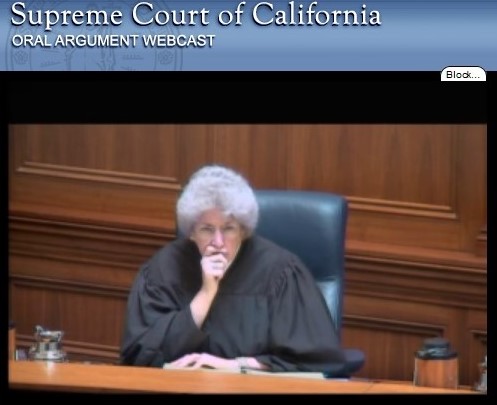
The dramatic moment of the day during last Thursday’s California Supreme Court oral arguments in City of Perris v. Stamper, No. S213468 (which we previewed here: “Cal Supreme Court Oral Argument Preview: In Just Comp Trial, Does Jury Determine Reasonable Probability Of Exaction?“), occurred during the rebuttal arguments by the city’s lawyer. The case
Just Compensation | Appraisal
Maine FOIA Doesn’t Make Parts Of DOT’s Appraisal Reports Confidential
A short one from the Maine Supreme Judicial Court. In Pinkham v. Dep’t of Transportation, No. 2016 ME 74 (May 19, 2016), the court held that portions of the DOT’s appraiser’s report which appraised other properties being taken as part of the same project were not confidential or privileged under the state’s public records laws. …
Cal Supreme Court Oral Argument Preview: In Just Comp Trial, Does Jury Determine Reasonable Probability Of Exaction?
Tomorrow morning, Thursday, May 26, 2016, starting at 9:00 a.m., the California Supreme Court will be hearing oral arguments in an eminent domain case that sits at the intersection of jury determinations of just compensation, and the Nollan/Dolan unconstitutional conditions issue.
Here is the link to the argument live stream.
The court…
CFC Awards Just Comp In Katrina Flooding Case And Tees Up The Appeal
About this time last year, the Court of Federal Claims held that the federal government was liable for a temporary taking to certain property owners for the flooding caused by Hurricane Katrina and the Corps of Engineers’ failure to maintain the “MR-GO” (Mississippi River-Gulf Outlet) canal system. See also a guest post by…
So Sue Me: Remedy For Condemnor Taking More Than It Is Condemning Is Inverse Condemnation
In Ransom v. Village of Cross Plains, No. 2015AP1556 (Apr. 28, 2016), the Village took a part of Ransom’s property, 703 square feet to be precise. The parties actually agreed on the amount of just compensation for the 703 square feet. But Ransom asserted that the Village also took a temporary easement after the…
6th Cir: Going To War With The Army You Have Isn’t Good Enough To Get To The Jury
A quick one from the U.S. Court of Appeals for the Sixth Circuit, in a federal condemnation, United States ex rel TVA v. 1.73 Acres of Land, No. 15-5530 (May 5, 2016).
The Tennessee Valley Authority condemned an easement on a strip of Mr. Thomas’ undeveloped land (zoned for agricultural/residential uses) for utility lines.
Cal Supreme Court Post-Argument Analysis: Does The Entry Statute Provide The Same Protections As Eminent Domain?
California Associate Justice Goodwin Liu — often mentioned on short lists of potential future nominees to the U.S. Supreme Court even after the Republican-led Senate stymied his nomination by President Obama to the Ninth Circuit — just saw his chances for a promotion go up today, if ever so slightly. No, we’re not talking about…
Virginia: Taking By Eminent Domain Is “Purchasing” Property. Why? Because We Said So.
Is the forced acquisition of property by the government’s power of eminent domain a “purchase?” To the Virginia Supreme Court, the answer to that question is yes. Why, we’re not really sure, because the court doesn’t tell us why.
In City of Chesapeake v. Dominion SecurityPlus Self Storage, LLC, No. 150328 (Apr. 29, 2016)…
$133,500,000 CFC Verdict For A Categorical Lucas Taking
We’re tied up today, so can’t write much, but wanted to post this recent decision from the Court of Federal Claims. Here’s the court’s own summary:
Plaintiffs Love Terminal Partners, L.P. (“Love Terminal Partners”) and Virginia Aerospace, LLC (“Virginia Aerospace”) are leaseholders of property at Dallas Love Field Airport (“Love Field”), located in Dallas, Texas.
Hawaii Court Of Appeals Draws A Bright Line In Eminent Domain: In Larger Parcel Analysis, Unity Of Contiguity Means Parcels Must Touch
A longer post to start the week because it involves an eminent domain case, a somewhat rare occurrence from the Hawaii appellate courts. The issues determined by the Hawaii Intermediate Court of Appeals are important, and because we have an old eminent domain code and don’t have a whole lot of current decisional law applying it —…