
Is the forced acquisition of property by the government’s power of eminent domain a “purchase?” To the Virginia Supreme Court, the answer to that question is yes. Why, we’re not really sure, because the court doesn’t tell us why.
In City of Chesapeake v. Dominion SecurityPlus Self Storage, LLC, No. 150328 (Apr. 29, 2016), the court held that the use of the word in a subdivision plat in which the owner agreed that it “reserve for future purchase by the City” a part of its property with no compensation for any improvements on that land, meant that the owner also agreed to let the city condemn the land without paying for the improvements.
This case involved a highway widening and elevation project in southern Virginia. The current owner of the property, which operates a self-storage facility on the parcel, purchased it from the prior owners who had subdivided it so it could be used as a storage facility. After initially rejecting the prior owner’s subdivision application, the city eventually conditioned its approval of a variance on the owner’s agreeing to the reservation of a right of way in the frontage of the property for the future highway project. The variance included this language:
The owner and/or their heirs, assigns, lessee, grantees or successors in interest agrees to reserve for future purchase by the City the area hereby designated on the plat and shall convey same to the City by deed containing general warranty and English Covenants [of] Title. The purchase value of said area is to be based on the fair market value as of the date the City exercises its right to purchase the area designated as reserved with no compensation for any improvements placed within the area. The owners agree that it shall not make or have any claims for damage to the said improvements or damages to the residue [of] the owners’ property by reason of the said purchase.
Slip op. at 2. The storage operator purchased the land subject to these requirements.
Flash forward, and after attempts to “purchase the property and easements from Dominion failed,” the city condemned. The highway project not only added two lanes, it elevated the roadway “more than 30 feet above Dominion’s property.” The project needed to take land and easements from Dominion within the frontage area covered by the variance, even though the expanded roadway was outside of this area:
No part of the widened Dominion Boulevard included property taken from Dominion as part of the condemnation, as the City already owned the right of way needed for the widened highway. Because of the raised elevation of the roadway, Dominion’s storage facility is no longer visible from Dominion Boulevard. In addition, Dominion no longer has direct access to Dominion Boulevard. Instead, access to Dominion’s self-storage facility is now achieved by way of an access road reached by exiting Dominion Boulevard.
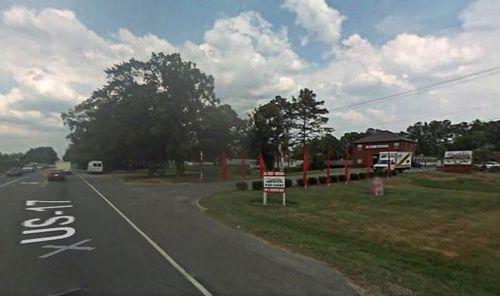
Slip op. at 3 (footnote omitted). The photo above from 2008 shows the “before” condition. Compare that with the “after” condition (more accurately, “during” condition) which shows the elevated highway construction.
Dominion objected to the variance condition as an unlawful exaction, and sought compensation for the loss of access and visibility (severance damages). The court awarded, and the city appealed.
The Virginia Supreme Court first addressed whether the exaction language regarding “purchase” by the city included a taking of the property by eminent domain. If it did, then Dominion wasn’t entitled to compensation for any damage to the rest of the property due to improvements in the frontage because its predecessor in title had surrendered that right in the variance. Concluding that the variance was a binding contract, the court rejected Dominion’s argument that the language only included damages foreseeable at the time the city issued the variance. Even though the court didn’t challenge Dominion’s argument that at that time, the project could not have been envisioned to be so grandiose, the court held that it didn’t matter because there’s no such limitation in the variance itself, which has very broad terms: “The owners agree that it shall not make or have any claims for damage to the said improvements or damages to the residue [of] the owners’ property by reason of the said purchase.” Any claims is very broad.
The court also rejected the argument that acquisition by eminent domain was not a “purchase.”
The City did offer to purchase the property. That offer was refused by Dominion. Therefore, the City proceeded to acquire the property through condemnation. In light of the fact that the City’s attempts to purchase the property were rebuffed by Dominion, we conclude that Note 7 was applicable to the City’s acquisition of the property within the reserved area by means of eminent domain.
Slip op. at 8. The court chided Dominion for “cit[ing] no authority in support of its argument,” even though the court’s opinion suffers from the very same defect. So we really don’t know why the court concluded that eminent domain is a “purchase,” other than the city tried to purchase it (a good faith attempt to purchase is a requirement under Virginia law), and, well, because the court said so. One may reasonably wonder whether the terms “purchase” and “condemnation” were meant to be interchangeable as the court concluded, since in the bona fide purchase statute, the legislature sure seemed to have treated them as separate events:
A condemnor shall not institute proceedings to condemn property until a bona fide but ineffectual effort to purchase from the owner the property sought to be condemned has been made.
Because this resolved the remaining issue (is loss of visibility compensable), the court didn’t address it. Judgment reversed, and entered in favor of the city.
City of Chesapeake v. Dominion SecurityPlus Self Storage, LLC, No. 150328 (Va. Apr. 28, 2016)