November 2019

Check this out: the Complaint, filed a couple of days ago in federal court against the State of New York (and others), that alleges the state’s recently-adopted rent control regulations is a taking (among other claims). 

It’s a long complaint so we shall leave it to you to delve into the details yourselves. Most
Untitled Diagram-Page-1(1)

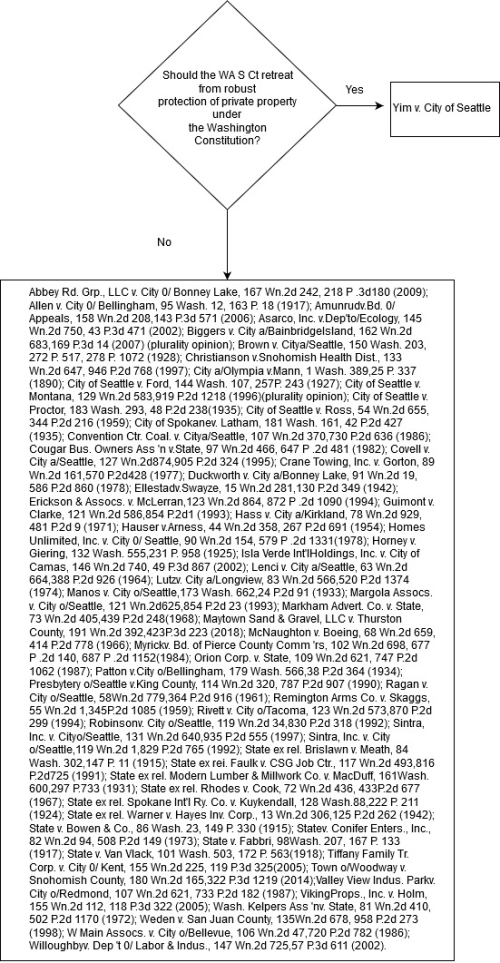
We add a flowchart to this post because the Washington Supreme Court on page 15 of its opinion in Yim v. City of Seattle, No. 95813 (Wash. Nov. 14, 2019) (em banc) (Yim I), includes a flowchart that purports to solve the regulatory takings puzzle once and for all.

Really.

You should

All seemed to be going well for the property owners in a Florida takings case. They obtained a satisfactory compensation judgment for the taking of their healthy citrus trees (yes, this is that case). And because Florida’s Constitution requires “full” compensation, they were also entitled to attorneys’ fees and costs. $13 million in compensation

IMG_20170726_181554

You may recall that last October, we attended the first round of Supreme Court oral arguments in the Knick case with our William and Mary law class (Law 608: Eminent Domain and Property Rights).  

And even though there’s not a takings case on the Court’s current docket, we figured that the Maui Clean

Yesterday’s Supreme Court arguments in what is known as the “DACA case” would normally not be something we’d cover on this blog. Yeah, the issue of whether the executive branch has the power to unwind (or, as the cert petition puts it to “wind down”) a prior administration’s executive actions is interesting and

Check this out. The Complaint that we’ve been meaning to post for a while, filed last month in a Los Angeles U.S. District Court, alleging that California’s new rent control laws are a taking, among other things.

Are rent control laws takings? Yes, pretty sure about that. But will courts conclude that they are takings?

Here’s the OA video (courtesy of the Michigan Supreme Court) from last week’s arguments in what we’re calling the “keep the change” case. 

That’s the one where the government is arguing that after a property owner was late paying $8.00 in property taxes, the government is not only entitled to foreclose on the property, but

Check out this story by JD Morris (“PG&E renews push to avoid strict liability for 2017, 2018 fires“) in the San Francisco Chronicle, about the recent (and ongoing) California wildfires, and the issue of what has been called the “unusual,” “unique,” and “so-called” doctrine of inverse condemnation in that state’s courts.

Here’s the cert petition in a case we’ve been following since it was decided in the property owner’s favor by the Colorado Court of Appeals.

In Carousel Farms Metro. Dist. v. Woodcrest Homes, Inc., 444 P.3d 802 (Colo. App. 2017), the court invalidated an attempt to exercise eminent domain to take property which

IMG_20191106_112246

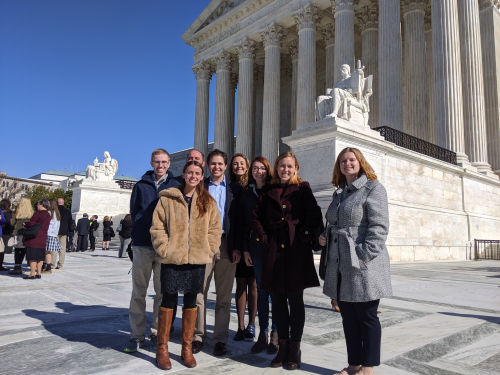
Protip for the public line for SCOTUS arguments: you have to get there really early. As in really early. Before 5 am early. Because that’s the time that we, along with some of our William and Mary Law students (pictured above, after the arguments), arrived at 1 First Street NE to take up our place