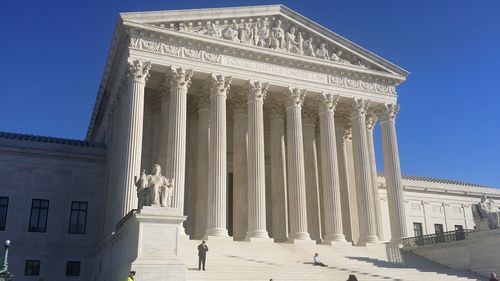
Today, the Honolulu Star-Advertiser published an op-ed by me, Col. David Brostrom (U.S. Army, retired), Rep. Mark Takai, who represents Hawaii’s First Congressional District in the U.S. House of Representatives, and Andrew Walden, editor and publisher of Hawaii Free Press, about the case, argued this morning in the U.S. Supreme Court about who
Appellate law
Lessons From Takings Law For The “One-Person, One-Vote” SCOTUS Cases
Who gets counted for reapportionment purposes?
Everyone!
Tomorrow, the Supreme Court is hearing oral arguments in two election law cases, Evenwel v. Abbott, No. 14-940, and Harris v. Arizona Ind. Redistricting Comm’n, No. 14-232. We’ve covered the issues presented by these cases several times, so please forgive the continuing detour from takings law…
The View Of The Nai Aupuni Election From Washington, D.C.
Hawaii is either 5 or 6 hours behind Eastern Time, depending on the time of year (we don’t adhere to Daylight Savings Time), so we’re a quarter-day behind the part of the country where a lot — if not most — of the important things legal, financial, and political occur. Scheduling conference calls can…
Carts Before Horses, And Pearls Before Swine: The Hawaii Supreme Court’s Fractured Rationale For Invalidating The TMT Permit
Space. The final frontier. These are the voyages of the telescope Thirty Meter. Its five year continuing mission: to explore strange new worlds. To seek out a Conservation District Use Permit from the Board of Land and Natural Resources, and navigate the treacherous waters of Hawaii administrative law. To boldly go where twelve other …
Justice Kennedy Temporarily Halts “Hawaiians Only” Election
The latest news in a fast-moving election law case, about the validity of a Hawaiians-only election to choose delegates to a constitutional convention about the issue of Hawaiian national sovereignty: this morning, Associate Justice Anthony Kennedy issued this order which temporarily puts a stop to the counting of the ballots. An extraordinary move, but one …
Court Of Appeal Files Pro-Condemnor Amicus Brief In Cal Supreme Court “Entry Statute” Case
The headline of this post is clickbait, of course, since the California Court of Appeal didn’t formally file an amicus brief in favor of the government in Property Reserve, Inc. v. Dep’t of Water Resources, No. S217738, a case now pending in the California Supreme Court. But the court’s opinion in Young’s Market Co. …
Ga App: Property Owner Entitled To Temporary Takings Damages In Addition To Attorneys’ Fees When Condemnor Drops Case
A quick one from the Georgia Court of Appeals. In Fincher Road Investments, LLLP v. City of Canton, No. A15A1290 (Nov. 13, 2015), the court held that a condemnee was entitled to recover attorneys’ fees and costs when the condemnor abandoned a taking, and was entitled to recover just compensation for the temporary cloud…
New SCOTUS Amicus Brief: There’s No IOU’s In Eminent Domain – Quick-Take Deposit Belongs To The Property Owner
Here’s the amicus brief we filed today on behalf of our Owners’ Counsel of America colleagues in Livingston v. Frank, No. 15-470 (cert. petition filed Oct. 9, 2015). That’s the case in which the Florida District Court of Appeal held that the interest generated by quick-take deposits is not the private property of…
New Cert Petition: Interest Earned On Quick-Take Deposit Is Property, Gov’t Can’t Keep 90%
We all know the old rule that “interest follows principal,” which means that when a deposit on account is private property, so is the interest which that deposit earns.
Not according to the Florida Court of Appeals, however. In a 2014 decision, that court held that interest earned on quick-take deposits was not…
Amici Brief In SCOTUS Affordable Housing Case: Prohibiting Homebuilders From Selling At Fair Market Value For 55 Years Is A Taking
Here’s the amici brief we filed today in California Building Industry Ass’n v. City of San Jose, No. 15-330 (Oct. 16, 2015).
That’s the case in which the California Supreme Court upheld the city’s “affordable housing” requirement against a challenge which asserted that it was an exaction and thus should have been subject to …