
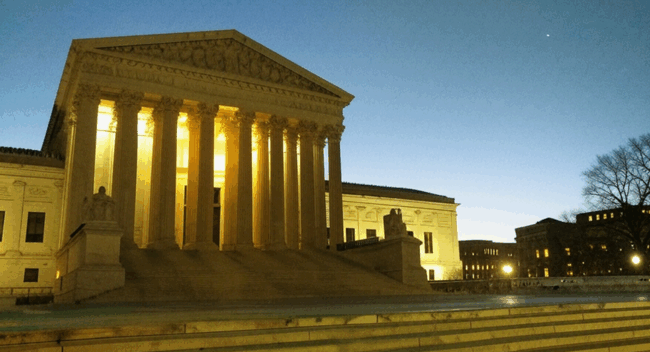
Here’s the latest in a case we’ve been following. [Disclosure: this is one of ours, so we won’t be commenting much at all.]

In Pung v. Isabella County, No. 25-95, the U.S. Supreme Court is considering these Questions Presented:

1. Whether taking and selling a home to satisfy a debt to the government, and keeping the surplus value as a windfall, violates the Takings Clause of the Fifth Amendment when the compensation is based on the artificially depressed auction sale price rather than the property’s fair market value?

2. Whether the forfeiture of real property worth far more than needed to satisfy a tax debt but sold for fraction of its real value constitutes an excessive fine under the Eighth Amendment, particularly when the debt was never actually owed?

(Here’s the cert petition.)

Today, the petitioner filed the merits brief, arguing that yes, “[w]hen

Continue Reading SCOTUS Merits Brief (Ours) In Just Comp/Excessive Fines Case

This just in: in this Order, the U.S. Supreme Court has granted certiorari and agreed to review two cases which involve property and property rights.

First, in Pung v. Isabella County, No. 25-95, the Court will be considering these Questions Presented:

1. Whether taking and selling a home to satisfy a debt to the government, and keeping the surplus value as a windfall, violates the Takings Clause of the Fifth Amendment when the compensation is based on the artificially depressed auction sale price rather than the property’s fair market value?

2. Whether the forfeiture of real property worth far more than needed to satisfy a tax debt but sold for fraction of its real value constitutes an excessive fine under the Eighth Amendment, particularly when the debt was never actually owed?

Here’s the cert petition in Pung. Note that the Court agreed to review the Excessive Fine

Continue Reading SCOTUS Grants Two Property Rights Petitions

We have no idea what these cases might be about, or whether there is any substance behind the property owners’ objections, but these are headlines no condemnor could possibly like:

  • Bedford County Widow Sued (via wjactv.com) – “A Bedford County widow is being sued for trying to keep Columbia Gas Transmission off her property. The Texas-based company is using eminent domain to gain access to 67-year-old Mary Ellen McConnell’s 125-acre farm.”
  • Granny Vows To Fight For House (via wyff4.com) – “On the other side of Stenhouse Rd, 85-year-old Juanita Sullivan worries about eminent domain.”

Might as well say they’re trying to take property from cute, fluffy kittens.


Continue Reading Headlines No Condemnor Likes To See

Here at inversecondemnation.com we also cover eminent domain, regulatory takings, land use, and environmental issues. We even cover election law when it strikes our fancy.

But here’s one that’s in our core competency: in Frick v. City of Salina, No. 101,355 (July 9, 2010) the Kansas Supreme Court held that property owner-plaintiffs did not meet their summary judgment burden of opposing the city’s motion, and affirmed a judgment that the city did not inversely condemn their property by denying them the ability to construct driveways to access their land.

After the city condemned their property, the Fricks moved their businesses to another nearby site. The move, according to the Fricks, “was thwarted by the ‘inappropriate regulatory’ action of the City. Slip op. at 8. The regulatory actions complained of included:

(1) denial of reasonable access to the relocation site during the Project; (2) construction activities

Continue Reading Kansas: Inverse Condemnation Case Resolved By Summary Judgment Burdens

In United States v. 191.07 Acres of Land (Martinek)(No. 04-35131, Apr. 4, 2007), the Ninth Circuit set out a good definition of “inverse condemnation” in the context of when a property owner has a right to a jury trial for federal takings. 

    Where the [condemnor] does not acquire privately owned land statutorily but instead physically enters into possession or institutes regulations that restrict the land’s use, the owner has a right to bring an “inverse condemnation” action to recover the value of the land.  Kirby Forest [Inds., Inc. v. United States, 467 U.S. 1, 4-5 (1984)].  “Such as suit is ‘inverse’ because it is brought by the affected owner, not by the condemnor.  The owner’s right to bring such a suit derives from the self-executing character of the constitutional provision with respect to condemnation.”  Id. at 5 n.6

(slip op. at 3865).  In Martinek

Continue Reading ▪ What is “Inverse Condemnation?”