
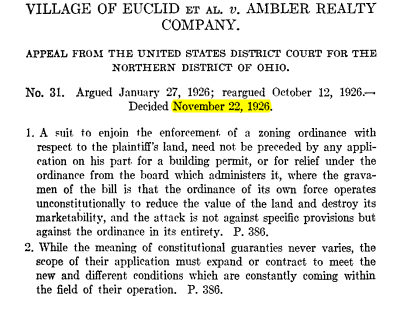
Today, November 22, 2026 is the 100th anniversary of the day in 1926 when the United States Supreme Court issued its landmark opinion in Village of Euclid v. Ambler Realty Co., 272 U.S. 365 (Nov. 22, 1926).
You know this one (and can you call yourself a dirt lawyer if you don’t?). It’s the one in which the Supreme Court first upheld — against a facial due process challenge — the validity of this thing we now call “Euclidean zoning.”
In the intervening century, “zoning” has become a catch-all term for all sorts of regulatory restrictions on the uses of real property, land users know that zoning — ackshually — refers only to regulations and restrictions regarding uses, density, and height. At least that’s how it began. The Euclid court concluded this was mostly preemptive nuisance prevention, so no worries. But we’d bet that what passes for zoning today would make the 1926 Village of Euclid’s planning department wide-eyed it its scope: asethetics, historic preservation, and design, for example.
Maybe it shouldn’t be surprising that in 100 years, “mission creep” set in, and what started off as the Court okaying a particular expression of police power generally, to a virtual “hands off” approach by the judiciary that any restriction with a conceivable relation to the public welfare is just fine.
While “Euclid” and “Euclidean zoning” have become part of the land use lexicon and landscape, the decision might have been seen as somewhat surprising at the time. After all, the Supreme Court was in the height of the so-called Lochner era, when it might have been expected to get the legal vapors over these type of restrictions on economic liberty and property. In an era when the Court was more aggressively policing the police power, for it to uphold, even generally, the validity of zoning restrictions might not have been expected.
And perhaps more surprisingly, the opinion was authored by none other than Justice George Sutherland, one of the notorious Four Horsemen who would later regularly vote to invalidate similar New Deal legislation.

Justice Sutherland is not amused (although he did author Nectow)
But Sutherland and the Court went the other way on this “zoning” thing, applying what later became known as the rational basis standard of review. Fairly debatable? No sweat. Who are we, mere judges, to say otherwise?
What accounts for that? Some have noted that the “Bettman Brief,” a late-filed amicus (submitted after oral argument) on behalf of the National Conference on City Planning and others, held sway. The dots are not that difficult to connect — much of the language and imagery in the Euclid opinion such as the “parasitic” nature of (horrors!) apartments which characterized mult-family dwellings in language used for public health vectors — comes straight out of the Bettman brief. As did the zoning-is-merely-the-codification-of-nuisance-law vibe. And it also isn’t that hard to connect the dots between a facially-neutral tool of exclusion like zoning, and the Supreme Court’s then-recent rejection of express racial discrimination in local land use regulations (we’re talking Buchanan v. Warley, 245 U.S. 60 (1917)).
But despite those roots, with a few hiccups along the way — a mere four year later, pretty much the very same Court held in Nectow v. City of Cambridge, 277 U.S. 183 (1928) that, as applied to a specific parcel, Euclidean zoning was arbitrary and capricious and violated a property owner’s rights, with the very same Justice Sutherland authoring the opinion — zoning has been widely accepted around the nation (except, most notoriously, in Houston, which has opted for a more ad hoc, less comprehensive plan-based form of use regulation), with the courts doing little to stand in the way.
These days, however, there’s a renewed focus on Euclid and zoning’s troublesome roots, and a renewed questioning of the decision’s assumptions. But even as we reckon with that history and spinoff effects, zoning chugs merrily along towards the century mark.
Let’s see what the next year might bring. In the meantime, we’re going to recognize Euclid‘s birthday. Whether it is a happy one is subject to change.
Others have offered thoughts on Euclid‘s centenary:
Sara Bronin, How Zoning Determines Who Lives Where, The Regulatory Review (Nov. 22, 2026) (“Bronin argues that states should take a stronger role in overseeing local zoning decisions. She proposes that state legislatures set expiration dates for local zoning codes to require localities to ensure codes serve current constituents’ needs and emphasizes the importance of careful, thoughtful law and policy design.”).
Anastasia Boden, When the Supreme Court blessed zoning, SCOTUSblog (Oct. 26, 2026) (“Bettman’s theory differed from Metzenbaum’s in important ways. The village’s lawyer argued for an expanding understanding of the state’s police power that would allow the government not just to regulate for public health and safety, but to promote the general welfare. Bettman, by contrast, argued that zoning was just like other nuisance laws, except it allowed localities to prevent nuisances from occurring in advance. Bettman’s theory threatened to say the quiet part out loud: certain defenders of zoning considered some people, rather than their property, a nuisance.”).
Joseph Lawler, Zoning Alone, New Atlantis (Fall 2026) (“But after a century, that may change. A group of free-market legal activists sees an opportunity to undo or hollow out Euclid, as they believe the Supreme Court is now supportive of property rights. Robert Thomas, the director of property rights litigation at the Pacific Legal Foundation, told me that the Supreme Court is in as favorable a position for reconsidering these arguments as it’s been “since roughly Euclid or maybe [the] New Deal era.” The problem, from the pro–property rights perspective, is that the regime created by Euclid and subsequent court cases essentially gave planners a new kind of power to impose arbitrary restrictions on the use of property. The use of that new authority came with vast negative unintended consequences. In addition to creating a crisis of housing cost, it has also led to the proliferation of sprawl and lonely neighborhoods.”).
Aaron Lubeck, Revisiting Euclid v. Ambler at 100, Southern Urbanism (July 7, 2026) (“Within a few short years, copy-paste boilerplate zoning was ubiquitous across the country. The Euclid precedent underwrote not only a routinization of single-family development but also the sweeping powers exercised by figures such as Robert Moses, whose urban-renewal and highway-planning projects remade New York by clearing “blighted” areas, generally poor and minority neighborhoods. Euclid continues to underwrite contemporary NIMBYism, in which organized homeowners and allied politicians invoke “neighborhood character”, “traffic”, “schools”, or environmental capacity to block multifamily housing, accessory units, and modest urban infill.”).

Euclid is literally a landmark decision.
So stay tuned. Next week, we’re moderating another event in our year-long series, focusing on what may be next: “Building the Next Century: Zoning, Freedom, and the American Dream” (Dec. 1, 2026, 3:00-4:00 p.m., ET) (free webinar, register here). Details:
This past summer, in The Cases That Zoned America, Pacific Legal Foundation explored two landmark Supreme Court decisions—Village of Euclid v. Ambler Realty Co. and Nectow v. City of Cambridge—that have shaped the layout of American cities over the past century.
On Tuesday, December 1, we’re shifting our focus to the next 100 years of zoning in America.
PLF Director of Property Rights Litigation Robert Thomas will moderate a virtual panel of leading academics and policy experts as they discuss how to reform zoning in America. They will explore how modern zoning has grown far beyond the limited rules established by those early cases and offer solutions to America’s housing crisis. Join us to learn more about how a brighter future for housing in America begins with zoning reform today.
Hope you can join us.
(Un?)happy Birthday, Euclid. You don’t look a day over 99.