
June 2023

In Livingood v. City of Des Moines, No. 22-0586 (June 9, 2023), the Iowa Supreme Court held that the city’s use of the Iowa’s process by which the government can satisfy all or part of a taxpayer’s debt to a public agency by grabbing someone’s tax refund. In a nutshell, after trying to collect the debt by more conventional means:

the income offset program allows the department of administrative services to collect debts for public agencies by offsetting the debts against any income tax refund owed to a taxpayer. The city entered into a memorandum of understanding with the department of administrative services to use the income offset program.

Slip op. at 4-5.

The debt owed in Livingood is for traffic violations caught on camera.

Is it a taking under the Iowa Constitution to not give the taxpayer/cam-violator the full amount of tax refund?

No. First, the court held

Continue Reading Iowa: City Of The Monks Keeping Part Of Your Tax Refund Isn’t A Taking, Red-Light Runners

Rindge

Continuing in our line of posts noting milestones in dirt law, we bring you Rindge Co. v. County of Los Angeles, 262 U.S. 700 (1923), decided 100 years ago today.

For any of you who have driven the Pacific Coast Highway through Malibu, you will know the site of this eminent domain case. As described by the Supreme Court in its opinion:

The plaintiffs in error are the owners of a large tract of land lying on the shore of the Pacific Ocean, known as the Malibu Ranch, extending in an easterly and westerly direction about twenty-two miles and varying in width from one-half mile to one and one-half miles. It lies at the base of a high and rugged mountain range which parallels the shore at a distance of from three to four miles, its northern line extending along the slope and foothills of this mountain

Continue Reading Has Not Aged Well – SCOTUS, June 11, 1923: “The necessity for appropriating private property for public use is not a judicial question.”
Screenshot 2023-06-07 at 07-14-12 Google Maps

Here’s the latest from the U.S. Court of Appeals for the First Circuit on takings ripeness, Haney v. Town of Mashpee, No. 22-1446 (June 6, 2023). 

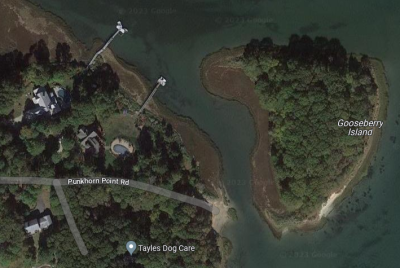
The case centers on Gooseberry Island, Massachusetts, which is zoned by the Town of Mashpee as R-3. But under the Town’s zoning code, any residence must have at least 150 feet of frontage and a paved access roadway within 150 feet.

Which is problematic because Gooseberry Island is, well, an island — separated from the mainland by a 40 to 80 foot channel depending on the tides. There’s no bridge, although you can wade across the channel at low tide. No bridge means no roads, and no roads means no residential development.

So the owner sought variances from the frontage and roadway requirements in 2013. Denied. The road and frontage requirements are about emergency access. Next, the owner sought approvals to build a

Continue Reading CA1: Despite Two Variance Denials, Takings Case Not Ripe Because It Isn’t Futile To Try Again
Here’s the latest in a case we’ve been following, one of the multiple challenges to New York’s latest ratcheting up of rent control.

We think the Questions Presented spell out the issues pretty well:

New York has implemented the most sweeping and onerous rent control provisions the United States has ever seen in its Rent Stabilization Laws and accompanying regulations (“the RSL”). As recently amended, the RSL makes New York’s once “temporary” rent stabilization regime permanent for over one million apartments. Petitioners are owners of apartment buildings regulated by the RSL. The RSL expropriates a definitional feature of Petitioners’ real property—the right to exclude—by granting their tenants a perpetual right to renew their leases. The RSL closes off all viable exit options for Petitioners to change the use of their property and thus avoid RSL regulation. These provisions, when combined with the RSL’s ceiling on the rents that landlords

Continue Reading Another Cert Petition Challenging NY’s Draconian Rent Control As A Taking

Hill went down to the fishing hole on a Colorado river, the one he claimed was his favorite. Until those darned landowners “chased him off the property, sometimes with force.” He claimed they didn’t take too kindly to his efforts to go fishing on their land: “Specifically, Hill alleges that they threatened to have him arrested for trespass, thew baseball-sized rocks at him, and shot a gun at his fishing buddy.”

Hill sued, asserting that the landowners don’t actually own the riverbed, and thus he had a legal right to be there. His complaint asserted two claims: (1) he sought a declaratory judgment that the riverbed is public land, owned by the State of Colorado (Equal Footing Doctrine and public trust alert!), and (2) he sought to quiet title, apparently in the State. 

In State v. Hill, No. 22SC119 (June 5, 2023), the Colorado Supreme Court sent the case

Continue Reading Colorado: Only The State Can Assert The Public Owns A Riverbed

History of ED Event

Mark your calendars to join us on Wednesday, June 7, 2023 at 5pm Eastern Time, as the Eminent & Right of Way Club welcomes Professor Greg Jackson, host of the History That Doesn’t Suck Podcast.

We’re going to have a discussion about the history of eminent domain, what zoning looked like in the 19th Century, and if the Founders planned for the infrastructure we have today.

RSVP for this Lounge Event on the App (register for the (free) Clubhouse App here).

What’s this “Clubhouse” thing, you ask? More here on that. Come, join us!Continue Reading Upcoming Event: “The History [That Doesn’t Suck] of Eminent Domain” (Wed, June 7, 5pm ET – Free!)

A new cert petition to check out. We don’t need to explain it much, because the petition does a good job of it.

Here’s the Question Presented:

New York State redevelopment agency seized, via eminent domain, a large tract of real estate occupied by an existing building in downtown Brooklyn for redevelopment. The building, partially used for office space, included a useable basement of over 13,000 square feet, which had a government-issued certificate of occupancy. During eminent domain proceedings, the lower court ignored the certificate of occupancy’s determination of a usable basement as a valued property interest.

The question presented is:

1. Are government-issued attributes of private property (e.g., certificates of occupancy, building permits, business permits) entitled to constitutional protection under the Fifth Amendment when they are seized under the government’s eminent domain power, just as they are presently entitled to constitutional due process protection under the Fourteenth Amendment?

Follow

Continue Reading New Just Comp Cert Petition: Is Due Process Property Just Compensation Property?

Screenshot 2023-06-02 at 10-47-03 Sackett v. EPA and the Future of the Clean Water Act ALI CLE

Want to find out what the experts — including arguing counsel for the property owners, our law firm colleague Damien Schiff — think about the Supreme Court’s recent Clean Water Act decision, Sackett v. EPA. And most importantly, what is next?

You are in luck: on Wednesday, June 7, 2023 at 1:00 – 2:15pm Eastern, ALI-CLE is producing a webinar, “Sackett v. EPA and the Future of the Clean Water Act.”

Here’s the program description:

The U.S. Supreme Court’s May 25 landmark decision in Sackett v. EPA ends over 30 years of volleying between the judicial and executive branches of the federal government over the jurisdictional reach of the Clean Water Act (CWA). In finding that the “significant nexus” test is not authorized by the CWA, and instead setting out a new, much narrower test, the effect of the Sackett decision on federal and state regulation of discharges

Continue Reading ALI-CLE First Look At “Sackett v. EPA and the Future of the Clean Water Act”

Bear
The (allegedly) offending Bear Number 119.

Check this out.

As reported in the Law360 story, “Does A Bear Film In The Woods? Couple’s Suit Says Yes,” a Connecticut property owner has filed this federal court complaint asserting that state game and fish officials tagged a wild bear and turned it into a state-sponsored, photo-taking, mobile-camera-platform to perform warrantless searches of the plaintiffs’ persons, houses, papers, or effects.

Here are the critical allegations in the 3-page complaint:

6. During all times mentioned in this complaint, the defendant knew that bears, including a bear the defendant had tagged as Number 119, frequented the said property.

7. On an unknown date prior to May 20, 2023, but subsequent to January 1, 2023, the defendant affixed a collar to Bear Number 119 which contained a camera. The defendant thereupon released the camera-carrying bear in the vicinity of plaintiffs’ property.

8. At approximately

Continue Reading Hey Boo Boo! This Case Is Better Than Your Average Warrantless Search Case: Camera-Toting Bear Accused Of Violating The Fourth Amendment

Here’s the latest in a case we’ve been following since before it became one of ours.

In Gearing v. City of Half Moon Bay, No. 21-16688 (Dec. 8, 2022), the Ninth Circuit upheld the district court’s dismissal of a regulatory takings case, holding that federal courts should abstain from considering regulatory takings cases in favor of pending state court eminent domain actions, even when the condemnor instituted the state court action after the federal takings lawsuit was filed.

In the time since the Ninth Circuit issued the opinion, our law firm has joined up with our colleague Kristen Renfro who represented the owner in the court of appeals. That’s why we won’t be commenting further, and instead suggest you read the cert petition we filed today, chiefly authored by Counsel of Record Deborah LaFetra (lately of the Tyler v. Hennepin County takings case)

Here is the Question

Continue Reading New Takings Cert Petition (Ours): Can Govt Thwart Federal Court Regulatory Takings Claims By Seeking Abstention In Favor Of State Courts?