
June 2023

In this very short (but apparently published) opinion, the U.S. Court of Appeals held that it was not right to dismiss a claim on the pleadings and that factual development is warranted, even where the complaint alleges that a municipal land use ordinance is arbitrary and capricious, and the city claims it has a rational basis for the ordinance.

And when we say “short,” we mean it. Here’s the entirety of the opinion:

Plaintiffs here appeal the Rule 12(b)(6) dismissal of their complaint alleging that the City of New Braunfels’s zoning regulation banning short-term rentals of residential properties in certain areas of the city is unconstitutional. The district court ordered dismissal by approving a few conclusory paragraphs in the magistrate judge’s recommendation. This court’s relevant case law, however, indicates that some factual development may often occur in these cases, and that summary judgment may often follow. See, e.g

Continue Reading CA5 Makes Short Work Argument That Asserting A Rational Basis For A Short-Term Rental Ban Is Enough To Secure Pleadings Dismissal Of Arbitrary And Capricious Challenge

Vests

As we noted here (“Would You Like A Fleecy Inversecondemnation.com Swag Vest? If So, Here’s How To Get Yours“), we have produced the first post-prototype batch of swag attire.

After several delays (“supply chain” they said, but that’s probably what everyone hears nowadays), we have received the production order from the manufacturer and done our quality checks. All good, and we’re ready to ship the pieces out to those of you who placed an order.

What next, and what do you need to do? Look for an email from me with an invoice ($42 USD, USPS shipping included). As we noted earlier, this is at-cost, no gravy for us. After you send in payment (PayPal) and your mailing address, and it will go out in the US Mail shortly thereafter. 

Then all you need do is wait for the weather to cool off a bit

Continue Reading They’re Here, Ready For Shipment: Your Inversecondemnation.com Fleecy Swag Vests (Just In Time For Summer!)

Screenshot 2023-06-16 at 17-28-39 TJB SC Orders & Opinions 2023 June June 16 2023

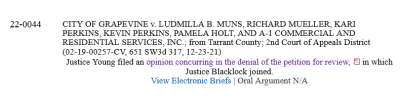
In this order, the Texas Supreme Court declined to review a case we’ve been following, in which the court of appeals held that Grapevine’s total ban on short-term renting of property — banning even owners who had been doing so for a while — might be a taking. The court held that even though the owners did not possess a classic vested right to continue using their properties to rent on a short-term basis, they owned their properties and that was enough. Property ownership comes with the “fundamental” right to rent it out and there’s no need to show more, such as a vested right under state law. More details on the city’s ban and the court’s reasoning here.

The city sought discretionary review and somewhat unusually, the property owners agreed that this is an important issue worthy of the Supreme Court’s review.

But even with everyone

Continue Reading Texas Supreme Court: We Want To Resolve Whether Short-Term Renting Property A Natural Right, Just Not In This Case
Here’s the cert petition, filed last week, in a case we’ve posted about. See here (Ninth Circuit arguments) and here (en banc petition).

The Ninth Circuit affirmed dismissal of a takings claim because (it held) the claim isn’t ripe. The government hasn’t made up its mind, and just might allow the owners to make some use of their residentially-zoned land (even though the property is also subject to an overlay zone that expressly prohibits residential development). More background here

This is one of ours, so we’re not going to be saying too much more about it. The petition also lays out the situation.

Here are the Questions Presented:

Randy Ralston and Linda Mendiola (Ralstons) wish to build a retirement home on their residentially-zoned land in San Mateo County, California. However, their property sits entirely within an overlay zone, the Montecito Riparian Corridor (Corridor), which categorically bans residential

Continue Reading New Takings Ripeness Cert Petition (Ours): Knowing The Permissible Uses “to a reasonable degree of certainty” Is All You Need For A Claim To Be Ripe

Here’s the latest in a case we’ve been following.

In Ideker Farms, Inc. v. United States, No. 21-1949 (June 16, 2023), the U.S. Court of Appeals for the Federal Circuit held that temporary, but recurring government-caused flooding was correctly treated by the Court of Federal Claims as a categorical per se taking, and not under Arkansas Game & Fish‘s Penn-Central-plus multifactor test. The court also held that the property owners are entitled to just compensation for their lost crops.

The opinion is pretty dense (39 single-spaced pages) so we’re not going to provide a blow-by-blow account of the arguments and the court’s reasoning. But we will hit some of the highlights:

  • The Missouri River floods annually. In the 1990s, the Corps of Engineer and Fish and Wildlife Service “began discussions concerning proposed changes to the River designed to mitigate the environmental impact” of the federal flood


Continue Reading CAFED: Temporary But Recurring Flooding Is A Categorical Taking, Not Penn-Central-Plus

Screenshot 2023-06-16 at 07-52-47 How Did Property Rights Fare at the Supreme Court What Happened in the 2022 Term and What's Next ALI CLE

On Wednesday, August 9, 2023 at 1:00 – 2:00 p.m. (Eastern Time), please join us for ALI-CLE’s web program, “How Did Property Rights Fare at the Supreme Court? What Happened in the 2022 Term and What’s Next.”

Here’s the course description:

This has been a blockbuster U.S. Supreme Court term for property law, with the Court deciding three major property cases: Tyler v. Hennepin County (government’s keeping the excess value when seizing and selling a home to satisfy a property tax debt is a taking), Wilkins v. United States (is the federal Quiet Title Act’s statute of limitations a jurisdictional bar?), and Sackett v. EPA (the scope of Clean Water Act wetlands jurisdiction). To gain a better understanding these opinions, the current state of takings and property law, and what these cases mean for your practice, join a distinguished panel of experts for this one-hour webcast. The faculty will

Continue Reading Join Us August 9, 2023: ALI-CLE’s “How Did Property Rights Fare at the Supreme Court? What Happened in the 2022 Term and What’s Next”

Magna_Carta_(British_Library_Cotton_MS_Augustus_II.106)

808 years ago today* on a grassy plain down by the river, the barons convinced bad King John to affix his seal to Magna Carta. Or the Magna Carta. Or Magna Charta. However you want to grammarize it. (And no, he didn’t “sign” it, they didn’t do things like that back then.)

And boy was that guy bad even by the standards of medieval royals: when you type “bad king…” in your search engine, the first suggested search is “bad king … John.”

Badkingjohn

There’s a lot of good stuff in Magna Carta — and a lot of stuff that has been rendered irrelevant or quaint by the passage of time, and even some stuff that we’d consider cringe-worthy today (see art. 10, for example).

But we takings geeks all know and continue to appreciate article 28:

Nullus enarius aries, vel alius ballivus noster, capiat enar vel

Continue Reading Happy 808th (The) Magna Carta (Charta) Day!

Here’s what we’re reading this Tuesday:

Worth checking Continue Reading Tuesday Round-Up: Sackett, Tyler, Defending Zoning, Canada Property Rights … And More

Missed our law firm colleagues Jeff McCoy, Damien Schiff, and Christina Martin when they were live, talking about their SCOTUS wins in Wilkins v. United States (is the statute of limitations in federal Quiet Title Act cases a jurisdictional bar?), Sackett v. E.P.A. (scope of Clean Water Act wetlands jurisdiction), and Tyler v. Hennepin County (government’s keeping the excess value when seizing and selling a home to satisfy a property tax debt is a taking)?

We recorded it, so you can watch and listen at your leisure.

This is more than just a victory lap, the advocates offer their thoughts on the implications of the wins, and what might be next.

Bon appétit.Continue Reading ICYMI: “Property Rights Hat-Trick: Breaking Down PLF’s Supreme Court Victories” (vid)

Check out this now-under-consideration Petition for Review, which asks the California Supreme Court to take up a case involving Murderers Creek, in Pleasant Hill, California. (Now there’s a jarring juxtaposition for you.)

The case started off as a “routine inverse condemnation case.” Pet. at 2. When Murderers Creek flooded, it damaged the plaintiffs’ land. The County, the plaintiffs allege, didn’t maintain a 40-year old concrete spillway which is part of a drainage system the County required a private developer to install in the 1970s as a condition of subdivision. The County never actually took over the drainage system, but it did accept the dedication “for recording only.”

The plaintiffs said this should have been enough to establish a claim for inverse against the County: it has been a longstanding rule in California that drainage infrastructure that diverts surface waters onto private property triggers inverse liability even if privately

Continue Reading California Supreme Court Reviewing The Murderer’s Creek Inverse Case