
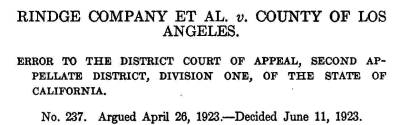
Continuing in our line of posts noting milestones in dirt law, we bring you Rindge Co. v. County of Los Angeles, 262 U.S. 700 (1923), decided 100 years ago today.
For any of you who have driven the Pacific Coast Highway through Malibu, you will know the site of this eminent domain case. As described by the Supreme Court in its opinion:
The plaintiffs in error are the owners of a large tract of land lying on the shore of the Pacific Ocean, known as the Malibu Ranch, extending in an easterly and westerly direction about twenty-two miles and varying in width from one-half mile to one and one-half miles. It lies at the base of a high and rugged mountain range which parallels the shore at a distance of from three to four miles, its northern line extending along the slope and foothills of this mountain range, and is traversed by many ridges and intervening canyons leading from the mountains toward the shore. It lies about ten miles west of Santa Monica, one of the principal cities of Los Angeles County, situated on the coast to the southwest of the City of Los Angeles, and is mainly in Los Angeles County, but extends about a mile and a half into Ventura County, the adjoining county on the west. It is traversed lengthwise by a private road of the ranch owners which was formerly used by farmers and settlers living north of the ranch on the slope of the mountains and west of the ranch in Ventura County, but which has been for several years closed by the ranch owners to the public.
Id. at 702-703.
LA County wanted to turn that private road into a public thoroughfare to be known informally as the “main road” and officially as “Roosevelt Highway,” so adopted resolutions declaring it to be in the public interest and necessity to take the property by eminent domain to build a public highway. Based on those resolutions the County instituted condemnation proceedings. The owners “vigorously resisted,” raising two primary issues: lack of a public use, and lack of necessity.
The public use objection fared as well as you might predict. “That a taking of property for a highway is a taking for public use has been universally recognized from time immemorial. The California Code specifically declares ‘highways’ to be ‘public uses’ for which the right of eminent domain may be exercised. Here, the Board of Supervisors, familiar with local conditions, has declared these highways to be for public uses, and the local and appellate state courts have likewise held them to be for public uses authorized by law. Id. at 706.
But this isn’t a “genuine highway” argued the property owners. The road is a “sham[] under the name of public improvements, which cannot, in fact furnish ways of convenience or necessity to the traveling public.” Id. The “main road” doesn’t go through and connect with other public roads, but end on the owner’s property.
Sorry, the Court concluded, the roads will be open to the public, and if drivers want to go into areas with “no adequate outlet” that is their business. And other owners who now need to use the private road to get out to LA, can use the “main road” to exit. That’s good enough. Id. at 706-707. A road taken by eminent domain doesn’t need to connect to a public road in order for the taking to be for public use. Id. at 707. (“otherwise, great embarrassment and difficulty would be experienced in establishing highways across state lines”).
The Court rejected the owner’s necessity challenge even more emphatically. While public use questions are for judicial resolution (even with the thumb firmly on the scale on the condemnor’s side), the question of necessity doesn’t even get that:
The necessity for appropriating private property for public use is not a judicial question. This power resides in the legislature, and may either be exercised by the legislature or delegated by it to public officers.
Id. at 709.The necessity question is “purely political, [and] does not require a [predeprivation] hearing, and is not the subject of judicial inquiry.” Id.
In other words, the County’s resolutions that the taking was necessary “were conclusive evidence as to the necessity for the taking of these public highways[.]” Id.
Roosevelt Highway eventually gets renamed PCH and designated California Highway 1. And Malibuans have been trying to keep outsiders out ever since.
Interested in the briefing? Here you go:
More on the case:
- Martha Groves, “One ranch owner nearly stopped PCH from running through Malibu,” Los Angeles Times (July 13, 2015) (“If Malibu ranch owner May Rindge had prevailed against public sentiment and the U.S. Supreme Court a century or so ago, Pacific Coast Highway might never have been built through the coastal enclave of Malibu. She fought with a fury in the early 1900s to maintain Malibu’s peaceful qualities and keep the state from seizing her ranchland for the road through eminent domain.”).
- Hadley Meares, “How Malibu Grew,” Curbed Los Angeles (Nov. 21, 2018) (“By 1918, the feud had gotten out of hand. Her chauffeur and a ranch hand were even involved in a gunfight with squatters, and there were attempts to capture May herself. But all of May’s lawsuits, injunctions, and walls could not stop the coming of the age of the freeway. In 1923, the U.S. Supreme Court agreed that the government had the right to build a highway through the Rindge property. May had lost tens of thousands of dollars, all for naught.”).
Think about that next time you take the drive.
Rindge Co. v. County of Los Angeles, 262 U.S. 700 (June 11, 1923)