Those of us who practice eminent domain and land use law see the world through a different lens than everyone else. When normal people get stuck in traffic because of highway construction, they may view it as a mass of cement mixers, graders, and safety-vested crews. We eminent domain lawyers see partial takes, severance damages, limited access problems, and recalcitrant DOT’s. Where others see a harbor or a dam, we see navigational servitudes. Where others see billboards, we wonder if it’s a fixture for which the owner is entitled to compensation. And that’s not a train, it’s a future rails-to-trails issue.
Come on, you’re among friends — you can admit if you’ve done the same.
When we travel away from our home base, we somehow locate the eminent domain angle, no matter how obscure. We’ve done it before, and even once crossed over into “nuclear tourism” on a visit to Los Alamos, New Mexico.
So it was on a recent visit to Asheville, North Carolina for the Spring Meeting of the ABA State and Local Government Law Section. One afternoon, during a break in the proceedings, we came across the Grove Arcade, a neat multi-story building filled with shops on the lower level, offices on the upper floors, and a slanted floor we have not encountered elsewhere.
We also came across a summary (pictured below) of how this building came to be. It notes the Arcade was the creation of E.W. Grove (the same fellow who built the nearby iconic Grove Park Inn), in order to foster a “vibrant downtown.” At one time, it was the largest building in the region, and “[f]or 13 years, the Arcade was the center of commercial and civic life in Western North Carolina.”
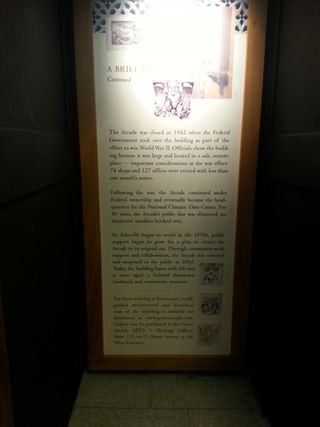
But then, “[t]he Arcade was closed in 1942 when the Federal Government took over the building as part of the effort to win World War II. Officials chose the building because it was large and located in a safe, remote place — important considerations in the war effort. 74 shops and 127 offices were evicted with less than one month’s notice.”
Our eminent domain sense was starting to tingle: “Took over the building?”
A quick visit to the interwebs confirmed the takeover and quick evictions were accomplished by an exercise of eminent domain. As the site notes:
By most accounts, though, the dire economic times [the Depression] had little effect, and the building and its public market quickly became a vital social and economic anchor in downtown Asheville — until the federal government stepped in. In 1942, with World War II in full swing and the government expanding at an astonishing rate, Uncle Sam, under the auspices of eminent domain, took over the building. Within a month, the tenants were evicted and the government moved in, covering the building’s many street-level windows with yellow brick and transforming the ornate structure into a utilitarian workhorse.
Eureka! See here for more details from the Arcade’s web site. Just compensation was $275,000, according to this report. In 1997, the City of Asheville got the property from the feds and remains the owner to this day.
Speaking of the Grove Park Inn, there’s a law angle there, also. Apparently, U.S. Supreme Court once selected the hotel as its alternative site in the event of Judgment Day. On the wall of one lounge hangs the following letter.
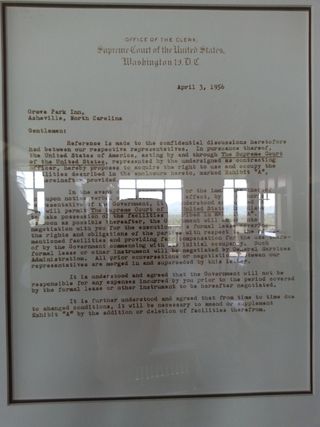
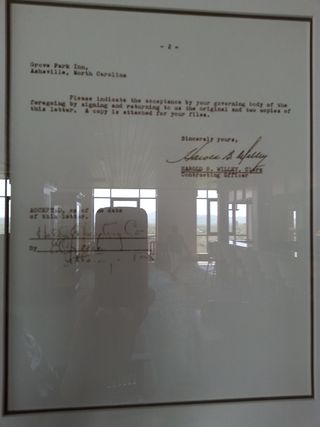
We know the letter is difficult to see clearly, so here’s the gist. The letter is from the SCOTUS Clerk, one Harold B. Willey, who, in addition to his duties as Clerk, was also the Contracting Officer for the Court. He wrote the Grove Park Inn that the Court “hereby proposes to acquire the right to use and occupy the facilities described in the enclosure hereto.” And what would cause the Court to move from its tony digs on First Street NE? “In the event of an enemy attack or the imminence thereof,” wrote Willey. Head for the hills, the Reds are coming!
Eminent domain was not mentioned, and thankfully, we’ve not yet had to figure out what to with ourselves — much less Their Honors — if the Russkies hit the button, or if Skynet became self-aware. But we suppose that in the event these came to pass and negotiations with the hotel broke down, the Court could just take it. As this story from the Wall Street Journal notes, “[t]he hotel considers itself still bound by the agreement,” although “[c]iting security concerns, a Supreme Court spokeswoman declined to confirm whether the relocation plan remains in effect, or to comment further. Several current and retired justices said they were unaware the court had readied for the first Monday after Armageddon.”
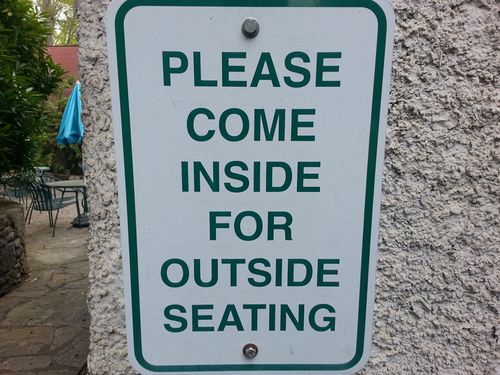
And just so you don’t think that we’re, like, obsessed, with legal stuff, we offer this parting photo, a sign on a nearby cafe which also gave us pause.