

Hawaii has a unique status among American states. It is the only state that once was a separate sovereign nation, the Kingdom of Hawaii and then its short-lived successor, the Republic of Hawaii.
Yes, we know that Texas may lay claim to the whole six-flags thing, so maybe the more accurate statement would be that Hawaii is the only state that was a sovereign kingdom, ruled by royalty.
Those who practice law in the present State of Hawaii know this well. There’s a statute (the very first up when you crack the statute books) reminding us that “Hawaiian judicial precedent” remains the common law of the state:
§1-1 Common law of the State; exceptions. The common law of England, as ascertained by English and American decisions, is declared to be the common law of the State of Hawaii in all cases, except as otherwise expressly provided by the Constitution or laws of the United States, or by the laws of the State, or fixed by Hawaiian judicial precedent, or established by Hawaiian usage; provided that no person shall be subject to criminal proceedings except as provided by the written laws of the United States or of the State.
And by “Hawaiian judicial precedent,” the statute means all of it, not just precedent since statehood in 1959. A glance through the Hawaii Reports (née “Hawaiian Reports”) reveals opinions by the Kingdom of Hawaii Supreme Court, the Republic of Hawaii Supreme Court, the Territory of Hawaii Supreme Court, and the State of Hawaii Supreme Court. All still good law, citeable and binding in Hawaii courts today (unless overruled, of course).
You get a sense of this history any time you visit the Aliiolani Hale courtroom (with its address on King Street, named after, you know, The King) where the court conducts arguments today.

Which takes us to today’s post about a Kingdom of Hawaii Supreme Court decision from 1887. Generally speaking, we like old cases, especially decisions issued by the Kingdom Supreme Court. First, many of those cases reflect timeless principles. And second, like a lot of dirt lawyers, we’re an amateur history buff. That’s why we are happy any time we can find a historic case that is still good law, and that reminds us of enduring principles. When that case also involves eminent domain? We’re in heaven.
The Kingdom of Hawaii Supreme Court’s decision in In re Widening of Fort Street, 6 Haw. 638 (1887) is just that sort of case.
Named after the Russian-built fort that once stood at the present-day corner of Queen Street and Fort Street, Fort Street is one of the oldest historical thoroughfares in the downtown Honolulu central business district, adjacent to Honolulu Harbor.
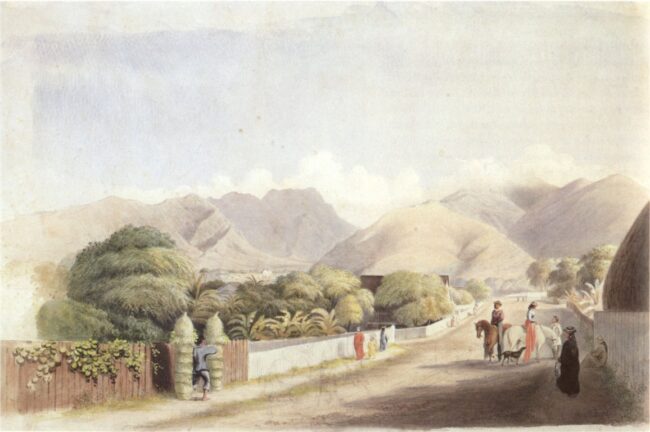
Modern denizens of Honolulu will know Fort Street pretty well, but not when it looked like this (looking mauka towards Nuuanu Valley).
Or even when it looked like this, when it had developed into the downtown shopping hub back before the automobile era.

Today, much of Fort Street has been malled over, turned into a car-free pedestrian walkway. It’s a bit sketch in places, but still retains much of its historic character if you pay attention and look for it.
The issue in the Widening of Fort Street case was the amount of just compensation owed to the property owners as the result of the Kingdom’s Minister of the Interior exercising the Crown’s power of eminent domain for, well, the widening of Fort Street (between Queen and Merchant). Like the U.S. Constitution and the later-ratified State of Hawaii Constitution, the 1864 Kingdom Constitution in effect at the time recognized property rights, and contained a “reasonable compensation” provision that the Kingdom Supreme Court considered much like the U.S. Constitution’s Just Compensation requirement:
Each member of society has a right to be protected by it, in the enjoyment of his life, liberty, and property, according to law; and, therefore, he shall be obliged to contribute his proportional share to the expense of his protection, and to give his personal services, or an equivalent when necessary; but no part of the property of any individual shall be taken from him, or applied to public uses, without his own consent, or the enactment of the Legislative Assembly, except the same shall be necessary for the military operation of the Kingdom in time of war or insurrection; and whenever the public exigencies may require that the property of any individual should be appropriated to public uses, he shall receive a reasonable compensation therefor.
Haw. Const. art. XIV (Kingdom 1864).
A jury had determined the amount of compensation which the Crown was obligated to provide to the owners, which included a calculation of what special benefits, if any, accrued to the owners’ remaining property as the result of the widening. The Kingdom statutes in effect at the time set out a process by which this was to be accomplished, including judicial review.
One of those provisions required the Road Supervisor to post notice “along the line of the road, calling upon all parties interested to forward their claims, etc.” Fort Street, 6 Haw. at 643. The Road Supervisor did post notices, but those notices said only that “all owners of property to send in their claims,” but did not use the term in the statutes, that “all parties interested” should send in their claims.
This made a difference, the court noted, because this meant that “occupiers and lessees who are not within the term owners were not notified.” Id. The court also noted that the Crown took what appear to be several “shortcuts,” and did not follow the exact process as set out in the statutes.
Some seem like fairly innocuous shortcuts, and the court noted that at least one of the shortcuts was “the usual and customary course taken by commissioners in like cases.” Id. at 645. Other omission were more obviously important, such as the statute’s requirement the Commissioners “show their work” by making a “computation” of the costs of widening the street be made.
The Crown’s response was something you have probably heard it before: “Rules? Statutes? Yes, there are rules and we know the statute says ‘X,’ but come on, that’s not the way we’ve always done things here, Your Honor. Those are just, you know, irrelevant details.“
The Kingdom court said no, the Crown must adhere to the requirements of the statute, and “close enough” wasn’t good enough:
I have no hesitation in holding that those objections must be sustained. I cannot conceive that it was the intention of the Legislature that any person should be deprived of his property,- or that his property should be charged with the payment of large sums of money for so-called benefits, without giving him an opportunity of being heard in support of his claim or against the charge assessed.
Id. at 646.
And here’s the money quote, where the court noted that strict compliance is the rule in eminent domain:
The Constitution provides that no person shall be deprived of *. *. * “property without due process of law,” and – it is undoubted law that when a statute confers upon the Government or other parties the right to take another’s property for public purposes, every form and particular required by such statute must be complied with.
Id. at 646-647.
This statement is a good encapsulation of the “turn square corners” principle, as we noted above. But what is especially important to us is that this is the King’s own court limiting the power of the Crown, and holding it to the rule of law. By that time, Hawaii was not an absolute monarchy, but was more of a constitutional monarchy, where the Crown was subject to law and a constitution limiting its legitimate exercise of powers (and requiring compensation for expropriations). But nonetheless, a royal court insisting that the King and his ministers strictly adhere to “every form and particular” in a statute adopted by the legislature, seems like a pretty clear message.
And if you are wondering if the Fort Street message is still good law, it is. First, in 2002 the (State) Supreme Court reaffirmed the principle that condemnors must adhere strictly to a statute’s requirements (aka “turn square corners”).
And second, here’s the latest iteration of that vibe, our Application for Transfer to the Hawaii Supreme Court, recently filed in a longstanding (very longstanding) eminent domain case we’re handling on behalf of the owner of property on the south shore of Maui.
One of the issues on which we prevailed in the trial court was the inadmissibility of the State’s appraisals, two of which offered an opinion of our client’s property on a date different than the date of summons, which under the Hawaii eminent domain code is the date of valuation:
§101-24 Assessed as of day of summons. For the purpose of assessing compensation and damages, the right thereto shall be deemed to have accrued at the date of summons, and, except as provided in section 46-6, its actual value at that date shall be the measure of valuation of all property to be condemned, and the basis of damage to property by reason of its severance from the portion sought to be condemned, subject, however, to section 101-23.
When the State claimed that the effective date of its appraisals were close enough, and what’s a few days here or there, we pointed to Fort Street and the “every form and particular requirement.” We prevailed on that issue, and after the trial court entered summary judgment in the owner’s favor, the State appealed to the court of appeals. The Application for Transfer liked above is our request that the Hawaii Supreme Court immediately take up the appeal (effectively skipping the court of appeals).
We are urging the Supreme Court to consider the issue:
This appeal presents two questions of imperative or fundamental importance: (1) whether the usual burdens in summary judgment govern the factual determination of the amount of just compensation the State is obligated to provide in eminent domain; and (2) the duties and obligations of the government when exercising the sovereign power to forcibly acquire property from an owner.
….
This case presents the Court with an opportunity to emphasize what the Kingdom of Hawaii Supreme Court held nearly a century and a half ago: that if an actual monarch was bound by law to treat fairly and justly compensate owners forced to surrender property for the public good, the government of the State of Hawaii is as well. See Fort St., 6 Haw. at 646-47.
In short, if a literal king must follow the rules, mustn’t a democratic government?
Stay tuned.
In re Widening of Fort Street, Honolulu, 6 Haw. 638 (Kingdom 1887)