
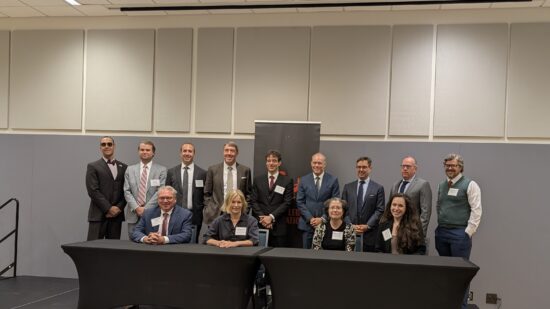
The faculty
You are no doubt familiar with the “property is a bundle of sticks” metaphor. For nearly a century, private property rights have been described as a “bundle of sticks,” with each stick representing a distinct right associated with the ownership of property: the right to possess it, to exclude others, to use, alienate, and develop it, and so on. The metaphor is common parlance — but is it truly a good way to actually capture what this thing called “private property” means?
Recently, Pacific Legal Foundation and the George Mason Law Review gathered judges, scholars, practitioners, and students at the Law School for a symposium to try to shed some light on that question, by focusing on a metaphor that courts, lawyers, and legal academics invoke so frequently that we often forget to ask whether it actually helps explain anything, or accurately captures the essence of this thing we call “private property.”
In a takings case for example, how a court identifies the relevant “stick,” or decides that the stick may not be considered separately at all, can go a long way toward deciding whether the owner possesses the necessary “private property,” and whether the government has taken it. Thus, the bundle metaphor is not merely descriptive. Used one way, it helps courts recognize distinct and protected interests. Used another, it permits those interests to merge into a larger whole. (Yes, we are looking at you, “parcel as a whole.”) The question of what is the relevant property interest can lead to “conceptual severance,” where an owner identifies a particular property stick severely affected by government action and claims he is owed compensation, while the government responds that the owner’s right to do X is evaluated more broadly against what sticks he has remaining.
This was the subject of the day’s first group of scholars, featuring Professor Eric Claeys and PLF’s Ethan Blevins and Sydney Madigan, moderated by Third Circuit Judge David Porter. Professor Claeys addressed conceptual severance, while Blevins and Madigan examined how courts use — and sometimes misuse — the bundle-of-sticks metaphor in takings cases. The classic reference point is Penn Central, where the owners argued among other things that New York’s landmarks law had taken their ability to build in the space above Grand Central Terminal. The Court declined to isolate those air rights and instead considered the effect of the regulation on the owner’s entire holdings. The “denominator,” as takings lawyers know, can be dispositive. The tension is inherent in the bundle metaphor itself. If property really is a collection of legally distinct sticks, why can an owner not point to the particular stick the government has wiped out? Conversely, if every stick must always be considered only as part of the entire bundle, how much independent significance does the metaphor retain?
The second panel turned to questions at the intersection of theory and emerging forms of property. Moderated by Chief Judge Matthew Solomson of the Court of Federal Claims, the discussion included Professor James Stern’s examination of property duties and the structure of ownership, along with Professors Andrea Tosato and Christopher Odinet’s exploration of digital assets and whether existing property concepts adequately account for increasingly important forms of intangible wealth.
Digital property provides an especially useful stress test for the bundle metaphor. With land and tangible objects, possession, exclusion, use, and transfer may be comparatively familiar. Digital assets force courts to ask which incidents of ownership matter, how those incidents arise, and whether existing property categories can accommodate assets that do not fit comfortably within traditional physical analogies. Again, identifying the property is not simply a threshold exercise. It may be the whole ballgame.
The conceptual-severance discussion from the day’s first discussion also provided a useful frame for the symposium’s third panel, which addressed (among other things) how the Supreme Court employed history and tradition in Tyler v. Hennepin County. The final panel, moderated by CFC Judge Ryan Holte, brought history and constitutional interpretation to the forefront. Professors Julia Mahoney and Cynthia Nicoletti addressed the uses and abuses of history in Tyler, while Professor Adam MacLeod explored property’s pluralism and the multiple legal and social functions served by ownership.
Tyler presented a recurring question in constitutional property law: who gets to define the property that the Constitution protects? If the government may first eliminate an interest by statute and then rely on that statutory elimination as proof that nothing was taken, the constitutional inquiry becomes circular. Or as we have put it before, government should not be able to manufacture its own defense by saying, “You have no property because the law authorizing us to take it says you have no property.”
To get to the answer, the Court relied on history and tradition. It looked to sources including Magna Carta, English practice, Blackstone, early American law, and later state practice in determining whether an owner traditionally retained an interest in value exceeding a tax debt. That history helped the Court test Minnesota’s claim that no protected property remained. Of course, invoking history raises its own questions. Which history? At what level of generality? How uniform must the historical practice be? And is history identifying an existing property interest, placing constitutional limits on the state’s ability to redefine property, or doing some combination of both?
Those questions explain why Tyler is likely to remain important even after the immediate “home equity theft” issue is resolved. The opinion offers a way to think about the relationship among state law, traditional property principles, historical practice, and the independent force of the Takings Clause.
Although the symposium papers approached property from different directions, a common thread emerged: property rights are not merely technical features of private law. They are foundational constitutional protections that shape individual liberty, economic opportunity, and civil society. That proposition may not generate much controversy among readers of this blog. But what was particularly valuable about the symposium was the range of approaches brought to bear on it. Some presenters emphasized history, some theory, some doctrine, and some practical consequences. That is why “bundle of sticks” is more than a classroom metaphor. Properly used, it can illuminate the distinct rights protected by property law. Used carelessly, it can conceal the taking of one of those rights.
The George Mason Law Review deserves credit for bringing together a distinguished group of participants and fostering a discussion that was both theoretical and practical.
We expect the symposium papers will be worth checking out when published. Stay tuned.