July 2024

Check out this decision, entered by a Rhode Island Superior Court (a general jurisdiction trial court) denying the State’s motion for summary judgment. The court concluded that a recently-adopted statute shifting the boundary between public and private property on RI’s beaches is a taking.

We won’t be commenting in too much detail because this is one of ours (PLF colleague Dave Breemer represents the plaintiffs). But here’s what you need to know:
  • Until recently, RI law used the high water mark (mean high-tide line) as the boundary between the public beach and private property.
  • In 2023, the RI Assembly adopted a statute that redefined that boundary, and moved it shorewards to where “the land held in trust by the state for the enjoyment of all of its people ends and private property belonging to littoral owners begins.”
  • As a consequence, the public may enter and use “where


Continue Reading Statute Moving The Public/Private Beach Boundary Shoreward Is A Taking

Because the latest takings cert petition is one of ours (our colleagues Dave Breemer and Deb La Fetra are counsel for the petitioner), we won’t be commenting all that much on it.

Except to say that this is the latest in a series of cases where the obligation to provide just compensation for takings butts up against a state government’s claim that it cannot be sued in federal court unless it agrees to be sued. We wrote up the Seventh Circuit’s opinion below here (“Coming And Going: Eleventh Amendment Trumps Fifth Amendment – States Must Consent To Be Sued In Federal Court, Even For Just Compensation“)

Here are the Questions Presented:

1. Whether a state’s constitutional obligation to pay just compensation when taking property waives its sovereign immunity from a claim seeking damages for an unconstitutional taking?

2. Whether a property owner may sue state officials in their

Continue Reading New Cert Petition: Does The Obligation To Provide Just Compensation Waive Sovereign Immunity?

We were all set to write up a scintillating and detailed analysis of the New Jersey Appellate Division’s opinion in Englewood Hospital & Med. Center v. New Jersey, No. A-2767-21 (June 27, 2024), when we thought, ah, why not just ask you to read our New Jersey colleague Joe Grather’s scintillating and detailed analysis.

Short story is right there in the title of this post. As Joe puts it:

In short, the hospitals argued that requiring them to provide charity care and Medicaid care at a loss was an unconstitutional taking of private property without just compensation.  The trial court analyzed the claims as an “as-applied” challenge.  Therefore, it dismissed some of the claims because of a failure to exhaust administrative remedies.  The “slightly different reason” was that the Appellate Court found the claims were a facial challenge to the constitutionality of the statute, and therefore it analyzed the takings claims under the familiar rubric of whether there was a “direct government appropriation or physical invasion of private property,” or an “uncompensated regulatory interference with a property owner’s interest in their property.” Slip op. at 14.

No physical taking, no Penn Central taking. We recommend you read his entire post “As We Approach Our Nation’s Birthday, a New Jersey Appellate Court Rejects Hospitals’ Takings Claims.”

Joe ends it this way: “I bet the hospitals are preparing their petition for certification to the New Jersey Supreme Court now.  Happy 4th of July!”

That means to stay tuned for more.

Englewood Hospital & Med. Center v. New Jersey, No. A-2767-21 (N.J. App. Div. June 27, 2024)

Continue Reading New Jersey: Forcing Hospital To Provide Care At A Loss Isn’t A Taking

Alicle

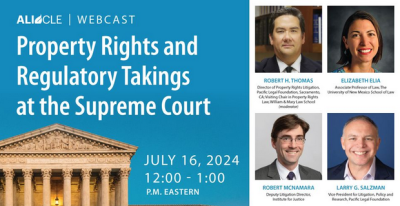
Join us next week with ALI-CLE for “Property Rights and Regulatory Takings at the Supreme Court.” We’ve assembled legal experts including counsel in the Sheetz and DeVillier Supreme Court cases, and a dirt law legal scholar to discuss these important decisions and answer your questions (including “what’s next?”):

The 2023-24 Supreme Court term has been another one of significance in the world of property rights. In particular, two unanimous cases directly addressed takings: Sheetz v. County of El Dorado, 601 U.S. __ (2024) (holding that the Fifth Amendment’s takings clause does not distinguish between legislative and administrative land-use permit conditions) and DeVillier v. Texas, 601 U.S. __ (2024) (holding that property owners adversely affected by a flood evacuation barrier should be permitted on remand to pursue their takings clause claims through the cause of action available under Texas law).

To better understand the importance of these

Continue Reading Join Us July 16, 2024: ALI-CLE’s Webcast: “Property Rights and Regulatory Takings at the Supreme Court”

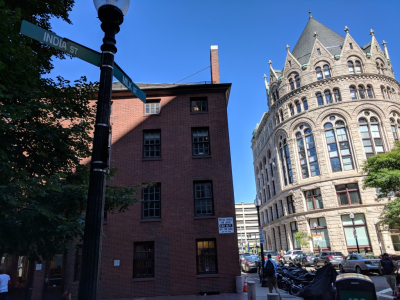
IMG_20180719_154523
The famous corner of India and Milk, Boston
(at least for takings nerds)

Today, along with our friend and colleague Hawaii eminent domain lawyer Mark M. Murakami, we filed this Application for a Writ of Certiorari* in a condemnation case that has been pending for more than a decade (including more than five years in the court of appeals). We posted about the case — including an aerial video of the property, located on Maui’s south shore — here.

The Question Presented:

May a jury determining just compensation consider evidence of the influence of the condemnation on the fair market value of property being taken?

You eminent domain types know the answer to this: No.

Indeed, no way! If you thought the “project influence” rule is a baseline requirement of the Fifth Amendment, a rule applied by courts nationwide, and for ages has held that “any

Continue Reading New (State Court) “Project Influence” Cert Petition* – Inadmissibility Of Evidence Of Use & Value Of Property As Condemned

Worth reading: a student-authored piece in the latest issue of the Harvard Journal of Law & Public Policy, “Original Understanding of ‘Background Principles’ in Cedar Point Nursery v. Hassid.

From the Introduction:

But in Cedar Point, when considering a regulation that authorized union organizers to enter certain businesses, the Court held that even a temporary physical occupation was a per se taking requiring compensation.

The Court’s shift to a per se rule is significant because it means a landowner can receive “just compensation” without satisfying Penn Central’s high bar required for regulatory takings. For governments, the Cedar Point holding could pose a heavy financial burden if they must compensate landowners for temporary intrusions authorized under existing regulations. Due to this imposing financial burden, some have suggested that Cedar Point threatens existing civil rights regimes, which at first blush resemble the labor rights regulation at

Continue Reading New Article: “Original Understanding of ‘Background Principles’ in Cedar Point Nursery v. Hassid“

Check this out, a local government has filed a cert petition seeking reversal of one of those relatively rare circumstances where the property owner won below on a temporary regulatory takings claim for the County’s denial of a development permit.

We won’t go into details on this, but urge you to read the petition, especially the Questions Presented:

In First English Evangelical Lutheran Church of Glendale v. Los Angeles County, Cal., the Court held that the Fifth Amendment requires “just compensation” for temporary regulatory takings, i.e., “those regulatory takings which are ultimately invalidated by the courts.” 482 U.S. 304, 310 (1987). The appropriate compensation for a temporary regulatory taking is described as “fair value for the use of the property during this period of time.” Id. at 322. All claims for temporary regulatory takings must be analyzed using the ad-hoc, fact-based analysis set out in Penn Central Transp.

Continue Reading New Cert Petition: Gov’t Asks Whether A Penn Central Taking Is Really A Lucas Taking

001q

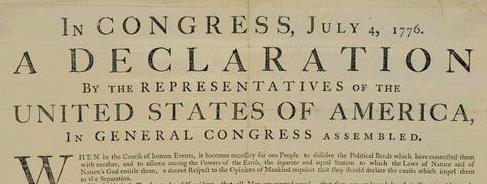
It’s not quite “Yes Virginia…” but here is our annual Independence Day missive on the legal angle on the Declaration. This may have special significance as the nation is in the process of reexamining many of our assumptions and history. But though the Founders may have been flawed individuals — as we all are — there’s really no question about the ideas they captured, and, thankfully, put down on for posterity.

—————————————————————————————

We know lawyers are easy targets (we enjoy lawyer jokes as much as the next person, i.e., What’s the difference between a good lawyer and a great lawyer? A good lawyer knows the law; a great lawyer knows the judge.).

Nonetheless, as we celebrate our independence, we note that author Thomas Jefferson and 23 other of the 56 signers of the Declaration of Independence were lawyers, and that the document was crafted and understood fundamentally


Continue Reading The Verified Complaint In Equity: The Declaration Of Independence, v.248

We were all set to write up the Wisconsin Supreme Court’s recent opinion in Sojenhomer LLC v. Village of Egg Harbor, No. 2021AP1589 (June 19, 2024) — after all, we were already following the case — when Lawprof Ilya Somin beat us to the punch: “Wisconsin Supreme Court Rules Sidewalks are not “Pedestrian Ways” – thus Allowing Local Governments to Use Eminent Domain to Take Property to Build Them.”

Short story is that a Wisconsin statute prohibits using eminent domain to take property for a “pedestrian way,” and the Village instituted a condemnation action to take Sojenhomer’s property for a sidewalk. No way, you say?

Yes way held the Wisconsin court. The key was that pedestrian way was a defined statutory term, and thus not subject to common meanings (which would seem to include a sidewalk as a pedestrian way). The court concluded that the sidewalk did

Continue Reading When Is A Sidewalk Not — You Know — A “Pedestrian Way”? Wisconsin Supreme Court Clues Us In

2012-02-06_11-19-51_574 (Small)

Here’s the latest in a case (and issue) we’ve been following closely.

In Watson Memorial Spiritual Temple of Christ v. Korban, No. 24-0055 (June 28, 2024), the Louisiana Supreme Court unanimously affirmed the Court of Appeal, concluding the duty to actually pay just compensation for a taking is ministerial. 

That may not seem like an earth-shattering conclusion. After all, since at least 1987, the U.S. Supreme Court has labeled the Just Compensation Clause as “self-executing” which means that if there’s been a taking, there must be compensation. Must means must. At least that’s what it means to us.

But as readers of this blog know, you can get a final judgment for inverse condemnation from a Louisiana court, but the defendant/taker retains the discretion whether to actually pay it, and the usual judgment-enforcement procedures are not available. That comes from this provision

Continue Reading “A judgment for inverse condemnation, left unsatisfied, does not constitute the payment of just compensation.” Government Has A Ministerial Duty To Pay (And You Know What That Means)