July 2024

Just compensation

Just a few posts ago, we put up the Louisiana Supreme Court’s opinion in a case where property owners obtained a final inverse condemnation judgment ordering the New Orleans Sewer Board to pay just compensation.

Then…crickets. The sewer board did not satisfy the judgment. It relied on a provision in the Louisiana Constitution that says that the state and local governments don’t need to pay civil judgments except when they want to.
The Louisiana Supreme Court didn’t see it that way, and held that just compensation is “self executing” and that paying it is a ministerial duty, meaning that no statutory authorization is needed, and mandamus to compel payment is an available remedy for non-payment.

Now, the sewer board has asked the court for a do-over. In its motion for rehearing, it asserts that that earlier federal litigation is res judicata and already resolved the issue (although that

Continue Reading Govt: We Were Really Really Really About To Pay…Until You Forced Us To Pay! Sewer Board Seeks Rehearing In Self-Executing Just Comp Case

Check out City of Kemah v. Crow, No. 01-23-00417-CV (July 25, 2024), from the Texas Court of Appeal (First District).

This is yet another takings ripeness case — here, the so-called “final decision” requirement — the second recent opinion on this issue from the Texas court. SeeFinal Decision Takings Ripeness Is Based On All Circumstances, Not Hard-And-Fast Requirements (Read That Again: A Factual Question)” for our write-up of the other case.

In this one, the owner asserted that the city issued her a building permit for her “barndominium” and and two other structures to be used as short-term rentals, but later issued a stop work order. This resulted in a Penn Central taking, she asserted.   

The city sought ripeness dismissal, asserting the owner didn’t actually have a permit issued by the city council as its ordinances require. The owner didn’t have the actual

Continue Reading Relying On Complaint’s Allegation That City Issued A Permit As Confirmed By Chief Building Officer Email, Texas App Holds Takings Claim Ripe Even Though City Said Council Must Issue Permits

On the surface, the U.S. Court of Appeals for the Ninth Circuit’s opinion in Stavrianoudakis v. U.S. Fish & Wildlife Svc., No. 22-16788 (July 25, 2024) is about Article III standing (a highly technical gateway issue that is very federal courts wonky).

But taking a deeper look offers an insight into ways other than the usual Fifth Amendment arguments for protecting property rights. [Before we go on, a disclosure: this is one of our cases, argued and won by PLF colleague Daniel Woislaw].

This is a case involving the sport of falconry. Can’t say that we knew too much about that — until maybe the occasional movie — until this case. First (and this may not come as a surprise to you who have been observing what things the government finds worthy of regulations and licensing), did you know that every state government except Hawaii has

Continue Reading CA9: Unannounced Inspections As Condition Of Falconry License Are Subject To Nollan/Dolan Challenge

You all have likely seen ’em, those “We Buy Houses Any Condition” billboards letting the world know that no matter what condition it might be in, there’s an outfit that says it is willing to buy your house.

Well, that outfit ran into the one other outfit that is willing to buy your house, except here, that outfit can force you to sell it. That’s right, the government. In this case, the City of Ontario, California, exercising its power of eminent domain. (As someone once famously described the power of eminent domain: “whether you know it or not, your house is for sale.”)

The city went through the usual motions to forcibly take “multiple vacant lots” next to the Ontario International(!) Airport which it claimed were blighted:

In 2021, the City held a public hearing, after which the city council adopted a resolution of necessity authorizing the City to

Continue Reading Blight Slight: No Taking Of Property For “The Proposed Project” When No Project Has Been Proposed

We suggest those of you interested in takings ripeness — here, the so-called “final decision” requirement — take a quick gander at the Texas Court of Appeals’ opinion in City of Buda v. N.M. Edificios, LLC, No. 07-23-00427-CV (July 2, 2024).

We won’t go into the details, except to say that a property owner developing its land entered into an agreement with the city, under which the owner would grant a drainage easement to the city to alleviate citywide flooding, while the city was obligated to construct drainage improvements. When the owner submitted a plan, the city instructed it to “provide additional drainage improvements on the property.” Slip op. at 2. Not so fast, said the owner: the city, not me, is on the hook for these additional improvements. If you condition approval of my development plans on me providing more drainage stuff, that’s a taking (what the

Continue Reading Final Decision Takings Ripeness Is Based On All Circumstances, Not Hard-And-Fast Requirements (Read That Again: A Factual Question)

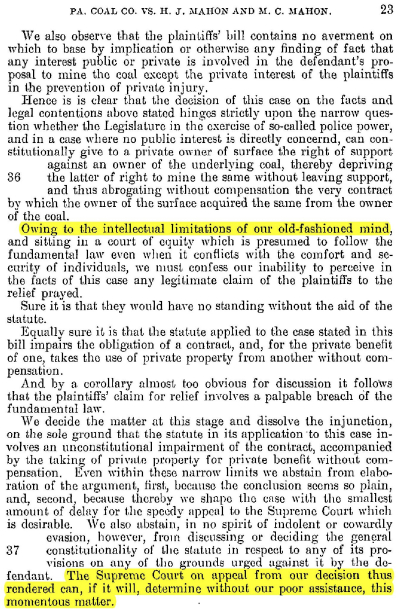
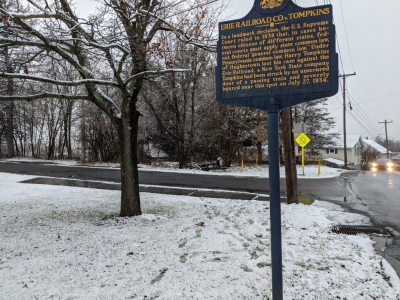
Erie
The site of the Erie incident, just a mile away from Mahon’s home.

Here’s an unusual, and kind of interesting one, from a U.S. District Court (Hawaii) in an eminent domain case brought by the County of Maui against the owner of Maui property which is needed for a solid waste disposal site for debris from the recent Maui wildfire.

First unusual point: the owner, a citizen of a state other than Hawaii, removed the case to federal court, asserting diversity jurisdiction. A state eminent domain action in federal court? Don’t see that every day, do you? (The County has not challenged federal court jurisdiction.)

Second unusual point: when the County deposited its estimate of just compensation and sought immediate possession under Hawaii’s eminent domain procedures (Hawaii does not have a true “quick take” procedure, but merely immediate possession where title does not transfer to the condemnor

Continue Reading Federal Court In Removed Eminent Domain Case: Quick-Take/Immediate Possession Is Erie Procedural, So Does Not Apply

A fairly short one from the North Carolina Court of Appeals, but well worth your time to read.

Mata v. N.C. Dep’t of Transportation, No. COA23-1140-1 (July 16, 2024) is the latest in the “Map Act” takings cases that we have long covered. There, N.C. legislature adopted a statute that identified future highway corridors and then “restricted [owners’] fundamental rights to improve, develop, and subdivide their property for an unlimited period of time.” Kirby v. N.C. Dep’t of Transp., 239 N.C. App. 345, 769 S.E.2d 218 (2015), aff’d, 368 N.C. 847, 786 S.E.2d 919 (2016). The Map Act also classified these properties as eligible for a 20% to 50% reduction of the appraised value for property tax purposes.

In Kirby, the North Carolina Supreme Court held that the restrictions the Act imposed amounted to a taking. In response, the N.C. legislature rescinded the Map Act.

The Matas own

Continue Reading NC App: “Map Act” Takings Are Temporary, Valued Not By Rent But “by taking into account all pertinent factors”

Check out this decision, entered by a Rhode Island Superior Court (a general jurisdiction trial court) denying the State’s motion for summary judgment. The court concluded that a recently-adopted statute shifting the boundary between public and private property on RI’s beaches is a taking.

We won’t be commenting in too much detail because this is one of ours (PLF colleague Dave Breemer represents the plaintiffs). But here’s what you need to know:

  • Until recently, RI law used the high water mark (mean high-tide line) as the boundary between the public beach and private property.
  • In 2023, the RI Assembly adopted a statute that redefined that boundary, and moved it shorewards to where “the land held in trust by the state for the enjoyment of all of its people ends and private property belonging to littoral owners begins.”
  • As a consequence, the public may enter and use “where


Continue Reading Statute Allowing Public To Access Formerly Private Portions Of Rhode Island Beaches Is A Taking

Screenshot 2024-07-14 at 09-00-18 Sheetz v. County of El Dorado Legislatures Must Comply with the Takings Clause by Brian T. Hodges Deborah La Fetra SSRN

Check this out: our Pacific Legal Foundation colleagues (Brian Hodges and Deborah La Fetra we on our Sheetz SCOTUS team), have posted a new scholarly piece on SSRN, “Sheetz v. County of El Dorado: Legislatures Must Comply with the Takings Clause.”

Here’s the Abstract:

For more than 30 years, the Supreme Court has recognized that building permit conditions requiring a dedication of property to the public implicate the Fifth Amendment’s Takings Clause and are therefore subject to the unconstitutional conditions doctrine as set out by Nollan v. California Coastal Commission, 483 U.S. 825 (1987), and Dolan v. City of Tigard, 512 U.S. 374 (1994). But for nearly as long as the Nollan/Dolan doctrine has been in place, state and lower federal courts have divided on the foundational question of whether the doctrine applies equally to all branches of government, or if it applies only to administrative

Continue Reading New Article – “Sheetz v. County of El Dorado: Legislatures Must Comply with the Takings Clause” (Brian Hodges & Deb La Fetra)