As we bid farewell to another calendar year, our mind wanders back over the last 364 days in an attempt to ascribe meaning, or even a theme — some connecting tissue — to what the scientists tell is is just the rotation of the earth.


For those of you who follow the wildfire/inverse cases (centered in, although not exclusively, California and Hawaii), you might want to check out this article by a fire engineer: Vytenis Babrauskas (aka “Dr. Fire“), “Electricity-Caused Wildland Fires: Costs, Social Fairness, and Proposed Solution.”
As the title suggests, the article is
A short one from the Ohio Court of Appeals.
In City of North Canton v. Brown, No. 2024-CA00030 (Dec. 16, 2024), the court held the trial court in a just compensation action wrongly excluded the owner’s evidence of the County’s property tax valuation.
Hang on. Doesn’t the owner usually want to exclude evidence of
A short one today, but worth reading because the Kentucky Supreme Court’s opinion in Kentucky Transportation Cabinet v. Atkins, No.2023-SC-0173 (Dec. 19, 2024) highlights an important point: when offering evidence of the compensation owed for the taking of income-producing property–and “[d]etermining the value of condemned real property is not a science”– it isn’t “speculative”
The latest edition of the Brigham-Kanner Property Rights Journal (William & Mary Law School) is out, with intriguing Dirt Law scholarship from the luminaries in the field.
Check out the Table of Contents above, and then go here to download each piece or the entire issue. We will note, with a small bit of pride
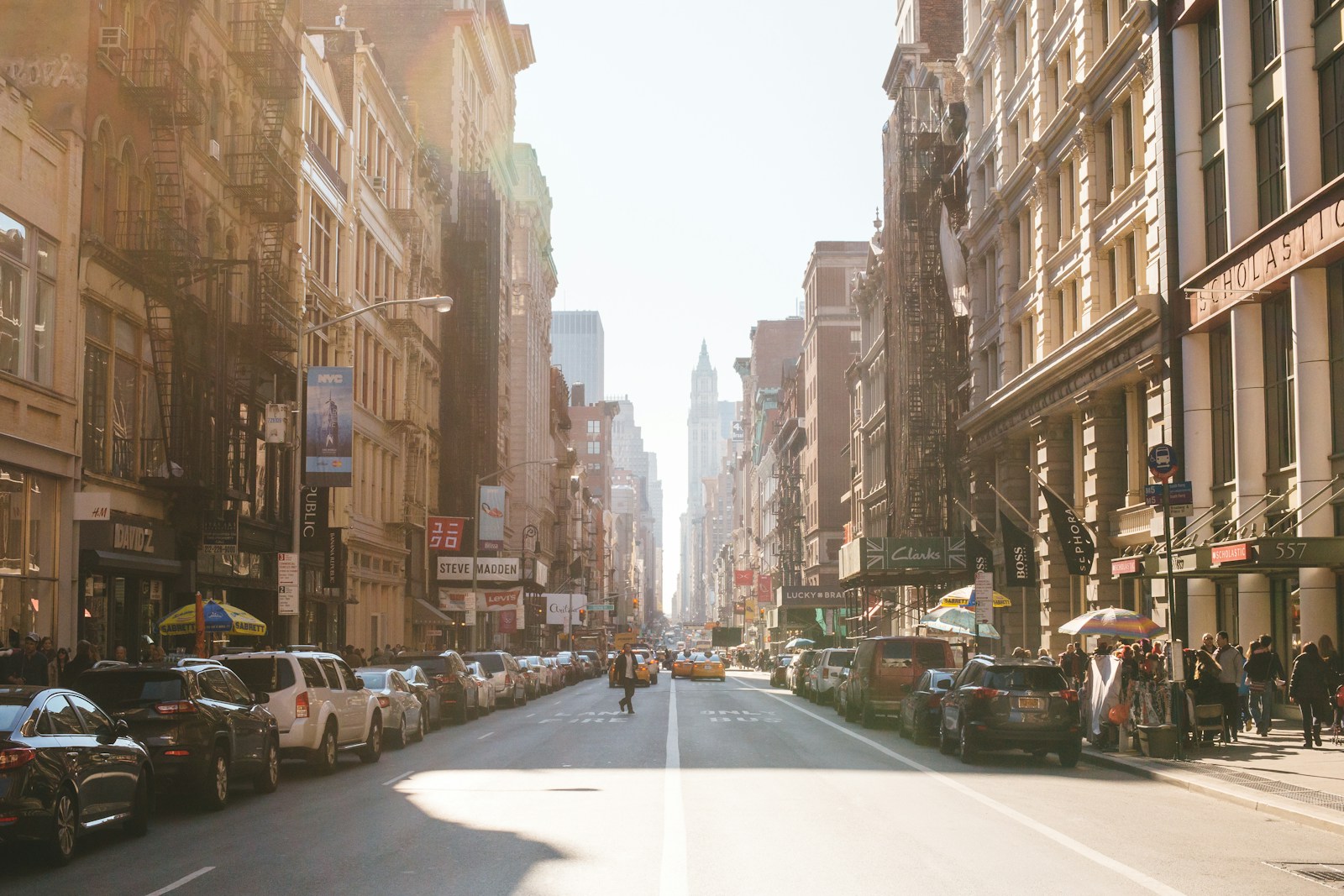
In what might be the most cliched “New York City” land use situation, check out the Appellate Division’s opinion in Coalition For Fairness v. City of New York, No. 2023-05338 (Dec. 5, 2024).
Want to convert your SoHo-NoHo artist live/work space to unlimited residential use? Be prepared to pony up and pay to the City’s Arts Fund a non-refundable fee of $100 per square foot as a precondition of even filing a building permit.
When owners challenged this fee as unconstitutional under Nollan/Dolan/Koontz/Sheetz, the trial division said no. But the Appellate Division held otherwise, concluding that the imposition of the fee lacked an essential nexus and was not roughly proportional to whatever impacts “certified artists” (who knew the government was in the business of “certifying” artists?) suffer when an owner converts.
The opinion, in true Appellate Division style is short (3 pages), so you can just read it. But here’s how the court laid out the analysis:
The ZR’s prohibition on new JLWQA units, coupled with this stated goal of broadening uses and the ZR text providing for conversions away from JLWQA use, further indicates that the City’s long-term land use goal is to phase out JLWQA units (see ZR § 143-13). By contrast, the City’s asserted goal in its arguments on appeal, of supporting art and local artists, is not related to any land use interest (see Nollan, 483 US at 837). Nor does payment into the Arts Fund promote the asserted legitimate end of preserving JLWQA stock for certified artists, as the Arts Fund does not pay for joint living-work units or other housing for artists, much less offer benefits specifically to certified artists. Instead, money from the Arts Fund “shall be allocated . . . to support arts programming, projects, organizations, and facilities that promote the public presence of the arts within the [SNX] District and surrounding neighborhoods,” with priority given to “under-resourced organizations and under-served areas” (ZR § 143-02).
Slip op. at 3.
And no proportionality either, because “there is no evidence of negative impacts on certified artists arising from the changes in zoning. Instead, [the City] represented during the approval process that there was a ‘scarcity of certified artists able to purchase’ JLWQA units, due to an ever-decreasing number of annual artist certifications the previous decade.” Id.
Declaratory judgment and injunction issued.
Check it out.
Coalition for Fairness v. City of New York, No. 2023-05338 (N.Y. App. Div. Dec. 5, 2024)
Continue Reading NY App Div: Requiring Art Fee “Donation” To Get Building Permit Lacks Nexus, Proportionality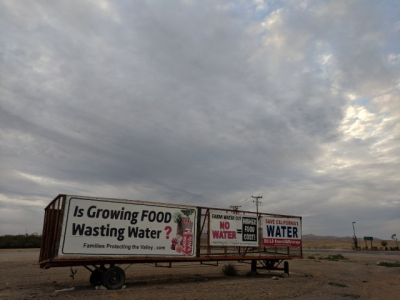
Strong letter to follow!
A long-ish read (32 single-spaced pages) from the Federal Circuit in City of Fresno v. United States, No. 22-1994 (Dec. 17, 2024), but worth reading.
Not only will you get a crash course in how water is allocated in California’s vast central valley (as the billboards above, set up along
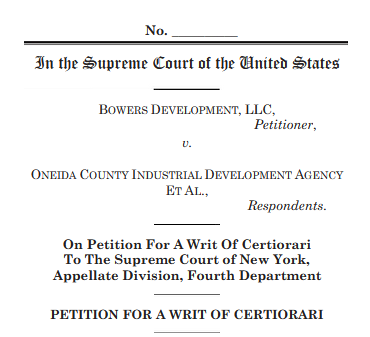
Our colleagues at the Institute for Justice–the same firm that represented Susette Kelo in her oh-so-close run at clearing up the Public Use requirement in eminent domain, today filed this cert petition in which they take another run. We will let you savor the wine and find out about the case and the arguments by
We tend to avoid cases about insurance. Not because they are dull (as you might wrongly imagine). Indeed, there’s more excitement in insurance cases than you’d guess. But insurance law and the insurance regulation field needs a certain level of very niche expertise that we don’t possess. So normally, we would not have given the
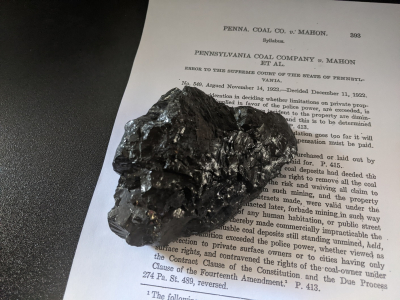
Too busy writing those briefs and petitioning for those writs, so haven’t found the time to hit your local store or the interwebs and fulfill your seasonal duties? Or maybe you just have gifter’s block about an appropriate present for the dirt lawyer in your life this holiday season?
You could go the last-minute route:

