
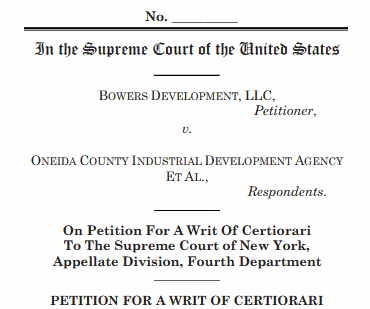
Our colleagues at the Institute for Justice–the same firm that represented Susette Kelo in her oh-so-close run at clearing up the Public Use requirement in eminent domain, today filed this cert petition in which they take another run. We will let you savor the wine and find out about the case and the arguments by reading the petition without our filtering.
But the short story is that this case comes from what is perhaps the worst-offender jurisdiction when it comes to public use questions, New York. Here, the County exercised eminent domain to transfer property from A (petitioner Bowers Development was under contract to buy the land with plans to build a medical office building) and give it to B (a different private owner that was planning to build … a medical office building on adjoining property which needed a parking lot).
The Appellate Division concluded that this satisfied the Fifth Amendment’s Public Use requirement which “encompass[es] virtually any project that may confer upon the public a benefit, utility, or advantage.” Pet. at 4. That’s right, the old rational basis test strikes again, here interpreted as broadly as possible to mean even if invisible space aliens might have done it. As the petition puts it:
It did not matter that the condemnation was originally requested by the private beneficiary; it did not matter that the asserted purpose of the condemnation was job-creation and community prosperity; it did not matter that the putative additional benefit of the public parking “at night” was invented after the public hearing. The government had articulated a conceivable benefit of taking property from A to give to B, and that was enough.
Pet. at 4-5.
Here are the Questions Presented:
Kelo v. City of New London, 545 U.S. 469 (2004), held that when the government uses eminent domain to take property from a private owner to give it to a different private owner—where the taking occurs as part of a comprehensive economic redevelopment plan and where the identity of the new private owner was unknown at the time of the taking—the taking may be justified by asserted secondary public benefits subject only to minimal rational-basis review. The questions presented are:
1. Does the Public Use Clause require something more than minimal rational-basis review when the government takes land from one private owner to give it to a specifically identified private owner outside the context of a comprehensive economic redevelopment plan?
2. Should Kelo be overturned?
The petition doesn’t ask the Court to determine whether this taking is valid or not, but presents a more fundamental issue: if there’s a plausible assertion that there’s too much private benefit baked into a taking where the public will be permitted to use the property, should the courts just rubberstamp the taking, or should they be asking “if there’s smoke, might there be fire?”
We’ve been down this road before, when we successfully asked the Hawaii Supreme Court to conclude that under Kelo, plausible claims of too much private benefit or influence should be taken seriously by the courts, and not sloughed off by merely accepting the condemnor’s claim “there’s nothing to see here, move along.”
Stay tuned, as always.