
September 2021

IS WM

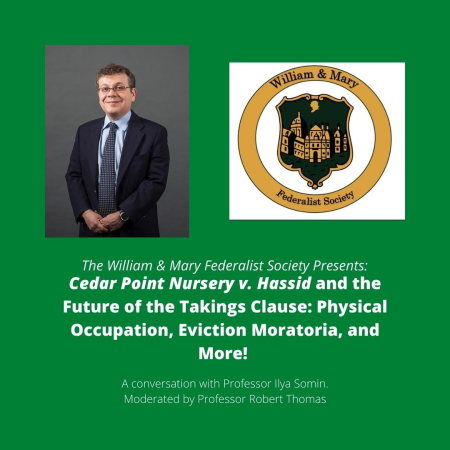
Next Tuesday, September 28, starting at 12:50pm ET, we’ll be moderating a talk sponsored by the William and Mary Law School chapter of the Federalist Society.

Professor Ilya Somin, a nationally-recognized expert in eminent domain, takings, and related topics, is zooming in to speak about “Cedar Point Nursery v. Hassid and the Future of the Takings Clause: Physical Occupation, Eviction Moratoria, and More.”
And guess what? You can Zoom in too. It’s open to the public, and it’s free.

So mark your calendars and join us for Prof Somin’s thoughts on the cutting-edge issues in property rights. Here’s the Zoom link: https://us02web.zoom.us/j/89365248145. See you on Tuesday!Continue Reading Join Us (For Free!): Lawprof Ilya Somin On “Cedar Point Nursery v. Hassid and the Future of the Takings Clause: Physical Occupation, Eviction Moratoria, and More” (Tues. Sep. 28, 2021, 12:50pm ET)
In case you missed it live, here’s the recording of the recent one-hour program on “The Future of Regulatory Takings at the Supreme Court,” featuring our colleagues Joshua Thompson (Pacific Legal Foundation) and Paul Utrecht (Utrecht & Lenvin, LLP), with Jim Burling (PLF) moderating.

The program discussed Cedar Point Nursery v. Hassid, Knick v. Township of Scott, and Pakdel v. City and County of San Francisco and what might be on the horizon.

If you are a takings nerd, a must-listen.Continue Reading Watch: “The Future of Regulatory Takings at the Supreme Court”

PXL_20210920_195630876

There’s still plenty of time to register and join us for the 18th Annual Brigham-Kanner Property Rights Conference at the William and Mary Law School, Thursday and Friday, September 30 and October 1, 2021.

Yes, you may attend in-person, or remotely. The registration fees are very reasonable, ranging from $0 (yes, free!) to $200 (go here, and click “Tickets” for the details).

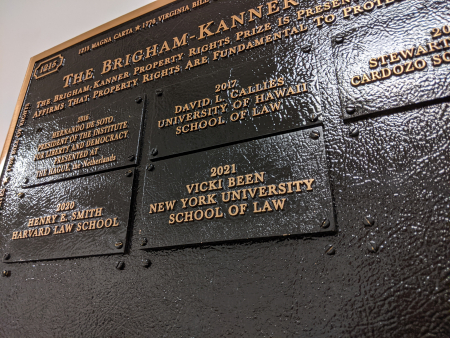
This year’s Brigham-Kanner Property Rights Prize winner is Professor Vicki Been (NYU Law). The Conference includes presentations on:

  • Remembering Toby Brigham
  • The Role of Empirical Research in Defining the Scope of Constitutionally Protected Property Rights: A Tribute to Been
  • The Relationship between Eminent Domain and Social and Racial Injustice (this is the panel on which we’ll be presenting)
  • Just Compensation Issues, Changing Public Uses, and Other Recent Developments
  • The Interdependence of Property and First Amendment Rights
  • The Distributional Implications of Land Use Regulation

Details on

Continue Reading 2021 Brigham-Kanner Property Rights Conference (Sep. 30 – Oct. 1, 2021) – Still Time To Join Us

There’s a lot going on in this cert petition, recently filed. More fallout from the big auto bailouts. Regulatory vs physical takings. And more.

But what really grabs our attention starts on page 35. There, the petition asserts the property owner’s loss in this case is just part of a bigger picture in which the Federal Circuit employs “result-oriented reasoning” in takings cases. Ouch.

The panel’s use of result-oriented reasoning, clearly “a Machiavellian, ends-justifies-the-means process[,]” is unconstitutional because it is beyond debate that “the Constitution … is concerned with means as well as ends.

The exercise of this Court’s Rule 10(a) supervisory power is the only obstacle to the Federal Circuit’s determined dismantling of the guarantees of the Takings Clause.

The most interesting Question Presented asks the Court to review the Federal Circuit’s “but for” requirement — which imposes a causation test that asks whether the damage to the

Continue Reading Cert Petition: Please Stop The Federal Circuit’s “determined dismantling of the guarantees of the Takings Clause”

On the day we celebrate Constitution Day (or should we say Khaaaaan-stitution Day?) we have to admit that pretty much nothing beats One Named Kirk’s reading of the Preamble

KIRK: This was not written for chiefs.Hear me! Hear this! Among my people, we carry many such words as this from many lands, many worlds. Many are equally good and are as well respected, but wherever we have gone, no words have said this thing of importance in quite this way. Look at these three words written larger than the rest, with a special pride never written before or since. Tall words proudly saying We the People. That which you call “Ee’d Plebnista” was not written for the chiefs or the kings or the warriors or the rich and powerful, but for all the people! Down the centuries, you have slurred the meaning of the words: “We

Continue Reading The Real “Prime Directive” – Happy Constitution Day 2021

Here’s the pending cert petition asking the Supreme Court to take up (pun intended) a case involving a Penn Central taking.

This is another one of the cases from the big auto bailout/takeover. The plaintiffs are (former) Chrysler dealers whose dealership franchise contracts were sloughed off as part of the $38 billion federal bailout of the auto manufacturers. As part of the deal, the companies were required to cancel many of their franchise agreements, forcing the dealerships to close.

Everyone agrees that these franchise agreements are “property,” and that the dealerships were profitable. But the Federal Circuit held that under Penn Central‘s “economic impact” factor, none of that mattered because the court concluded the franchises would have been worthless if the feds had not prevented Chrysler from failing. So to save Chrysler, it was ok to throw the dealers under the bus, so to speak.  

Here are the

Continue Reading Cert Petition: It Should Matter When A Profit-Making Enterprise Is Sacrificed For A Third Party

DqyzrckX0AIhgpM

Check this out, the latest from lawprof Lee Anne Fennell, her thoughts on the Supreme Court’s Cedar Point decision, “Escape Room: Implicit Takings After Cedar Point,” forthcoming in the Duke Journal of Constitutional Law & Public Policy.

Here’s the abstract:

In the June 2021 case of Cedar Point Nursery v. Hassid, the Supreme Court held that a California regulation that gave union organizers limited access to agricultural worksites (three hours a day, 120 days a year) amounted to a per se taking. The Court further opined that any governmental grant of physical access, no matter how time-limited or functionally constrained, similarly works a per se taking—unless one of the Court’s exceptions applies. This essay argues that Cedar Point is best understood as part of an ongoing campaign by the Court to selectively apply heightened scrutiny to property-facing governmental acts in ways that broadly entrench the status quo.

Continue Reading New Article: Lawprof Lee Anne Fennell – “Escape Room: Implicit Takings After Cedar Point”

A very short one from the Oregon Court of Appeals.

In Walton v. Neskowin Reg. Sanitary Auth., No. A168358 (Sep. 1, 2021), the court concluded that the trespass statute of limitations of six years applied to a physical takings (inverse condemnation) claim. The Sanitary Authority installed a main sewer line on the plaintiffs’ property in 1995. When the plaintiffs’ septic system failed in 2014, the Authority required them to connect to the sewer system. The plaintiffs asserted that they were entitled to a “no fee” connection, in accordance with an agreement with the Authority to allow the 1995 installation in exchange for a no fee connection. The Authority denied the existence of any agreement.

So in 2017 the plaintiffs sued for inverse condemnation. The Authority argued the statute of limitations on such a claim had expired. The statute began running when the invasion took place, and not when

Continue Reading Oregon App: Six Year Statute Of Limitations For Physical Invasion Takings Begins To Run When Property Occupied, Not When Compensation Is Denied