
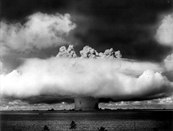
 How’s this for a raw deal: not only does the federal government seize both your land and your home, but it also takes your entire country with the intention of detonating multiple thermonuclear weapons where you once lived. Meaning you won’t be able to return to the homeland you loved for oh, let’s just say a very long time.
Thirty years pass, and after you sue the government for a taking, it settles the dispute by entering into an agreement which creates a tribunal to settle all claims, payable from a trust fund. The trust fund, however, is woefully underfunded and could not possibly satisfy your claims and those of your compatriots (of the money in the trust fund, only 1/3 is designated to actually pay the victims; the other 2/3 is set aside to support the tribunal’s operations). Nonetheless, the tribunal awards you and your neighbors nearly $1 billion for the loss of property, for restoration and cleanup costs, and for the hardships caused by the forced relocation and nuclear poisoning of your land.
How much do you and others actually see? Around $3 million.
The settlement agreement allows you to ask Congress to add to the trust fund. Although the request is submitted, Congress does nothing for 9 years. So back to court you and others go, bringing a complaint in the Court of Federal Claims for a taking of property, seeking just compensation under the Fifth Amendment. The CFC throws out the case because the agreement settling your earlier claims has a provision which deprives all federal courts of jurisdiction to hear your takings claims.
These are the background facts in The People of Bikini v. United States, Nos. 2007-5175 and 2007-5176 (Jan. 29, 2009). In that case, the Federal Circuit affirmed the CFC’s dismissal of the takings claims for failure to state a claim. The Federal Circuit noted:
Article XII of the settlement agreement instructs, “All claims described in Articles X and XI of this Agreement shall be terminated. No court of the United States shall have jurisdiction to entertain such claims, and any such claims pending in the courts of the United States shall be dismissed.” Section 177 Agreement, Art. XII (emphasis added).
Slip op. at 5-6. The court held that the Bikini islanders agreed that the sole avenue of relief would be to ask Congress to put additional funds into the trust fund:
The “Changed Circumstances” provision acknowledges that “this Article does not commit the Congress of the United States to authorize and appropriate funds.” Section 177 Agreement, Art. IX. The parties expressly agreed to this procedure and in doing so trusted the U.S. Congress to weigh and evaluate and act upon any changed circumstances. Thus, the settlement agreement entrusted the funding remedy to a procedure outside the reach of judicial remedy.
Slip op. at. 7. The court didn’t appear too happy about the decision, noting “[t]his court observes that its sense of justice, of course, makes it difficult to turn away from a case of constitutional dimension,” but that no jurisdiction means no jurisdiction. Slip op. at 9.
We hate to be cynical about this, but given the “Emergency Economic Stabilization Act of 2008” (aka The $700 Billion-plus Bailout) and the car companies, banks, and golden-parachuted executives queued up with their hands out, we have to wonder whether there will be any Congressional impetus remaining to make right by the Bikinians. We sure hope so.
The Federal Circuit’s opinion is posted here. The Bikinians’ appellate brief is here.
See also Bikini blow up from “Suits & Sentences,” the legal affairs blog by Michael Doyle of McClatchy’s Washington DC bureau.