
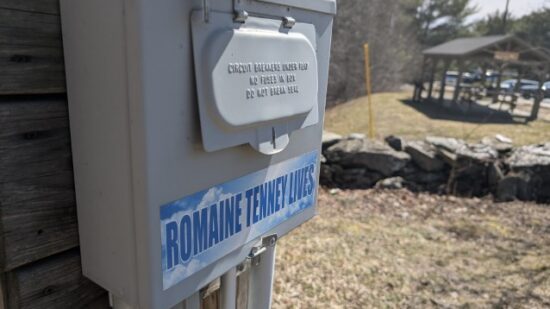
When you think of “Vermont roads,” the first images that might come to mind are mountain byways, covered bridges, and “highways” that elsewhere might qualify as backroads. We came across one such example a couple of days ago.
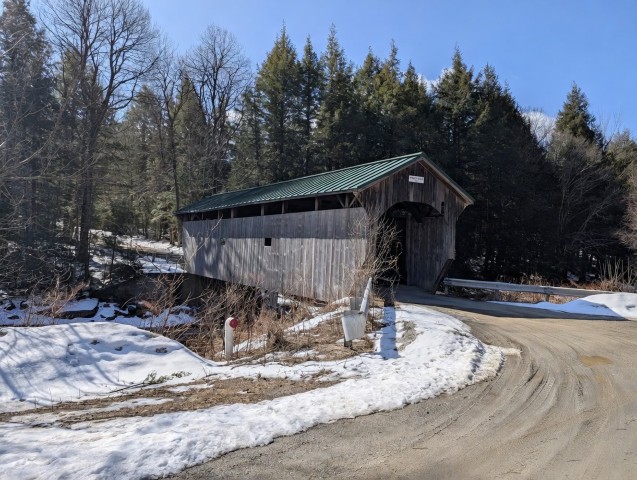
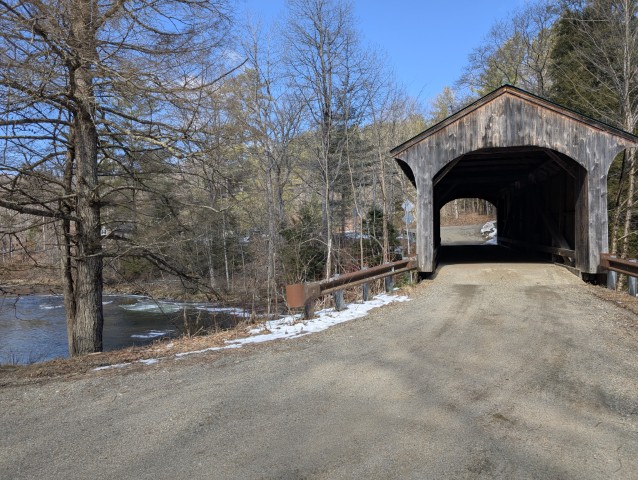
Although the thought is quaint, in truth the highways of Vermont run the usual gamut from the above (a town-maintained road and one of the state’s numerous covered bridges), to undivided State-maintained highways, such as the below.
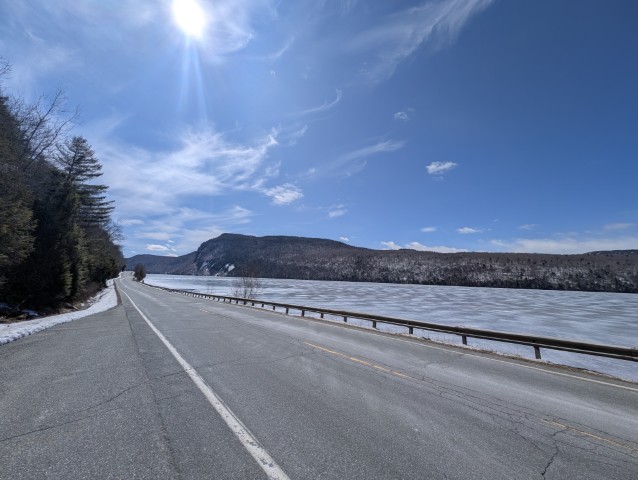
The Vermont road system also includes grade-separated limited access interstates such as the below (the north-south Interstate 91 which runs north-south on the eastern side of Vermont, along the New Hampshire border.
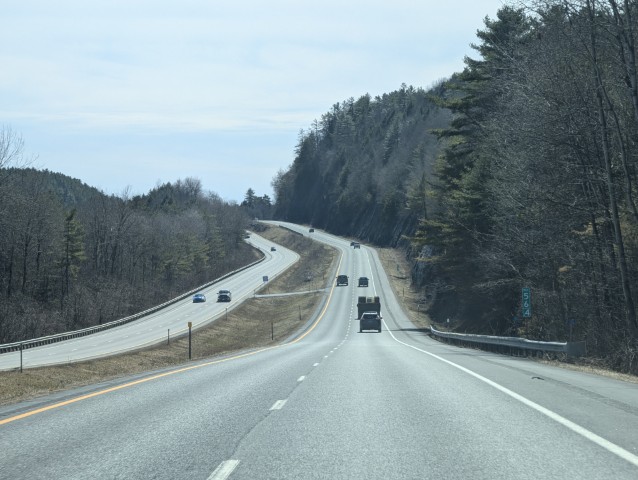
All the above is prelude, because it is here along I-95 south of White River Junction, that today’s story lay.
Unrelated sidebar: for you “experienced” takings mavens, the name “White River Junction” might ring a faint bell. But try and we might, we could locate neither the Howard Johnson’s Restaurant nor the actual Manifesto anywhere in the vicinity during our recent area visit. Thankfully, the Berger-Kanner response (which was to bear fruit less than a year later in First English) is preserved for posterity on the interwebs, while the Manifesto itself has been relegated to the dustbin of history, wrong the day it was written.
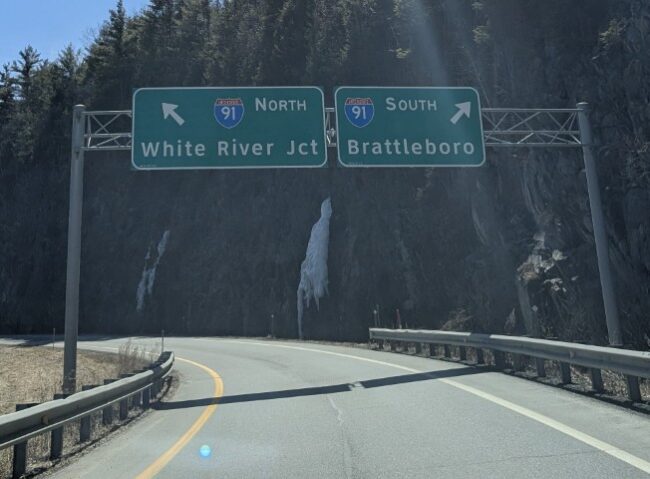
But we digress, for today’s post is not about these foundational battles won and lost.
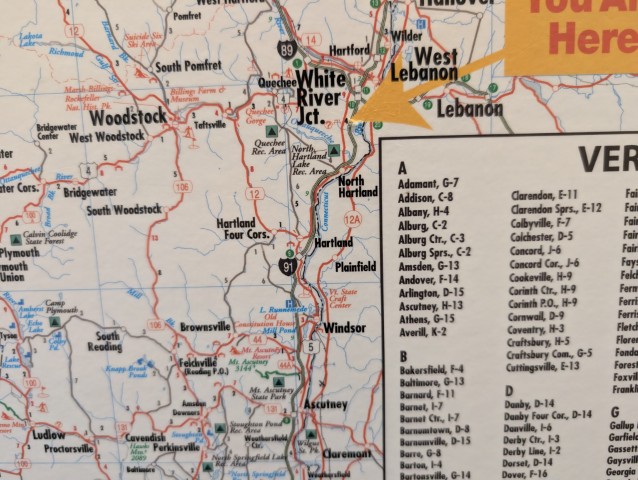
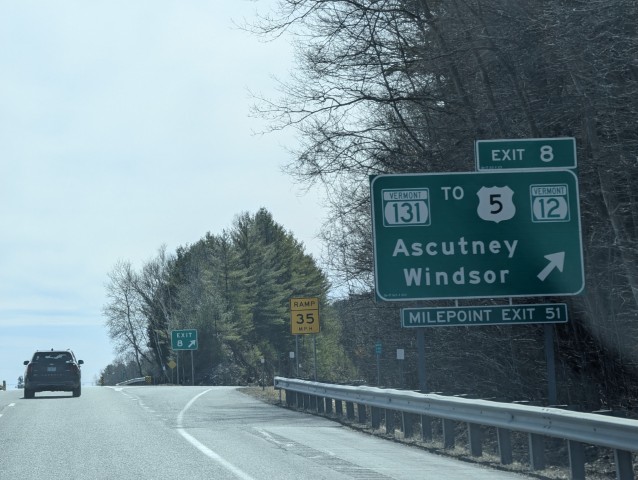
Rather, it takes place a few miles south, in the vicinity of Ascutney. Near Exit 8 from I-91, to be exact.
Here’s an Old School map showing the general vicinity (you remember what a map is, don’t you?).
If Exit 8 sounds familiar, you must be remembering our earlier post involving Exit 8, “A Permanent Memorial To Romaine Tenney, Vermont Eminent Domain Victim” (Nov. 4, 2019). Or maybe this one, “Must Watch: ‘Love of the Land’ – Romain Tenney’s Eminent Domain Protest” (May 27, 2024).
If those don’t jog your memory, perhaps this story from Vermont Digger: “60 years later, a Vermont farmer’s tragic tale lives on. But for how much longer?”
On Sept. 12, 1964, Romaine Tenney locked himself in his Weathersfield house and lit it on fire to protest its imminent bulldozing for Interstate 91. Today, fewer and fewer neighbors are around to share his story.
As we wrote: Romaine Tenney was one of those classic Vermonters. He entered the pages of history more than fifty years ago when, in reaction to the taking of his farm for Interstate 91, he burned his house and farm buildings down, and shot himself. He had nowhere else to go. As author Howard Mansfield puts it:
Tenney was that farmer by the road tourists used to stop and talk to as they sought out a specific kind of Vermont experience.
“Romaine himself, personally, he never went to town meeting, he didn’t write letters to the editor, he didn’t stand up and protest,” he said. “He was just living his life — and history, or the world, came to his doorstep, which is the way it happens all the time.”
We wrote that “[a]n informal memorial to Mr. Tenney — a maple tree (how Vermont) — has stood ever since near Exit 8. We learned more about Romaine Tenney last year when we spoke with Mr. Mansfield about his book “The Habit of Turning the World Upside Down – Our Belief in Property and the Cost of That Belief,” which features a chapter on Mr. Tenney.”
As readers may know, from time to time we like to go on what we call “property rights pilgrimages” to visit the sites of famous property cases or locations of interest even if they did not result in a legal action. Why would we do this, even though many of these spots are unremarkable to the casual eye? Well, as dirt lawyers know, nothing substitutes for a good site visit. Yeah, Google Maps and smartphone photos may give you a general sense of a place, but nothing beats being there, feeling the dirt beneath your shoes, smelling the air, hearing the sounds.
And another reason we like to pay visits to these places is that many are unremarkable. You go to Grand Central Terminal to understand more about the Penn Central takings case, you’re going to get overwhelmed with the majesty of the place. But if you visit the former Tenney property (as we did late last week), there’s nothing at all that is obviously significant about the place or the area. But the unremarkable nature of the place only emphasizes the things that owners often say about their land: it may not seem like much, but to me it is everything. The place I grew up or raised a family. The house my parents owned when they were starting off. And so on. Any property rights lawyer could tell you scores of stories such as these. That’s why we find even places without an obvious attraction are worth visiting.
We think the former Tenney property is one of those.
Indeed, once you exit at Exit 8 and pull into the parking lot, it kinda looks like a typical park-and-ride. Until you spot what looks like (and is) a tree stump surrounded by a very modest little henge thing.
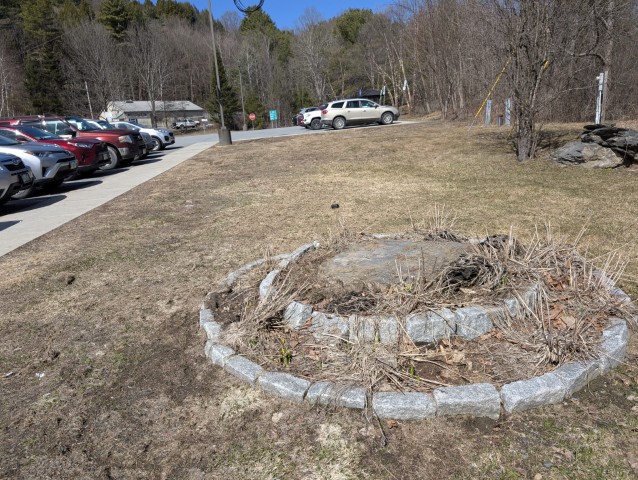
When we last left the story in the above-referenced posts, the maple tree that served as the informal memorial to Mr. Tenney was on its last legs.
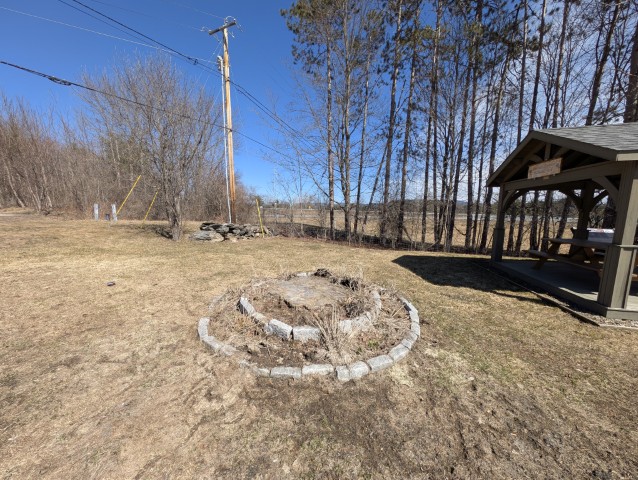
Since that time, the tree had to be removed which prompted a push for a permanent remembrance of the man who refused. Hence Stumphenge, all that remains of the maple tree.
But the tree’s expiration had a grander purpose: it spurred the creation of a permanent memorial to Mr. Tenney. Here’s the maple tree stump, a rock wall, and the memorial itself. That’s I-91 in the background beyond the line of trees, by the way, illustrating how the freeway’s construction cleaved his land in two.
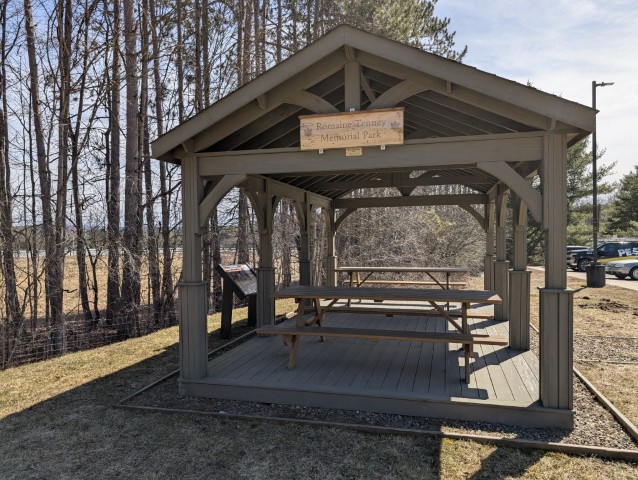
We would have busted out our laptop and written this post on one of the benches, but even though it is March and it is at least officially spring and a cloudless day, it is still pretty cold in this part of the country. So we noped out of that idea and instead took pictures and notes for later.
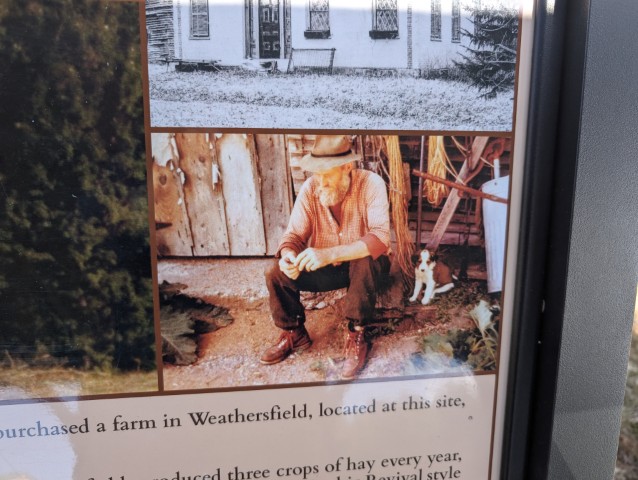
The interpretive sign has photos of Mr. Tenney looking exactly as you imagined he would.
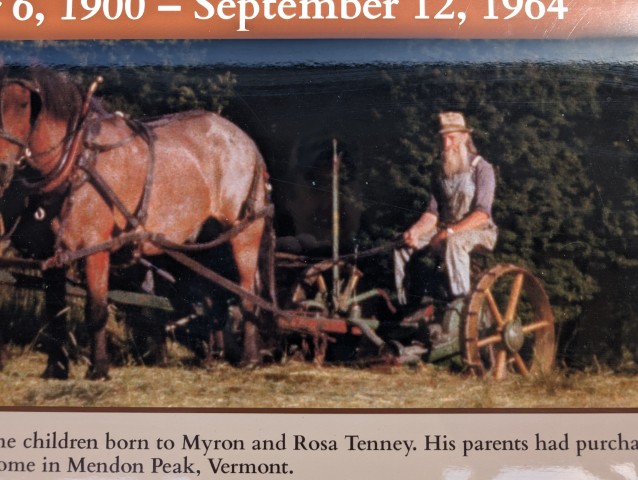
Another photo that you didn’t just imagine.
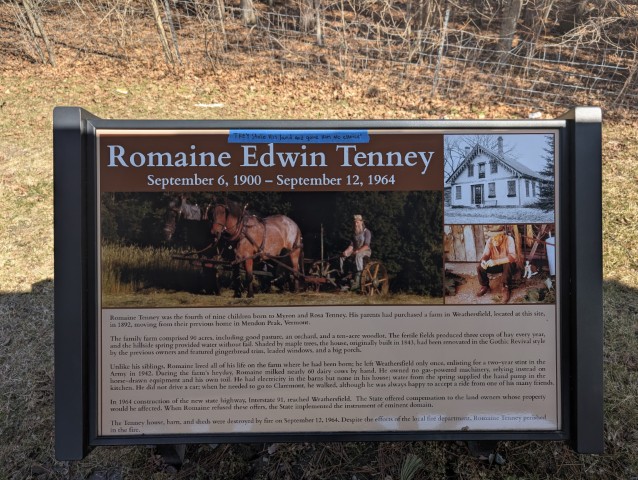
The interpretive sign, telling the casual visitor what and why, and why it is important.
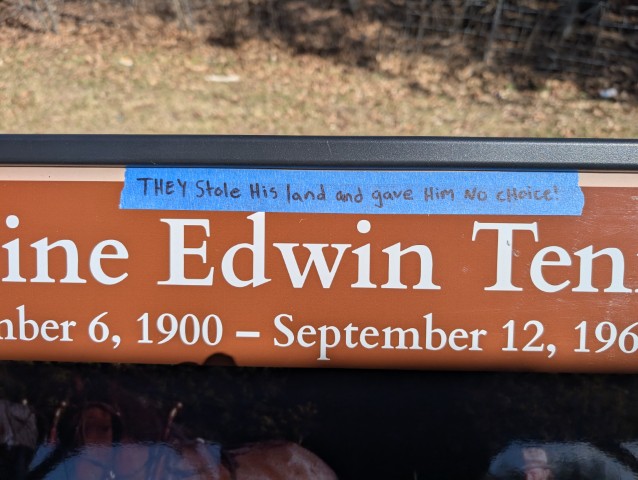
Someone graffiti-ed a pretty good definition of eminent domain on the interpretive sign: “They stole his land and gave him no choice.” And this being Vermont, the graffiti artist was very conscientious and used removable painting tape presumably as to not permanently deface the memorial. Good show!
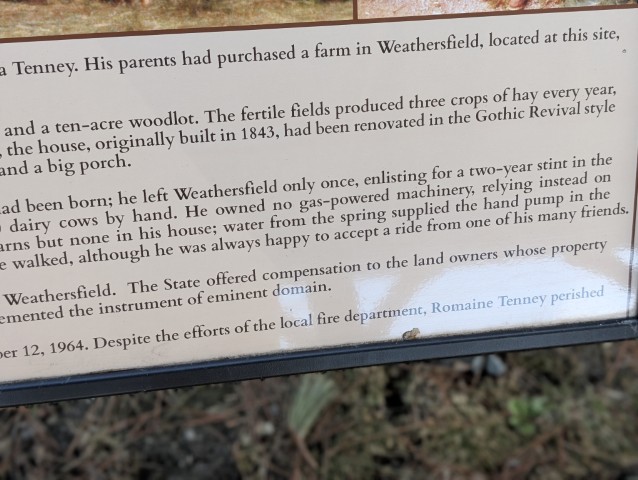
The interpretive sign uses the words “eminent domain” and “compensation.” But we still like the informal definition on the painter’s tape.
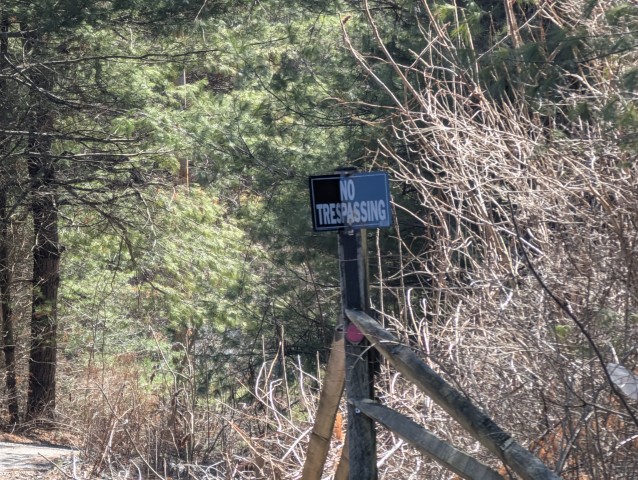
No trespassing … unless you are here to conduct a survey to see if we want to take my land. In that case … trespassing allowed!
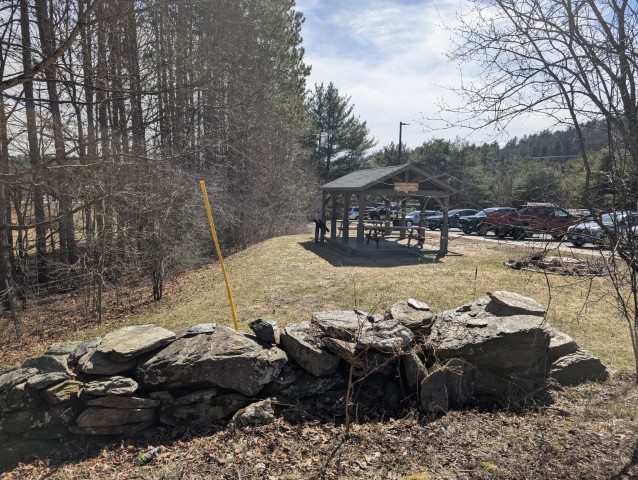
Another view. Question we don’t have the answer to: is the rock wall a remnant from the days when Mr. Tenney was here? Or something else? We don’t know.
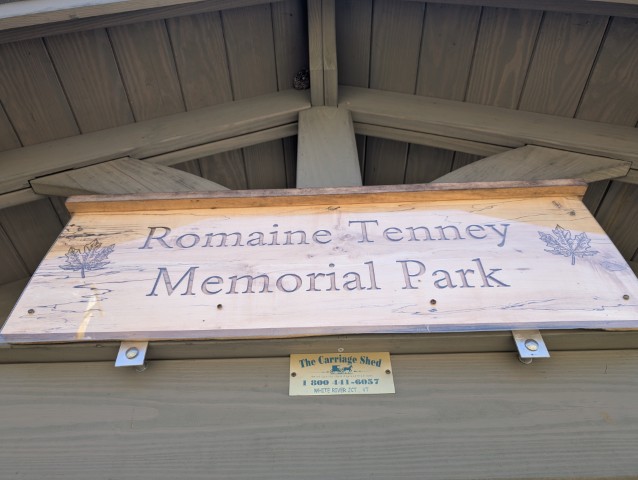
It shows up as “Romaine Tenney Farmstead” on Google Maps.
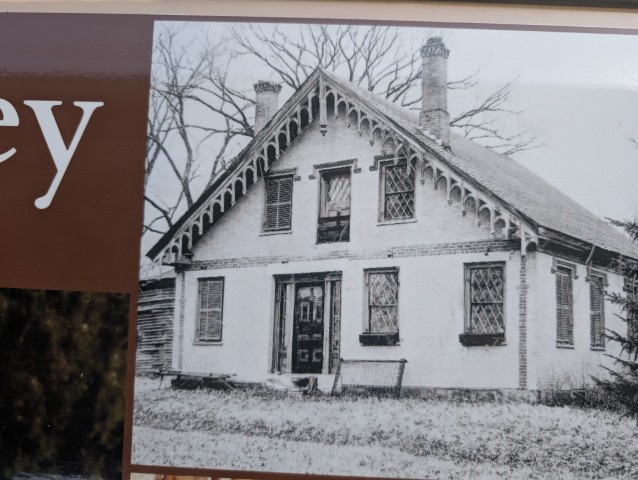
From the interpretive sign. That is a very modest house. No electricity, even. But there’s no doubt Mr. T loved it.
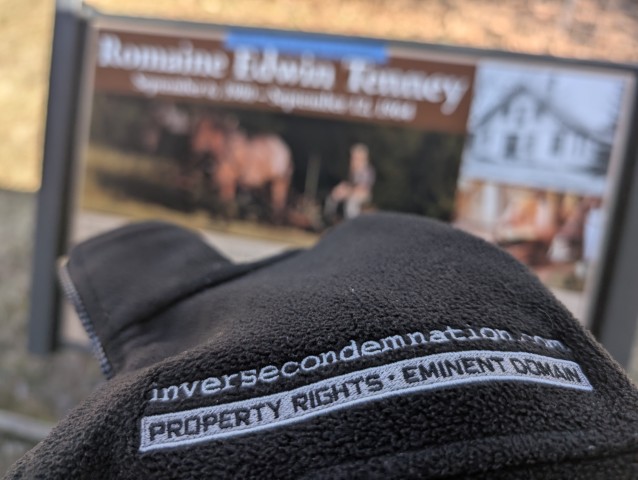
We made a small offering at this shrine to property rights. If Mr. Tenney’s ghost was still in the neighborhood, he made no indication (to us). But we swear we could feel his presence.
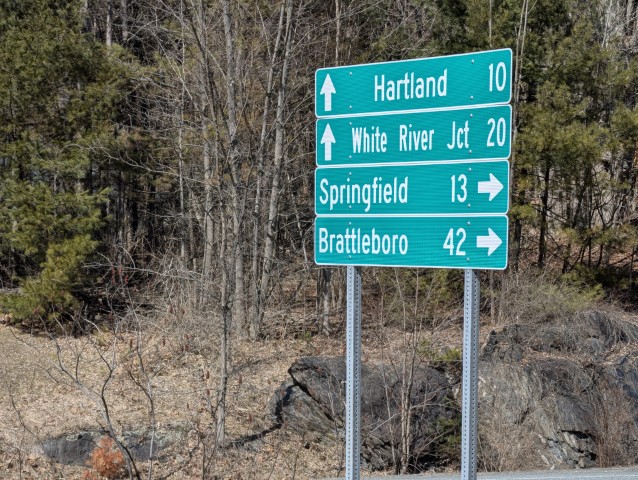
So you can get your bearings.
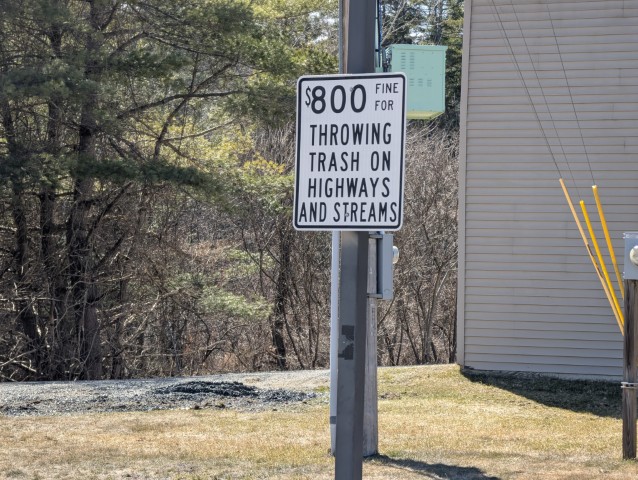
The grammarian in us so wants to proofread this sign.
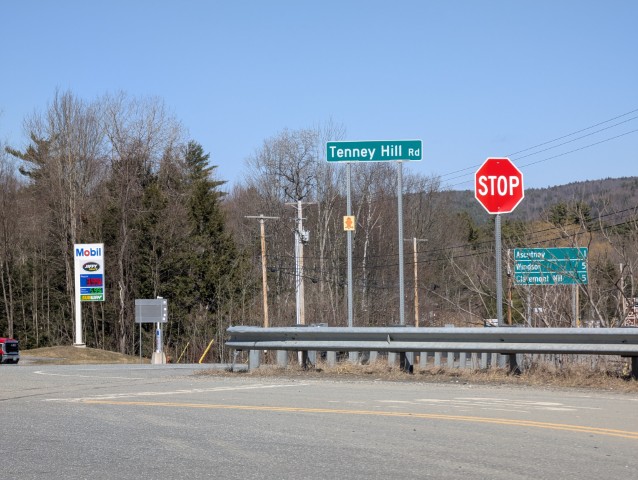
Not far across I-91 in the direction of New Hampshire is Tenney Hill Road.
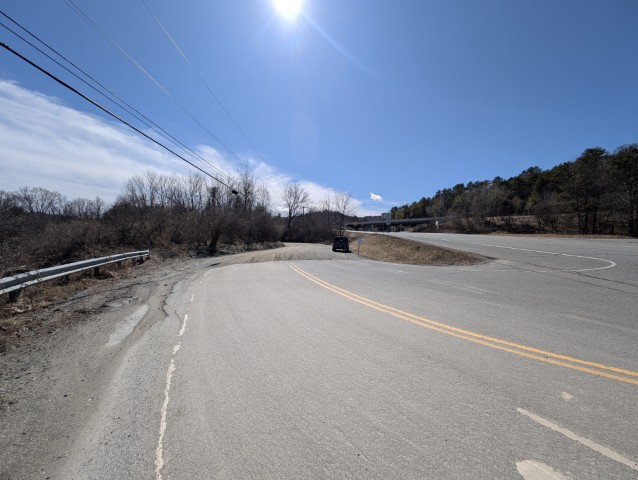
Tenney Hill Road quickly turns to dirt. That’s I-91 in the middle background.
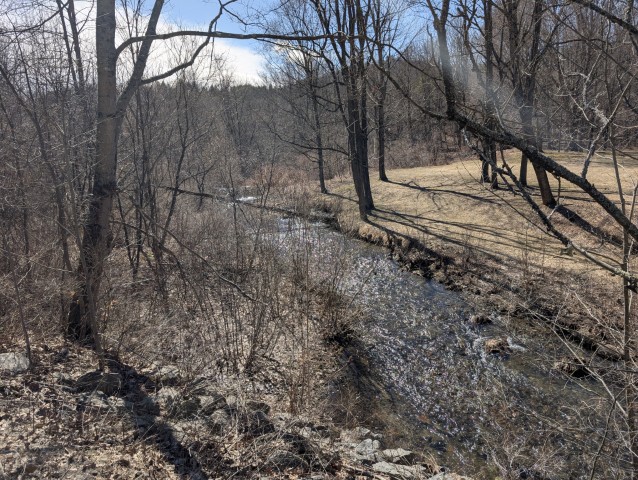
Mill Brook, which once cut through the Tenney property is obviously still there, but cut off from the farm site by the freeway (which is just on the other side of those trees in the mid-foreground in this photo).
What’s nice is that, despite its proximity to the freeway, most of the time you can only hear the meditative sound of the stream flow.
The memorial, a modest remembrance of what appeared to be a modest man, is probably not something you’d want to go way our of you way for, unless like us, you are a property super nerd. In that case, it’s a must visit. And if you are only a mild dirt law nerd, it is definitely worth visiting if you are in the neighborhood, if only to remember a man who felt he had nowhere to go when his land was threatened.