
Here’s one for all you CEQA mavens.
The California Supreme Court has determined that a denial of a conditional use permit to operate a private airport south of Sacramento is not a “project” under the California Environmental Quality Act. Sunset Sky Ranch Pilots Ass’n v. County of Sacramento, No. S165861 (Dec. 28, 2009).
Elk Grove airport has been around for a while (since 1934), when the surrounding area was most likely devoted to farming, not housing. We’re guessing that this one, like many rural airports, originally serviced crop dusting planes. By 2004, however, the nature of the area had changed, and the owner’s 5-year CUP was expiring. The owner applied for renewal.
The County denied renewal because the airport was “no longer … compatible with its surroundings.” One look at the aerial photo below should tell you this means residential development. People generally do not like airplanes buzzing overhead, even if the airport has been there for a long, long time and the houses got there relatively recently.
Additionally, having an airport near your undeveloped land may impact your ability to develop it under California’s statutory system of county Airport Land Use Commissions. And what is just north of the airport’s flight path? You got it, undeveloped land. And who were the real parties in interest in this case? The northside neighbors.
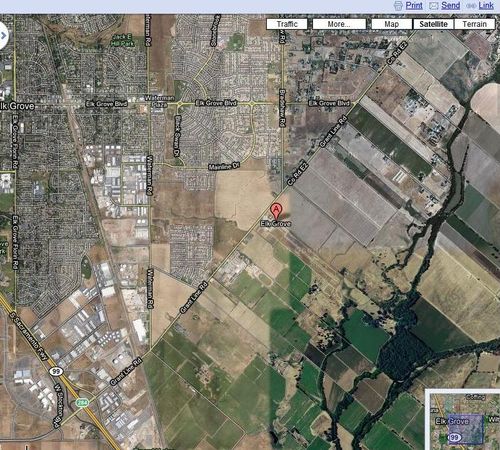
The airport owner claimed the County should have undertaken environmental review under CEQA to evaluate the impacts of closing the airport. The trial court granted the writ of mandate, but the Court of Appeal reversed.
The trigger to CEQA review is that the activity is a “project,” and has not been exempted. One exemption is for “[p]rojects which a public agency rejects or disapproves.” See Cal. Pub. Res. Code § 21080(b)(5). That seems to fit, argued the County.
Don’t be so narrow minded argued the airport owner, look a the big picture. The “whole of the action” (as the Court of Appeal found) was not only the denial of the CUP, but the result of the denial: closing down of the airport. That, the owners argued, would or could have an environmental impact, and therefore merited review.
The Supreme Court didn’t buy it, and the exemption carried the day:
The Court of Appeal erred by deeming the consequences of a project denial to be part of the project itself. Its reasoning would effectively abrogate the statutory exemption for projects disapproved by a public agency. In many cases, disapproval of a proposed project could have possible environmental impacts associated with alternative courses of action. “Yet the Legislature has determined for reasons of policy to exempt project disapprovals from environmental review under CEQA. Our state legislators evidently concluded that public agencies should not be forced to commit their resources to the costly and time-consuming environmental review process for proposed private development projects slated for rejection, whatever the reason for agency disapproval. This court does not sit in judgment of the Legislature’s wisdom in balancing such competing public policies. As we noted in Napa Valley Wine Train, the very purpose of the statutory CEQA exemptions is to avoid the burden of the environmental review process for an entire class of projects, even if there might be significant environmental effects.
Slip op. at 7 (citation and footnote omitted).
More here, from the Land Use Law blog.