
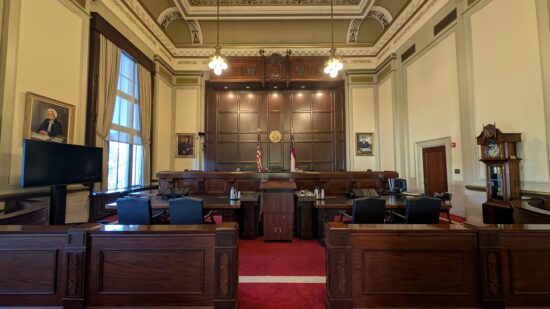
Watch the argument recording here
If you have a constitutional right to $100, but it costs you $30 to force the government to pay the $100, have you really received just compensation if all you get is $100? That’s the essence of the case which was argued yesterday in the North Carolina Court of Appeals in Dep’t of Transportation v. Rite Touch Invs., LLC, No. 26-413.
We attended the arguments, and here’s our report.
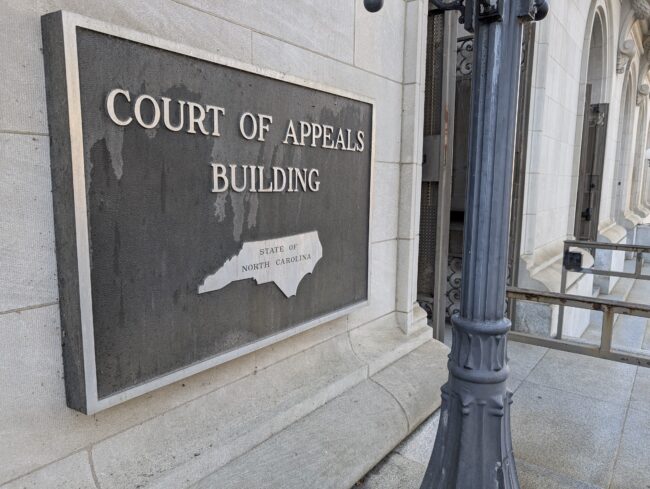
The question before the court was whether the state constitution’s Law of the Land Clause, N.C. Const. art. I, § 19, permits a property owner who proves the condemnor’s offer of just compensation was constitutionally inadequate, to recover attorneys’ fees and costs. Here, the trial court held yes, and NCDOT appealed.
Disclosure: we filed an amicus brief in the case in support of the property owner.
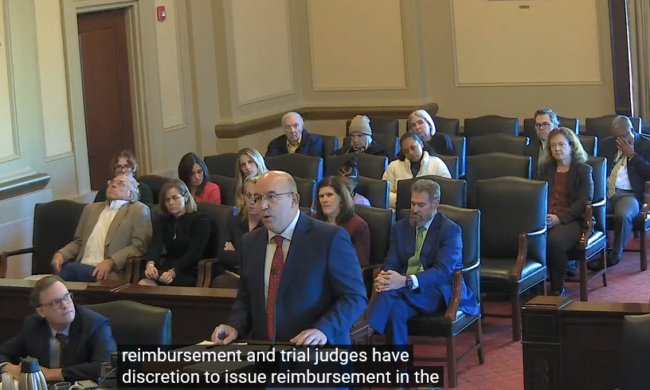
Jeremy Hopkins argued the case for the property owners.
The DOT’s main argument was that these are simply litigation costs covered by the “American rule” under which each party in civil litigation bears its own expenses, and the rule can only be displaced by the legislature — and the NC Legislature has not done so in eminent domain cases. (The DOT also raised a jurisdictional argument, asserting that challenges to the constitutionality of a state statute may only be considered by a three-judge court, and not a single trial judge as here. We think the court viewed this argument as a non-starter after the property owners’ lawyer pointed out that the trial court didn’t invalidate any statute, and wasn’t asked to do so.)
The DOT’s counsel argued that the Supreme Court’s United States v. Bodcaw Co. forecloses any federal constitutional right to attorneys’ fees and costs as part of just compensation, and that North Carolina precedent, particularly Charlotte v. McNeely, similarly makes recovery of condemnation litigation expenses a matter of statute, not constitutional command.
In short, the DOT pressed for a categorical rule that property owners in eminent domain cases may never recover fees and costs, no matter how inadequate the condemnor’s offer. Interestingly, the advocate for the DOT pointed out that its appraisals and resulting offers are very often below the compensation awarded by juries, and thus there’s nothing to see here your honors, so move along. That struck us as an odd argument because it validated the owners’ argument that systematic undercompensation is the reason why owners are reasonable when they are forced to retain attorneys and appraisers to obtain just compensation.
The property owner naturally saw the case very differently. It started off by pointing out a striking fact: NCDOT deposited about $41,000, while the ultimate award was roughly ten times that amount. Thus, Rite Touch was left with two choices: accept about ten cents on the dollar a compensation, or spend a substantial portion of its eventual recovery proving that the government’s valuation was grossly low.
The owners argued that it wasn’t necessary for the N.C. Legislature to have acted, because the N.C. Constitution has already done the work: the Law of the Land clause (remember, North Carolina does not have a takings or just compensation clause) requires indemnity, and the N.C. Supreme Court has held that owners in eminent domain cases are entitled to personal indemnity, and thus must be made economically whole. The owners emphasized that the Law of the Land clause, in contrast to the Fifth Amendment, protects a person from being disseized of property except by the law of the land.
According to the owners, North Carolina decisions characterize that protection as a personal, fundamental right requiring indemnification and putting the owner in the financial position the owner would have occupied absent the taking.
The owners’ counsel argued for a non-categorical rule, and did not assert that owners are entitled in every eminent domain case to include fees and costs as part of just compensation, only that trial courts should have the discretion in cases where the record shows the condemnor’s offer was inadequate (when compared to the compensation determined by the jury).
One final point: when responding to the DOT’s assertion that allowing fees and costs as part of compensation in some cases would increase the costs of public projects, the owners’ counsel responded that the rule being advocated for has no such effect, and will not increase the costs at all. The costs are the same, and it is only a question of who has to bear them, the owner or the condemnor.
We don’t have any sense of which way the court is leaning, because the bench didn’t ask a lot of questions (although the questions which the judges asked were very pointed, and seemed to be getting at critical points) and didn’t telegraph what the judges thought about the various arguments.
In the end, the court took the case under advisement, with a ruling to follow later.