

We got underway today for the two-day Brigham-Kanner Property Rights Conference, now in its 23d year. Produced and sponsored by the William and Mary Law School and Queen Mary University of London, the conference focuses on (naturally) property rights, and is expressly designed to put property scholars in the same room as property practitioners.
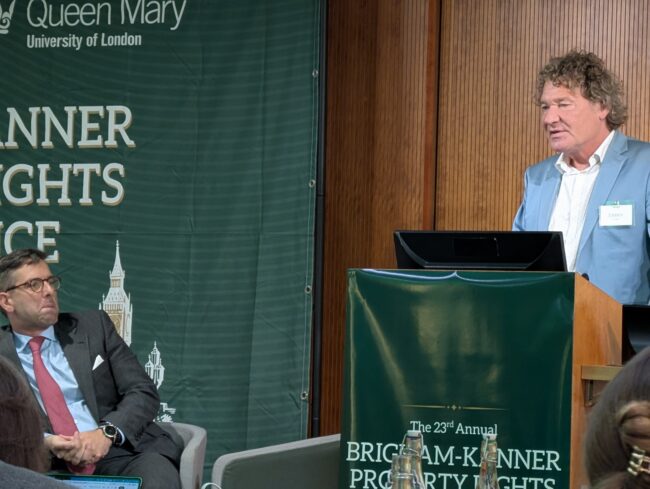
Professor James Stern (William and Mary Law School), the leader of the Brigham-Kanner Property Rights Project at the Law School, and Professor James Penner, 2026 Brigham-Kanner Property Rights Prize.

A full house of UK, Canadian, and US property academics and practitioners.
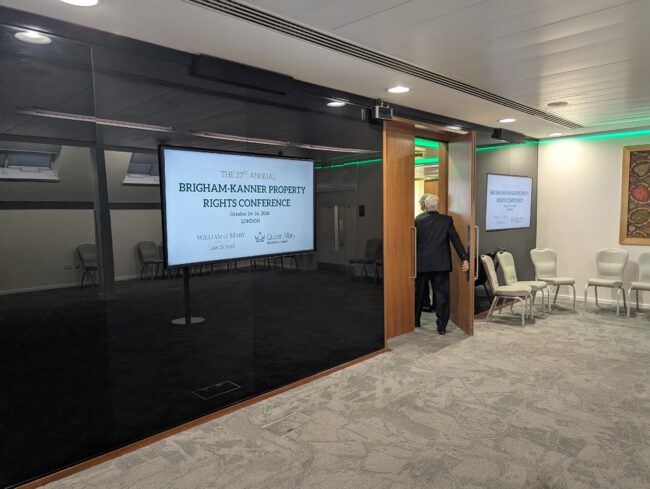
We spoke on a panel devoted to “Property, Human Rights, and International Law.”
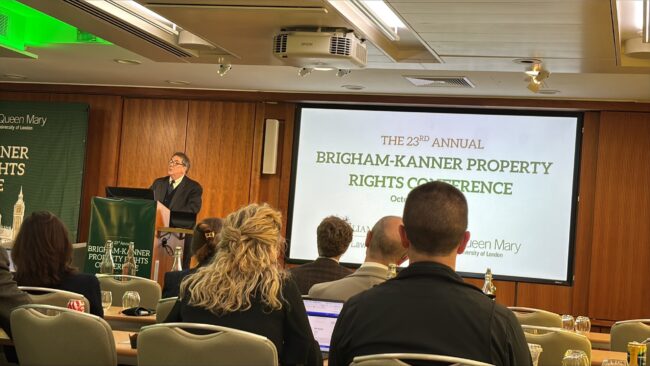
Proof we were actually in the room, not out walking the path
of the Great London Fire of 1666.
Courtesy of our colleague Jon Houghton. (Thanks, Jon!)

The view from the dais.
Here is an expanded version of our remarks:
*****
Thank you. Much of Professor Penner’s work asks what makes something capable of being owned. My question today is somewhat the converse: What things are incapable of being owned, and what does that tell us about the relationship between property rights and human rights?
Contemporary discussions often assume that property rights and human rights occupy different spheres: property is said to concern economic interests, and by contrast, human rights are said to concern personal dignity.
It seems to be received understanding that there’s a contradiction at the heart of the issue: that property rights are viewed as expressions of economic interests that government may adjust whenever competing social goals arise, excluded from the class of human rights deserving of protected status. Human rights protect dignity, equality, and liberty, while property protects wealth we are told. And when the two are in tension, property must yield.
That certainly is the century-old approach of American constitutional law. And with our Supreme Court now considering the constitution through the lens of “text, history, and tradition,” the history of how we treat property rights occupies a center space in the inquiry.
In my view, the history which includes slavery as a property right is a major obstacle preventing acceptance of a modern liberty-based view of property rights. How can property rights be human rights if the law recognized a property interest in someone else’s freedom, labor, and liberty? As we know, at its worst, property law – and the rights associated with owning property – supplied the vocabulary by which human beings were bought, sold, inherited, mortgaged, and pursued.
But I want to suggest that the American constitutional tradition has frequently understood the relationship between property rights and human rights more subtly. The same constitutional tradition that avoided the opportunity to repudiate that approach also withheld its highest authority from the proposition that one person could hold lawful property in another, planting the seeds for John Adams’s recognition that “property must be secured or liberty cannot exist.”
Our history tells a more complicated story, and I will be focusing on four snapshots from American property rights history which show property’s central role in protecting human autonomy, to me the central reason the law recognizes property rights.
My view is that the American tradition came to reject property in man, while increasingly recognizing property for man as an essential element of human liberty.
Let us begin with the original, unamended Constitution.
No candid account can deny that it accommodated slavery. Congress was barred from prohibiting the international slave trade before 1808. The Fugitive Slave Clause required that persons “held to Service or Labour” who escaped to free territory be returned.
And perhaps most notoriously, the Three-Fifths Clause counted enslaved people as only a fraction of a “person.” Even though the purpose was to dilute the political power of slaveholding states, this avoided confronting the persons-as-property conundrum and kicked the can down the road.
Those were grave concessions. They protected slavery in practice and helped preserve it for decades.
But the Constitution did not use the words “slave” or “slavery.” More importantly for our purposes, it did not classify a human being as property, in which others had rights. It accommodated persons-as-property without expressly affirming it.
That omission forms the basis for Sean Wilentz’s argument that the Constitution was at its core an antislavery document. Proslavery delegates obtained important concessions to allow unity and union, but they did not secure a declaration that slavery was a national constitutional right or that an enslaved person was constitutionally recognized property.
The Constitution spoke of “persons,” even where it shamefully permitted those persons to be held in bondage. That left unresolved an enormous contradiction. State law might purport to make a person property. But the national charter did not expressly constitutionalize that status as private property, insulated by the Constitution’s Takings, Due Process, and Contract Clauses from public deprivation.
What was in the text – and what was left out – mattered.
We should not romanticize this drafting choice. Euphemism could conceal moral responsibility as easily as it could preserve an antislavery principle. (And Professor Wilentz’s interpretation is debated – although I think he has the better view.)
Yet the omission had legal consequences. It left open a constitutional argument that slavery was a local creation of positive law, not a natural, or national, property right. It permitted antislavery advocates to insist that freedom was the baseline, slavery the exception, and that any claim of ownership over a person required affirmative and strictly construed legal authority.
Later, Abraham Lincoln, Frederick Douglass, and other antislavery constitutionalists built upon that silence and the refusal to validate “property in man.”
That argument would soon become central to one of the Supreme Court’s most remarkable property cases.
United States v. The Schooner Amistad reached the Supreme Court in 1841 as an admiralty dispute over who owned the cargo. That cargo happened to be human beings.
The Mende people aboard Amistad had been kidnapped in West Africa, carried illegally to Cuba, sold, and placed aboard the schooner for transport within Spanish territory. By force of arms they liberated themselves, took control of the vessel, and attempted to return to Africa. The surviving Spanish sailors instead steered them northward, where an American vessel seized Amistad in Long Island Sound and brought the Mende to Connecticut.
Spanish claimants asserted ownership of the vessel and its cargo, which it claimed included the Mende. The American salvors demanded compensation for recovering this same “cargo.” The Spanish government invoked treaty obligations claiming the Mende has been legally enslaved. The United States supported returning the Africans to the Spanish. The federal court pleadings characterized the Mende the same as the ship’s tackle, apparel, furniture, and cargo.
Were the Africans lawfully held slaves and therefore the property of the Spanish claimants? Or were they free persons who had been kidnapped in violation of law?
Justice Joseph Story concluded that they were free, ever lawfully enslaved, and thus entitled to use violence to remain free. Spanish law prohibited the international slave trade under which they had been brought to Cuba. The papers describing them as lawfully enslaved Cubans were fraudulent. Because the claimed enslavement was unlawful, Amistad’s owners had acquired no valid title to them.
The Court did not seek to weigh property rights against human rights and conclude that humanity outweighed ownership. It held that there was no ownership to balance.
The asserted title failed because the Mende were not property. They were, in the Court’s words, “kidnapped Africans” entitled to defend their liberty. The United States was required to respect their human rights as fully as the rights of Spanish property claimants.
That distinction is important.
Amistad did not hold that valid property rights may be disregarded when sufficiently important interests appear on the other side. It held that possession, official papers, and governmental assertion cannot manufacture a legitimate property right where law never permitted one to exist.
The case thus gives concrete legal force to “no property in man.” This decision seems counterintuitive, particularly in the antebellum United States, from a Court soon to issue Dred Scott v. Sandford.
So to me, the Amistad case tells us something about property itself: property is not merely control backed by power. A pirate has control. A kidnapper has possession. A government may even supply title. But lawful ownership demands more.
Twenty years later, at the beginning of the Civil War, the role of property rights to secure liberty an unexpected turn at Fort Monroe, Virginia–only a short distance from William and Mary, ironically on the very spot, where enslaved Africans first came ashore in the English New World in 1619.
In May 1861, three enslaved men, Frank Baker, Shepard Mallory, and James Townsend, self-liberated and rowed across the mouth of the James River and presented themselves at the Union Army-held fort. The next day, their owner’s representative knocked on the door and demanded their return under the Fugitive Slave Clause.
The Union commander, General Benjamin Butler, faced a legal and political problem. The Lincoln administration had not yet adopted emancipation as a war aim. Indeed, it remained anxious not to alienate the slaveholding border states.
Butler, a Massachusetts lawyer in civilian life, answered with a property argument.
If Virginia regarded these men as property, and if that property was being employed to build Confederate fortifications and wage war against the United States, then the laws of war permitted the Union to seize it as enemy property. Butler refused to return the men. They soon became known as “contraband of war.”
The theory was morally awkward, certainly. These men had escaped slavery, yet the immediate legal rationale for protecting them treated them not as free persons, but as confiscable enemy assets.
The contraband policy was not emancipation. It did not initially rest on a universal declaration of their humanity. In a technical sense, it risked substituting the United States as owner for the Confederate enslaver.
Yet the theory’s practical force came from turning slavery’s own anti-property premise against itself.
Congress soon gave support to the policy by statute. Persons forced to labor in support of the rebellion would not be returned to those claiming their service. Thousands of people then fled to Union lines. The policy created physical spaces in which enslavers’ asserted title could not operate and in which freedom could begin to become a fact before it was fully recognized as a legal right.
The contraband theory therefore occupies an uneasy but crucial place in this story.
The Constitution had again refused expressly to recognize property in man.
At Fort Monroe, the Union provisionally accepted the slaveholders’ own characterization, then used the consequences of that characterization to deny them possession.
The theory produced a legal ratchet. If enslaved persons were human beings, they should not be returned. If they were property, enemy property could be confiscated. Either way, the claimed owner’s right to recover weakened.
Culture and law had not yet ready to fully recognize freedom. But property law had become a pathway through which enslaved people could seize freedom for themselves.
The Reconstruction Amendments finally abolished the legal category the contraband theory had exploited and the Emancipation Proclamation had codified.
And that point should not be overlooked: Baker, Mallory, Townsend, and the thousands who followed them were not passive objects of an ingenious legal theory. Their decision to escape created the facts to which the law had to respond.
This laid the foundation for the Thirteenth Amendment which extinguished slavery and involuntary servitude, and the Fourteenth Amendment guaranteed citizenship and prohibited states from depriving any person of life, liberty, or property without due process or denying equal protection. A Second Founding vision of property rights that did not include rights in others.
But formal freedom was not enough.
A person who may not acquire property, choose where to live, make a contract, or dispose of what he owns remains subject to the control of others. Freedom requires more than the right not to be owned. It requires some meaningful power to order one’s own life.
That brings me to Buchanan v. Warley.
In 1914, Louisville enacted a racial-separation ordinance. It prohibited a Black person from occupying a home on a block where the majority of residents were white, and imposed the reverse rule upon white persons, in accord with the then-valid theory that Equal Protection was not offended by racial segregation as long as the same restrictions were imposed “equally” on other races.
Charles Buchanan, a white homeowner, contracted to sell his property to William Warley, a Black lawyer and civil-rights advocate. Their contract conditioned the sale on Warley’s lawful ability to occupy the property. The ordinance made that impossible, and the resulting specific-performance action by Buchanan challenged the ordinance’s validity when it was raised by Warley as an affirmative defense, excusing his refusal to purchase the property for his intended use.
The Supreme Court unanimously invalidated it.
The ordinance deprived Buchanan of an essential attribute of ownership: his right to dispose of property to a legally qualified purchaser. It denied Warley the equal civil right to acquire, enjoy, use, and occupy property.
The Court emphasized that the Civil Rights Act of 1866 and the Reconstruction Amendments secured to Black citizens the same civil rights enjoyed by white citizens. Louisville could not evade that command by claiming that its ordinance applied symmetrically to both races or by invoking property values, racial hostility, or public peace.
The constitutional vice was not simply that the ordinance burdened a sale.
At heart, used government power to prevent two citizens from exercising their autonomy ordinary property rights because of the purchaser’s race.
Buchanan thus joined property, liberty, and equality in a single constitutional rule. The seller’s right to alienate and the buyer’s right to acquire were not rival rights.
To sum up, the lesson is not that every assertion labeled “property” is a human right. The antebellum claim that slavery is protected as a property rights demonstrates the danger of that proposition.
The lesson is that property rights at their core protect human agency. They give legal form to independence, security, mobility, enterprise, and the ability to say both “this is mine” and “this is essential to my autonomy.” And that I may do all sorts of things as expressions of my autonomy: use (or not use), say “keep out” or “come on in, the water’s fine.” And so forth.
So perhaps the answer to our panel’s question is this:
Property rights become human rights when they secure the human capacity to live as a free and equal person.
The American tradition’s answer to property in man was ultimately no.
Its answer to property as a means of human freedom should remain yes.
Congratulations to Professor Penner on the award of this most deserved Prize.
Thank you.
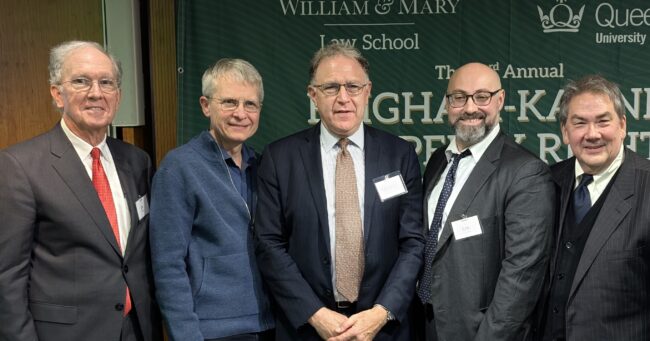
Joe Waldo, Moderator; Professor Thomas Allen, Durham U. Law School;
Professor Gregory Fox, Wayne State U. Law School;
Dr. Eric Loefflad, University of Exeter Law School; some guy.
*****