August 2025

BK2025

That’s right, it’s time to plan on joining us at the 22d edition of the best one-day property law conference, William and Mary Law School‘s Brigham-Kanner Property Rights Conference.

As we noted, Professor William Fischel will be awarded the 2025 Brigham-Kanner Property Rights Prize at the annual Wren Building candlelight ceremony in Williamsburg on October 23, with the following day being devoted to a celebration of his work and career, and discussions of the hot topics in property rights law.
The Conference is expressly designed to get legal academics and the nation’s best dirt law practitioners in the same room, discussion how legal scholarship and law practice work hand-in-hand to shape the law. 

More details:  

The Brigham-Kanner Property Rights Prize is presented annually to a scholar, practitioner, or jurist whose work affirms the fundamental importance of property rights. It is named in honor of the late Toby Prince

Continue Reading Registration Open: 22d Brigham-Kanner Property Rights Conference, Oct. 23-24, 2025, Williamsburg

Rethinking
Available now. 

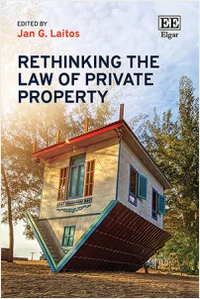
Just published: Rethinking the Law of Private Property, edited by lawprof Jan Laitos, with chapters by some of Dirt Law’s most notable luminaries. Here’s the abstract:

In Rethinking the Law of Private Property, eminent legal scholars consider how private property rights might be transformed and realigned to better cope with modern challenges. They rethink current paradigms around private property and natural resource ownership in light of police power regulations, health rules and expanded land-use regulations.

Vicki Been, Daniel Cole, Robin Craig, Richard Epstein, Jan Laitos, Roger Pilon, J.B. Ruhl, James Salzman and Ilya Somin are among America’s leading scholars on private property rights. Their chapters consider three critical issues facing private property owners in the 21st century. (1) To what extent may constitutional protections of private property resist police power limits restricting property uses? (2) Do developers of property for housing have the ability to provide affordable

Continue Reading New Book: Rethinking the Law of Private Property (J. Laitos, ed. 2025)

An interesting and timely decision from the U.S. Court of Appeals for the Fifth Circuit.

In United States v. Bennett, No. 23-40680 (July 24, 2025), way back in the day Hidalgo County, Texas, acquired an easement over her land to construct and maintain a flood-control levee, with the County soon thereafter assigning its rights to the federal government.

Flash forward to 2008, and the feds constructed a portion of the border wall atop the levee, for the dual purposes of flood control (it said) and border protection. Flash forward again to 2020, when the feds instituted an eminent domain proceeding “to construct and maintain fencing, barriers, and related structures to secure the border.” Slip op. at 3.

Bennett then asserted that the original wall built by the feds exceeded the scope of the flood-protection easement which the County had taken, and the feds had therefore been trespassing. This, in

Continue Reading CA5: The Border Wall Isn’t A “Fixture”

Here’s the latest in an issue we’ve been following.

In Fletcher Properties, Inc. v. City of Minneapolis, No. A23-0191 (July 30, 2025), the Minnesota Supreme Court held that the city barring owners from refusing to rent residential properties to a prospective tenant because the applicant is on public assistance is not a taking. 

What is colloquially known as “Section 8” is a federal program “that provides rent subsides to eligible families … to help them pay for housing in the private market.” Slip op. at 2. This is a voluntary program, both for the tenant receiving the assistance as well as the lessor who enters the program by contracting with the public housing authority.

The City of Minneapolis added discrimination based on a tenant’s receipt of Section 8 assistance to the list of forbidden reasons for refusing to rent to a prospective tenants such as “race, creed, religion, ancestry

Continue Reading Minnesota: Requiring Landlords To Rent To Tenants On Public Assistance Is Not A Taking

PXL_20250624_180653444.MP

The room where it happened.

We’re not going to say much about the California Court of Appeal’s recent decision in Sheetz v. County of El Dorado, No. C093682 (July 29, 2025), which is back in the California court system after remand from the U.S. Supreme Court, because it is one of ours.  

Here’s the bottom line:

Upon further analysis as directed by the Supreme Court, we now conclude that the challenged permit condition (TIM fee) does not constitute an unlawful monetary exaction under the Nollan/Dolan test. The legislatively formulated generally applicable impact fee is not an unconstitutional condition imposed on land use in violation of the Fifth Amendment’s takings clause. Accordingly, we again affirm the judgment.

Slip op. at 5.

We don’t necessarily agree 100% with our colleague Ben Rubin’s assessment, but do urge you to read his piece, “California Court of Appeal Confirms Legislatively Enacted

Continue Reading Sheetz On Remand: “The legislatively formulated generally applicable impact fee is not an unconstitutional condition imposed on land use in violation of the Fifth Amendment’s takings clause.”

Bundle of Sticks

What is private property? James Madison called it “that dominion which one man claims and exercises over the external things of the world, in exclusion of every other individual.” The Constitution’s Takings Clause doesn’t define it; it simply prohibits the taking of private property for public use without just compensation.

In this academic workshop – to be held in November 2025 – Pacific Legal Foundation seeks scholarly papers exploring the other sources of private property and how they should be used to define private property rights protected by the Takings Clause.

The U.S. Supreme Court has recently re-explored what property rights are protected under the Constitution in Tyler v. Hennepin County, where the Court unanimously held that home equity was a property right protected by the Takings Clause. Since the Constitution does not define private property, the Court explained, in Tyler, that private property can be defined by

Continue Reading “Unpacking Private Property’s Bundle Of Sticks” – Call For Proposals

It appears that the U.S. Court of Appeals for the Eleventh Circuit has addressed the issue the U.S. Supreme Court sidestepped recently in DeVillier v. Texas, 601 U.S. 285 (2024): do you need Congress’s ok to sue for just compensation for a taking?  

In Fulton v. Fulton County Bd of Commissioners, No. 22012041 (July 31, 2025), a 2-1 panel of the court held that the Just Compensation Clause is indeed “self-executing,” meaning that even in the absence of a legislative recognition of a cause of action, an owner whose private property has (allegedly) been taken by government action may sue for compensation. 

The opinion starts off dramatically, with this:

In Greek mythology, the Greek gods condemned Tantalus to eternal hunger and thirst, all while forcing him to forever stand in a shallow pool of water under a tree with low-hanging fruit. Though the remedy for Tantalus’s hunger and

Continue Reading CA11: Congress Doesn’t Need To Legislate A Cause Of Action For Just Compensation